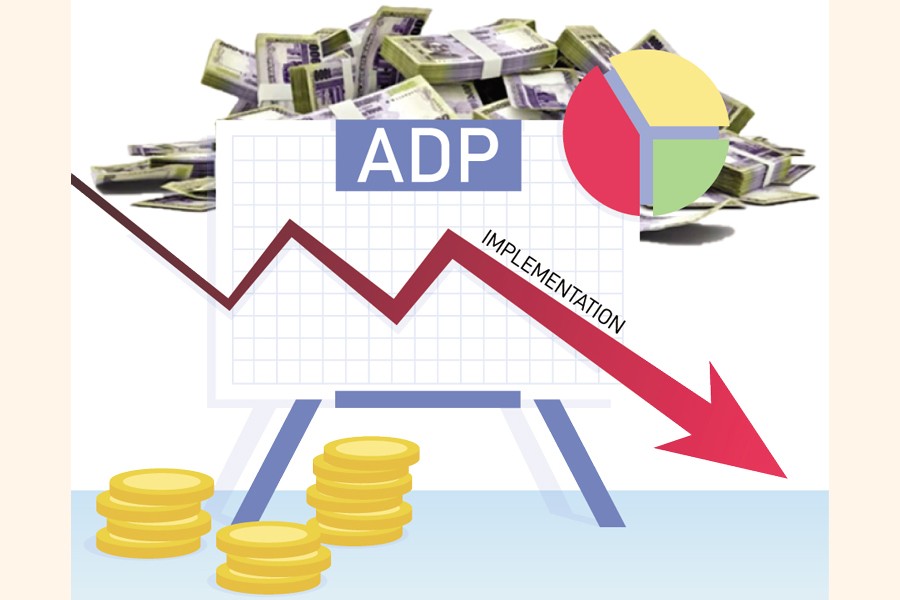
For years, poor implementation of Bangladesh's Annual Development Programme (ADP) has remained a recurring concern, despite ever-expanding budgets and ambitious targets. The Ministry of Planning has candidly acknowledged that flawed project design and absence of competent project directors lie at the heart of the problem. The admission, made during an inter-ministerial meeting chaired by Planning Adviser Dr Wahiduddin Mahmud, highlights the institutional weaknesses that continue to undermine the country's development drive.
The Planning Ministry has identified several key obstacles to effective ADP execution. These include flawed project formulation, a shortage of skilled project directors, inadequate feasibility studies, and chronic delays in land acquisition. These issues have long been known, but their persistence underscores how deeply entrenched the systemic inefficiencies are. Among these, the scarcity of competent project directors (PDs) stands out as a critical barrier. Ministries such as Health and Education, which are vital for human capital development, have consistently underperformed-partly because capable officials are reluctant to take up PD roles. The position, which carries heavy administrative and financial responsibility, offers little in the way of incentives or professional recognition. As a result, it is often seen as burdensome rather than prestigious.
In response, the government plans to appoint PDs for large, foreign-funded projects on lien or deputation, with additional financial benefits. The Planning Commission has gone further, proposing structural reforms such as creating a dedicated PD pool, introducing certification programmes for project planning and financial management, instituting performance-based awards and establishing clear policies on PD appointments and transfers. If implemented, these measures could help professionalise the role and inject the much-needed accountability into project management.
Another chronic weakness lies in the poor quality of feasibility studies -- a flaw that leads to unrealistic project goals, frequent revisions, and escalating costs. The Commission has suggested making independent peer reviews mandatory and involving professional institutions to ensure that feasibility assessments include comprehensive risk analyses, demand forecasts, environmental and social impact evaluations, and market studies. Such initiatives, if executed sincerely, could close one of the most damaging gaps in project preparation.
Land acquisition and utility relocation remain among the most stubborn bottlenecks in project implementation. These delays not only stall work but also inflate costs and erode public confidence in government efficiency. To address this, the Commission has proposed launching separate preparatory projects dedicated solely to land acquisition and relocation before the main projects are approved. This approach would include ownership verification, environmental clearance and the securing of necessary permits and no-objection certificates (NOCs). While pragmatic, such measures require strong inter-agency coordination and political will -- qualities that are frequently in short supply.
The Planning Commission has also emphasised the need for more realistic Development Project Proposals (DPPs), particularly in the light of the country's growing vulnerability to climate change. It has recommended that all projects include mandatory climate risk assessments and adaptation strategies and that they be aligned with national and international research findings.
A further area of concern is the ineffective use of the Implementation Monitoring and Evaluation Division (IMED). Although IMED routinely generates valuable insights and recommendations, these findings are seldom acted upon by the concerned ministries. To strengthen oversight, the Commission has proposed setting up IMED offices at the district and divisional levels, improving inter-ministerial coordination, and making it obligatory for ministries to respond to evaluation reports. Without such institutional follow-through, monitoring risks become a superficial exercise with little corrective value.
In the last fiscal year, the Revised ADP (RADP) achieved an implementation rate of just 67.85 per cent -- equivalent to Tk 1.53 trillion out of a Tk 2.26 trillion allocation -- the lowest in more than a decade. In the preceding five years, RADP implementation ranged between 82 and 93 per cent. The decline signals not merely inefficiency but a deepening structural malaise.
Sectoral performance, particularly in health and education, was alarmingly poor. The Health Education and Family Welfare Division spent only 15.36 per cent of its allocation, while the Health Services Division used 21.74 per cent. Even the relatively better-performing Primary and Mass Education Ministry left Tk 16.1 billion unspent. Such underutilisation in sectors critical to human development not only hampers service delivery but also jeopardises the long-term social foundations of economic growth.
The persistent underperformance of ADP projects reflects more than administrative inertia-it exposes a fundamental mismatch between policy ambition and institutional capacity. While Bangladesh continues to expand its development budget, the machinery for translating allocations into tangible outcomes remains weak, undertrained and poorly incentivised.
To break this cycle, Bangladesh must embrace systemic reform. Project management must become a professional, accountable discipline rather than a bureaucratic obligation. Feasibility studies must be rigorous and independent. Monitoring mechanisms must have teeth, ensuring that evaluations lead to concrete corrective action.
Bangladesh's development aspirations ultimately depend not on the size of its budgets but on the efficiency and integrity of its execution. Building institutional capacity, fostering a culture of accountability, and ensuring that every taka spent yields measurable benefit must become the guiding principles of public investment. Without such transformation, the country risks remaining trapped in a cycle of ambitious plans undermined by weak implementation -- a pattern it can no longer afford to sustain.
wasiahmed.bd@gmail.com
© 2026 - All Rights with The Financial Express

