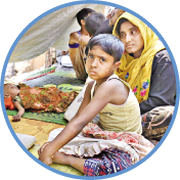
 After food, shelters are considered the most fundamental of the needs that humans require for a meaningful survival. The state of being homeless makes people shorn of their self-respect and the sense of dignity. Homelessness or life without a shelter is a perennial problem across the world --- irrespective of a country's socio-economic status. Lots of people are, thus, found feeling amazed to learn that like the poorer countries, many developed ones also have their share of homeless people. On this count, the developing Bangladesh can, allegorically, claim a place alongside USA, Canada, Denmark, France or Germany. In most of these countries, volunteer organisations come up to the rescue of the homeless people, providing assistance and emergency meal-feeding to the homeless people.
In contrast to these private sector initiatives, the government of Bangladesh has taken up a mega project of rehabilitating 2,778,085 people (of 555,617 families) under the Ashrayan project (1997 to July 2023). The project is run by the Prime Minister's Office. The premier has so far given houses to a total of 8, 29,607 families under Ashrayan projects and other programmes. Under this project some 4,148, 035 people have been rehabilitated in the small dwellings.
While opening the government's Ashrayan-2 project and declaring another 12 districts and 123 upazilas free of landless and homeless people, the premier opened the distribution of 22,101 houses among the poor. As part of formalising the ownership of the distributed houses, the keys of the houses and the ownership documents of 2-decimal lands for each were handed over to the families in different districts of the country. Some 115,000 people are being rehabilitated in these houses. With the addition of the new districts and upazilas, a total of 21 districts and 334 upazilas across the country have emerged free of homelessness and landlessness. The satisfaction of finding a place of dwelling of one's own is not comparable to any. The Ashrayan homes have, undoubtedly, given a new lease of life to the people without home or shelter. That it will add to the self-dignity of the once-destitute people need not be repeated. A great benefit coming from these shelters comprises the increased productivity of the people living there. Or else, a large segment of these unfortunate people may have turned to begging, and lots of socially unacceptable means of living. However, in this densely populated country, the percentage of people who have got their humble homes is too tiny. The government authorities behind the project must be aware of the need for expanding the Ashrayan network to the country's other parts.
In the meantime, alleged irregularities in allocating these home-units have been besetting the otherwise lofty project since the initial days. Besides, shortly after the construction of these dwelling units, their quality of making was brought into question. Storms and rains emerged as two periods of adversities to these semi-improvised houses. Since these are low-cost dwellings, their walls, windows and doors cannot be expected to withstand forceful assaults of nature. It didn't take much time for construction defects to surface.
The Ashrayan project appears to be a blessing for many poverty-stricken parents willing to see their children being admitted to nearby schools. On being able to live within the bounds of four walls, adult males and females can engage in small-scale handicraft enterprises, thus expediting income generation. Similar government housing programmes are in place in the neigbouring India. They are designed to help people come out of the poverty net. A programme of this type halves the cost of building homes, while also providing financial assistance to the low-income families. However, this programme is starkly different from that being executed in Bangladesh. In Bangladesh, the government bears all the expenses of building a small house before handing over the relevant documents and the key to the ultra-poor legitimate home owners. These houses are mostly located in the remote rural areas.
A secure dwelling place is not only meant for staying there peacefully. Dreams, both of their own and those centring round their children, have their roots in a four-walled house. A chaotic and dirty slum, crowded by myriad types of people cannot be an ideal place for spinning dreams. A universal truth has it that whatever is one's economic plight, everybody loves to dream. A prime requirement is that even the hand-to-mouth floating people should have a shelter to live in. Moreover, in these times of economic hardship, the previously socio-economically marginalised people do not stop seeing dreams in their humble ways. On becoming the owner of an Ashrayan unit, the lives of these people have evidently undergone a radical change. Apart from owning a secure residential unit, these people can now muster the moral strength to call themselves a proud citizen of the country. This is a phenomenal gift from the nation. On being able to be the proud owner of a small housing unit, their life may not be the same as in the past. It's because they now have a secure future.
With no shelter to live in permanently, adult persons go through myriad types of traumas. An undisturbed home eventually turns out to be the metonymy for peace. This universal saying becomes clear when the bliss of home is compared to the ordeals of the homeless people. The comparison becomes poignant when it brings into focus the agonies of refugee life. Few human sufferings come near the uncertainties which large numbers of homeless people undergo in times of socio-economic crises. The Ashrayan inhabitants may not have to brace for these nightmares, except those created by climate-change impacts.
shihabskr@ymail.com
© 2026 - All Rights with The Financial Express

