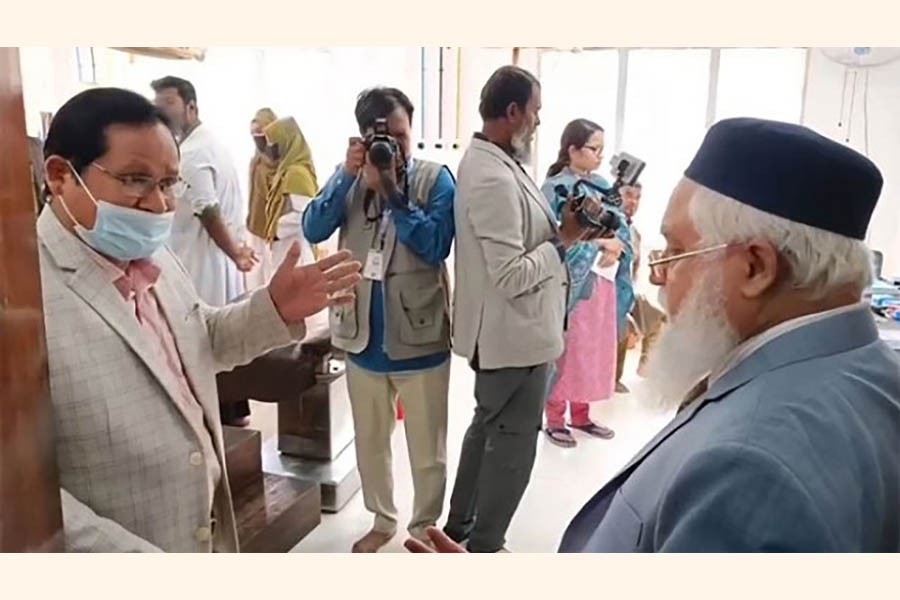
 MMCH doctor (L) is seen in an argumentative posture while talking to DG of health services.
 A causality department in-charge at Mymensingh Medical College Hospital did last Saturday what almost no one does these days. When the Director General (DG) of the Directorate General of Health Services (DGHS) visited his operation theatre, he publicly challenged the DG over missing a three-day training session in Dhaka where the DG was scheduled to appear twice. This was no small act. Holding a superior to account has become almost alien in our civil service culture where loyalty is prized above competence. Since pleasing superiors ensures better postings and privileges, performing one's actual duties often becomes secondary to demonstrating personal allegiance to those above. In this context, the firmness displayed by Dr Dhandeb Chandra Barman appeared to many as a rare breath of fresh air because hardly anyone in a subordinate position today shows the nerve to confront a superior, regardless of who is right. This resonated widely with the public. Many of them suggested that only someone with an unblemished conscience could speak with such candour.
The confrontation itself stemmed from a seemingly minor issue. The good doctor, who is generally known for his good temperament, was asked by the DG why an unnecessary table was in the OT and things quickly escalated from there. It later emerged that Dr Dhandeb's reaction had been an outburst of pent-up frustration over the irregularities that pervade the healthcare sector.
The DG was not wrong to question why a table and chairs were present in the OT. Their presence implies people sitting inside, and an unnecessary crowd in such a sterile space is a recipe for disaster because it increases the risk of contamination and infection. Yet Dr Dhandeb was also not wrong to voice his feelings and frustration borne out of longstanding disillusionment. Speaking to the media later that day, he likened the entire health to "riding on the back of a bizarre camel", a metaphor he aptly borrowed from Shamsur Rahman's poem that captures the absurdity of the situation. His work experience ranges from rural health sub centres to government medical college hospital. That journey allowed him to helplessly observe how irregularities, mismanagement and petty corruption shape the daily experience of patients and medical professionals alike.
At the union level, medicines are often stolen by staff before they reach the people for whom they are intended. Patients who are told that medicines are available at the clinic are later instructed to buy them from nearby pharmacies. This defeats the very purpose of public health facilities. The situation in large public hospitals is even more disheartening. These are the places people turn to only when all other options have been exhausted. Bed shortages are so acute that patients are forced to lie in corridors, walkways and verandas. Expensive medical equipment lies broken for months. Even where machines remain functional, the absence of proper scheduling systems pushes people towards costly private alternatives. Needless to say, if diagnostic equipment lies idle, the salary and allowances of the technicians responsible for operating it are effectively squandered. In the same vein, if a surgeon cannot operate because there is no anaesthesiologist or because the operation theatre is non-functional, the surgeon's pay is wasted.
There are disturbing allegations of technicians and support staff stealing patients' belongings and even their medicines during surgery. In the high-stake environment of an operation theatre at government hospitals, relatives of patients sometimes are told to bring the same medicines multiple of times. Most relatives remain silent even if they suspect wrongdoing out of fear that raising objections could compromise the wellbeing of their loved ones.
A key point Dr. Dhandeb highlighted to the media is the administrative failure to post the right personnel to the right positions. He pointed out that he himself, despite being at the end of his career, had never been allowed to practise general surgery inside the hospital. Meanwhile a gynaecologist worked alongside him in the casualty division even though that doctor's rightful place should have been the gynae department. Sadly, this is a pervasive malaise in the civil service where people are promoted based on seniority or connections rather than skill, merit and expertise.
The concentration of patients in capital-based hospitals is another predictable outcome of chronic neglect. Rural areas have community clinics, union sub centres, rural dispensaries and nearly 3,500 family welfare centres. Yet these facilities often lack skilled personnel, essential infrastructure and uninterrupted supplies. People therefore travel long distances to receive treatment for even minor ailments. The burden on urban hospitals inevitably grows as the rural centres remain stagnant. A more coherent administrative structure and stronger governance could change this reality. If treatment in rural areas is improved to the satisfaction of the public, the need for patients to rush directly to capital-based hospitals would significantly decrease, easing pressure on major hospitals and giving rural residents the dignity of receiving care close to home.
The Government Employee Hospital (GEH) illustrates what can be achieved when planning and sincerity align. Although the facility still has limitations and caters only to government employees and their families, the improvement in services over a short period shows progress is possible. It demonstrates that the broader public health system is fully capable of revival under competent management and steady oversight.
However, meaningful change requires strong and capable leadership. The DG's handling of the exchange caught in the viral video in which he was seen asking repeated questions about identity and status betrays poor administrative and communication skills, even as he attempted to assert authority. The hope for a cure to our healthcare system's ills recedes when its director general appears to lack the very qualities required for the operation. The misplaced table in the operation theatre, however legitimate the concern, was the least of the problems. The real issue is whether those in charge are even looking at the right patient.
showaib434@gmail.com
© 2026 - All Rights with The Financial Express

