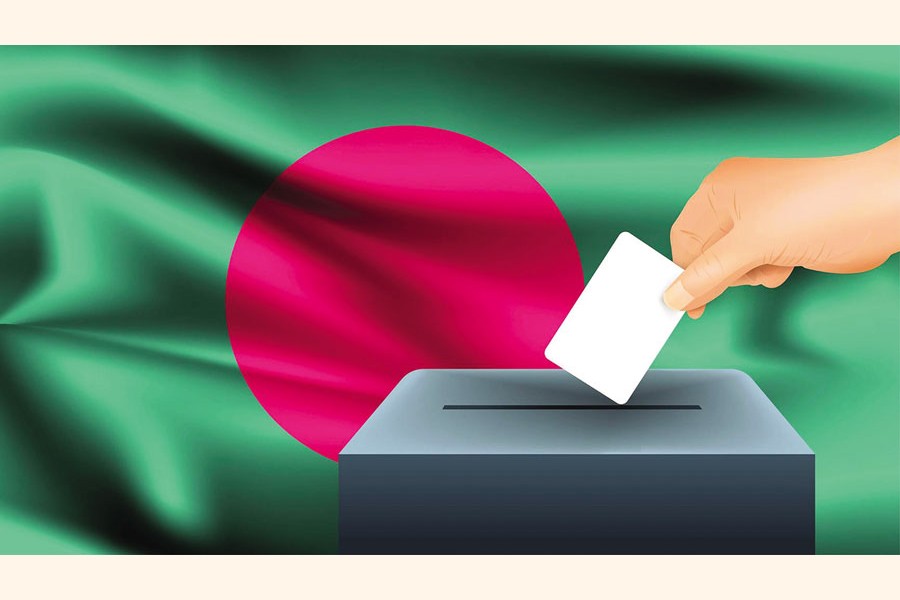
As Bangladesh goes to the polls today, a whiff of fresh air dispels the gloom. Lingering speculation and conspiracy theories over the fate of the election are finally giving way to cautious optimism. Hope surges for the revival of democracy. Since the country's independence in 1971, the journey to a lasting democratic system has been disrupted again and again, either by military coups or by democratically elected governments becoming authoritarian.
A mortal danger to democracy arose during the tenure of the ousted Sheikh Hasina regime. Even the slightest possibility of democracy faded when the regime, despite coming to power through democratic means in 2008, trampled on democratic values, undermined the peaceful transfer of power, and tried to cling to power indefinitely. But this time too, democracy endured, going through well over a decade of eclipse instead of being wiped out. A student-led mass uprising toppled the entrenched autocracy of Sheikh Hasina on Aug. 5, 2024, bringing to an end more than a decade of shrinking freedom of expression, constricted political space and rule by intimidation.
But the prolonged absence of democracy has left deep scars, affecting not only the evolution of the political system but also the growth of political leadership. As voters exercise their voting rights today, the leadership crisis looks acute. Many are groping in the dark for qualified people to lead the country in the coming days. Furthermore, the institutions that are supposed to create the checks and balances of power have withered instead of being nourished. Repairing the damage wrought by years of democratic deficit will therefore be one of the most pressing challenges in the days ahead.
Moreover, the country is mired in unprecedented economic and political challenges. The post-uprising interim government, led by Dr Muhammad Yunus, initially generated much hope for state reform and the rebuilding of democratic institutions. However, despite undertaking a wide range of reform initiatives, it soon became clear that many of these measures could not be implemented without a stable government backed by a strong public mandate.
Even though the government managed to stabilise the economy to a large extent from the mess it inherited, political uncertainty undermined efforts to win back the confidence of both local and foreign investors. Private investment fell to rock bottom in spite of the government's tall claim of big improvement in investment climate. Given the country's dependence on foreign loan and FDI, it is important to have political stability so that investors and lenders can feel safe about their decisions. Moreover, with so many different groups with their endless demands and pulling the interim government at the seams, it looks like the election couldn't be held a moment later.
Therefore, the 13th parliamentary election being held nationwide today, along with a referendum on constitutional reform, is one of the most consequential elections in the country's history. As the first national election since the 2024 uprising, it will not, in itself, resolve all the challenges Bangladesh is currently facing. But it is crucial for several reasons.
First of all, it is a day to redeem the pledge of restoring people's voting rights. For over a decade, Hasina sought to persuade the citizens to be content with the promise of development while depriving them of their fundamental right to vote. But in a free country one of the greatest satisfactions for citizens is drawn from the right to choose their own government. When people cast their votes, they feel empowered and recognised. Nothing provides the taste of freedom quite like this simple exercise, as it is evident in Bangladesh. Here election is not merely a mechanism for the peaceful transfer of power; it is a grand festival. Just as football fever grips the nation during the FIFA World Cup, election fever grips the entire nation during parliamentary polls.
Much of the election related excitement was missing during the last three general elections. Even though elections were held on regular interval, few felt the urge to go to the polling centers to cast their votes, as the winners of those races were a foregone conclusion due to state manipulation. The election frenzy has returned after nearly two decades. As a result, tens of millions of people who became eligible voters after 2008 are going to exercise their franchise, probably for the first time in their lives at 36 years of age!
Then the election could mark the beginning of a new and more positive direction in Bangladesh politics. For decades, the country's political landscape has been characterised by acrimony, violence, deadlock, corruption and the dominance of muscle power. But the younger generation, the Gen Z, that spearheaded the July-August uprising has political aspirations that differ markedly from those of traditional parties.
They are calling, among other things, for a more accountable, transparent and genuinely democratic system of governance. This election should not be viewed as the final hope for fulfilment of all the dreams and aspirations of the July-August uprising, but rather it could be a potential turning point. The real task lies in building on this opportunity.
aktuhin.fexpress@gmail.com
© 2026 - All Rights with The Financial Express

