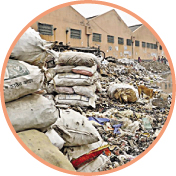
 Following the shifting of tanneries from Hazaribagh to Savar Tannery Industrial Estate, the most talked-about issue that kept appearing in the media and public discussions on the future of the tannery hub was the non-functional central effluent plant (CETP). The reason why the CETP at the tannery estate figured so prominently as a serious concern was the stalemate it had been through with practically no move forward. As a result, the purpose for which the tannery hub got relocated from Hazaribagh to Savar did not seem to make sense in the absence of a fully functional CETP. This is not just a case of delayed project implementation but of one that questions the authority's grasp of the issue in its entirety and gravity.
No doubt, it was the facility promised by the CETP - of treating all kinds of tannery wastes - that prompted the decision to relocate the age-old tannery hub from Hazaribagh in an attempt to save the Buriganga and adjoining localities from extremely harmful pollution. But soon after the relocation was made, albeit after repeated postponements, the shocker that did strike the tannery owners and local inhabitants living close to the Savar estate was that the CETP was only partially ready and that it was not equipped to deliver the services it was meant for. As a result, the relocation seemingly meant relocation of pollution-from Buriganga to Dhaleswary. Amid the lingering impasse, the authorities kept harping on doing the needful but sadly, at the expense of their credibility. Although the relevant authorities including the ministry of industries had time and again assured of making the CETP fully operational, things did not change as there was no meaningful move to fix the problems inherent in the design of the CETP and the flaws associated with it.
A recent news story covered by the mainstream media says that the Bangladesh Small and Cottage Industries Corporation (BSCIC) has sent a proposal to the ministry of industry for taking a project that will make the CETP fully functional. The proposed project, reportedly, will cost between Tk 500 and Tk 800 crore, and includes, besides correcting the technological glitches, a separate facility for solid waste management on 200 acres of land on the south side of the CETP. It may be noted that the government had spent Tk 565 crore for the CETP facility installed by a Chinese company that handed over an incomplete plant to the Dhaka Tannery Industrial Estate Waste Treatment Plant Company (DTIEWTPC). According to the newly proposed project, the facility now requires large-scale renovation or reconstruction of the plant.
Tannery is known to contain the highest level of waste, particularly toxic waste, among all industries. About 20 per cent of the large number of chemicals used in the tanning process is absorbed by leather, while the rest is released as waste. So, a non-functional CETP can cause havoc, as has been the case with the Savar tannery estate. Consequently, the entire leather industry is bearing the brunt. There are reports of foreign buyers refusing to procure products from the estate--- a grossly non-compliant hub as regards waste treatment and environmental mitigation. Besides, many enterprises in the estate are not in a position to initiate business expansion plans including export marketing. Without a fully functional CETP, local companies are not in a position to obtain the Leather Working Group (LWG) certification--- a foremost compliance requirement for procurement of tanned and finished leather by international retailers and brands.
Bangladesh's current share in the $215 billion global leather and leather goods market is only 0.5 per cent. This, industry experts hold, is appallingly short of the country's actual potential. This is unfortunate for Bangladesh as leather is among a handful of products that offers exporters the scope for nearly 100 per cent value-addition as raw materials are entirely available locally.
CETP thus continues to be a stumbling block to export. The Leather Working Group (LWG) certification would be a far cry without functional CETP having solid waste management and chrome recovery units in the tannery estate. So much has been said on this issue for years but no noticeable move is in sight, as of now. It is indeed intriguing that CETP, the most essential component of the leather estate, figures in the media and public discussion only to highlight the dismal failure of the authorities for years. The country's leather industry is desperately in need of a meaningful change in the overall scenario. Otherwise, the prospect still in sight will vanish in the distant horizon.
It is not certain whether the BISCIC project will get the government's nod. However, given the state of things, it is important that the government scrutinised the proposal. If needed, it may take expert opinions before taking a decision on resolving the CETP issue once and for all.
wasiahmed.bd@gmail.com
© 2026 - All Rights with The Financial Express

