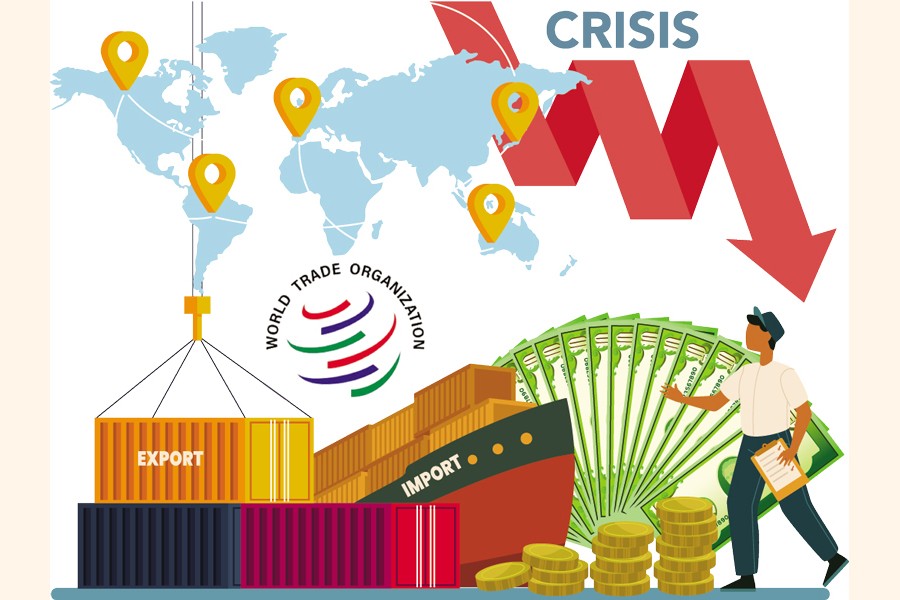
That the World Trade Organisation (WTO) is facing an existential crisis is no longer a matter of debate. What was once the cornerstone of global trade governance has been rendered largely ineffective, raising serious questions about its continued relevance. Much of this stems from the shifting posture of the United States, the dominance of which in global trade has turned the WTO into an entity with little influence, unable even to voice concerns at the state of affairs.
The United States, once the primary architect and champion of a rule-based open trading system, has retreated from its role as the WTO's principal backer. The system itself-designed after World War II as part of the liberal international order-was meant to encourage economic recovery, peaceful cooperation, and fair competition. Today, however, rising populism, intensifying geopolitical rivalries, and persistent inequality are eroding the very foundations of that order.
This shift became starkly visible under President Donald Trump. From the early days of his administration in 2017, he made no secret of his disdain for multilateralism. In his view, institutions like the WTO unfairly favoured developing nations at the expense of developed economies. His rhetoric, once dismissed as sweeping and simplistic, soon hardened into targeted criticism, especially of China. Trump argued that China's rapid export growth was facilitated by the WTO's "indulgence," which, according to him, gave Beijing an unfair edge in global trade.
Much of Washington's frustration revolves around its inability to counter China within the WTO framework. The United States accuses China of dumping cheap goods, using government subsidies to lower production costs, and capturing market share unfairly. US officials argue that the WTO's Appellate Body-its seven-member dispute settlement panel-has often acted beyond its mandate. In their view, WTO judges played the role of a "supreme court of world trade," frequently ruling in Beijing's favour on subsidy disputes while rejecting Washington's anti-dumping measures.
Trump even floated the idea of withdrawing the United States from the WTO during his 2016 campaign. At the time, the threat was brushed aside as political rhetoric. But the growing seriousness of US disengagement has since become clear, raising the spectre of a WTO unable to exert any authority without the participation of the world's largest economy.
Despite its present weakness, trade experts stress that the WTO remains central to the liberal international order. It is in the collective interest of the United States and other nations to keep supporting the institution. However, they also acknowledge that the WTO requires reforms if it is to regain relevance. Members must embark on serious negotiations to address shared concerns-whether through binding rules or strong political commitments. A regression towards unilateral trade actions and protectionism would be deeply damaging to the global economy.
While its failures are evident, the WTO's importance cannot be overlooked. It is the only global body entrusted with overseeing international trade rules, ensuring predictability and providing a forum for negotiation. Its dispute settlement system, though currently dysfunctional, has historically helped prevent trade conflicts from escalating into damaging trade wars. By promoting transparency in trade policies, the WTO has created an environment where businesses can plan investments, manage supply chains and operate with greater confidence.
For developing countries, the WTO is particularly vital. It offers them access to markets, a platform to voice concerns and assistance in adapting to complex international trade rules. Beyond traditional trade in goods and services, the WTO has also begun engaging with contemporary challenges such as digital trade, e-commerce, and climate change.
At the heart of the WTO's mandate lies the principle of Most-Favoured Nation (MFN), which helps ensure a level playing field by prohibiting discriminatory trade practices. This principle, along with the institution's rule-based framework, has provided stability and predictability for decades.
However, the global trading environment has evolved dramatically. Today's challenges extend beyond tariffs and goods to include cross-border data flows, digital platforms, and environmental concerns. The WTO's rulebook-crafted in an era dominated by physical goods-needs urgent updating to address these realities. Ongoing negotiations on digital trade and climate-related measures show that adaptation is possible but progress has been painfully slow.
The WTO's crisis is real, but declaring it obsolete would be premature. Its role as a stabiliser of international trade, a forum for cooperation and a safeguard against protectionism remains indispensable. Yet, without significant reforms-particularly in dispute settlement, negotiation processes, and the inclusion of modern trade issues-the organisation risks drifting into irrelevance.
For the United States and the wider international community, the choice is clear: either reinvest in the WTO as the cornerstone of global commerce or risk a fragmented trading system dominated by unilateral actions and power politics. The survival of the liberal international order may well depend on it.
Ultimately, the crisis of the WTO is not only about institutional weakness but also about the willingness of its most powerful members to uphold multilateralism. If major economies, particularly the United States, continue to bypass the WTO and resort to unilateral or regional arrangements, the very spirit of cooperative global trade will erode. Restoring credibility will require political will, trust-building and an acknowledgment that no single country, however powerful, can manage the complexities of today's interdependent world alone. In that sense, reforming and revitalising the WTO is not a matter of choice but of necessity for sustaining stability in the global economy.
With the next ministerial conference (MC14) knocking at the door (March 26-29, 2026), it remains to be seen what, if anything, the WTO has up its sleeve to discipline global trade.
wasiahmed.bd@gmail.com
© 2026 - All Rights with The Financial Express

