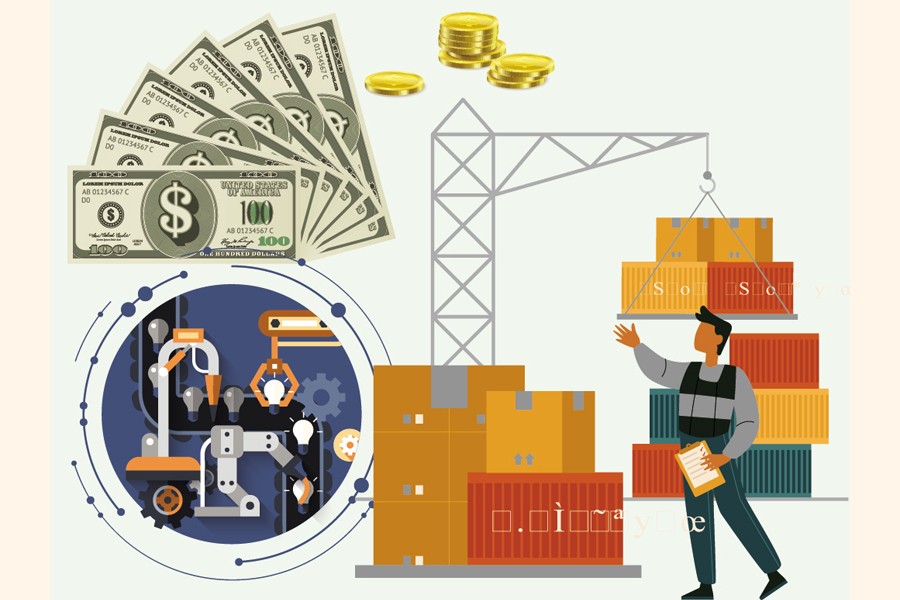
It is premature to conclude that import of capital machinery has peaked up in the first half of the fiscal year 2025-26 riding on the assumption of economic and political stability during this elected government. But the 24 per cent rise in the opening of letters of credit (LCs) year on year during the period makes quite a statement. The import worth $1,079 million is the highest in two years and follows three years of decline and sluggish growth of private sector credit. Such credit growth stood at 6.10 per cent in December last, one of the lowest in recent years.
As new investment was hard to come by for setting up new factories, the import of capital machinery and accessories was supposed to remain subdued. Then what is the mystery behind this resurgence of import? A plausible answer to this is, as Mir Nasir Hossain, former president of the Federation of Bangladesh Chambers of Commerce and Industry (FBCCI) hints at, BMRE--- balancing, modernisation, rehabilitation and expansion.
It can be a clear case of compulsion because increased LC openings during the July-November period, according to Bangladesh Bank (BB) were recorded in sectors like leather, pharmaceutical, packaging etcetera. These are the sectors that have immense potential and await not just tapping but realising it. The sooner it is done the better. These and information and communications technology (ICT) can more than rival the garment sector which now earns 80-84 per cent of the country's foreign exchange.
Bangladesh's overdependence on readymade garment sector is flawed on several counts. No country with little or no reserve for energy and minerals can and should depend on a single commodity's export. The export basket has to be diversified as much as possible. Leather and pharmaceutical industries have given enough proof of their capability to capture a fair share of the global market. While a mess has been created over the faulty central effluent treatment plant at the Savar Tannery Industrial Estate, the pharmaceutical industry in the country suffers from lukewarm interest in setting up factories for producing locally the active pharmaceutical ingredients (API) at the designated park in Gazaria, Munshiganj.
With only a few factories in their early stage of construction, the 200-acre API park remains underutilised because of a lack of gas supply and erratic power. The import substitute would be ready if the government's 100 per cent tax holiday had been complemented by effective gas and electricity connections. Sure enough, if the 24 companies which received 48 plots there could go into operation, the benefit would be reflected in the price level of life-saving drugs. Medicine would be less costly and in case of export, the pharmaceutical companies would have a competitive edge over rival exporting companies. In that case, the import of capital machinery would be even more compelling.
The current rise in import of capital machinery at a time of uncertainty therefore has a clear message. The message is that disease does not allow people to wait for better time. A life-threatening disease must be controlled by immediate and regular medication. Now that the investment made at a time of political uncertainty and fund crisis indicate that the investment in the sector is likely to gain momentum with the elected government taking the rein.
As for the leather industry, annoyed at the government's indecision some companies have installed their own effluent treatment plants (ETPs). No wonder that several tannery companies produce high class products and yet fail to qualify for Leather Working Group (LWG) certification. Some put the number of such certificate holders at two, some others at four and still some others at eight. So, the new minister in charge of industry should address the chronic problem of the leather industrial park's central effluent treatment plant on a priority basis. If that happens, more leather manufacturing companies will receive LWG certificates to have access to the global leather goods market valued at US $266-471 billion in 2024 and is projected to grow to $538-982 billion by 2033-34.
Similarly the packaging industry, considered a backward linkage industry of the RMG, has the capacity to grow to a 50-billion worth export industry. Right now it is experiencing a transition to a major global power. Supported by right policy, this industry can rival a few other sectors in revenue earning for the country.
Finally, the ICT can make its mark if policy frameworks and infrastructure are tailor-made to suit the sector. IT exports went up by 14 per cent in the first half of the fiscal 2025-26, in the July-November period to be precise. The demand was fuelled by artificial intelligent (AI). This shows that when the challenges are getting more daunting, there are also windows of opportunities. These opportunities have to be seized on time. Any delay or bureaucratic hassles may stall the progress in accessing the global market.
Bangladesh cannot afford this. It has to grab opportunities that come its way and therefore the foundational platforms have to be kept ready for launching the manufacturing and export drives. The tech-savvy young ICT graduates are competent enough to do the complex jobs in the IT sector. But if the internet speed and power failure cause problems, they fail to live up to their commitment with the result of future orders shifting elsewhere. AI-assisted development tools are helping produce software faster than before and transition to new types of software. Uninterrupted power and faster internet speed are a prerequisite for the transition to happen. So, import of new tools and accessories in all these sectors can turn manufacturing vibrant, allowing sustainable export diversifications to take a concrete shape.
nilratanhalder2000@yahoo.com
© 2026 - All Rights with The Financial Express

