 Of late there have been a few expert dialogues, seminars, view-exchanges etc on the state of rivers in Bangladesh. Those were organised apparently with a view to reaching consensus on the remedies to the adversities facing these rivers --- both large and small. Normally, the pollution of rivers by mindless human activities near the large cities and ports attracts the different colloquiums' focus. The river experts, researchers and the river-saving activists are found busy achieving their single goal: protection of the rivers from their death throes. Similar spotlights are thrown on some other scourges related mainly to river encroachment and sand lifting, and laying ownership to certain narrow rivers. It sounds atrocious. But it continues to happen in many remote areas of the country.
Helpless, poor villagers remain just witness to this grave crime of occupying rivers. Except cursing the influential quarters involved in the grave offence, they have little to do. As the former get away with many criminal activities, the peace-loving people just look on. They remain deprived of almost all kinds of benefits coming from these 'private rivers'. It is especially the fishing community who remains most affected by the prohibitions slapped by the local influential quarters on a river. These injustices have been in place for long.
These are isolated events related to the rivers of Bangladesh. But there are widespread scourges which plague the veritably vanishing rivers. A few of them hasten the premature thinning of once mighty flows. Experts, however, hold the view that despite their slowing down of flows, no rivers face complete death. Due to siltation and human interferences, some gorgeously flowing rivers lose their strength in current. Their decline in flows expedites their process of drying up. In the process, a few thinly flowing rivers do get buried under the expanse of dry lands and pastures. All-out efforts in the form of massive digging and dredging can help reclaim a few of these rivers, despite their disappearance a few decades, or even a century, ago. If put into practice, these physical and mechanical devices could have reclaimed a number of rivers long presumed dead in this country. As a corollary, the controversy over the exact number of rivers in the river-filled land would have long resolved.
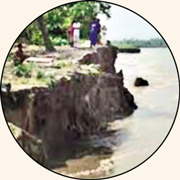
Of all the river-related adversities, the most terrible in the context of the present Bangladesh appears to be the non-stop spate of erosion. This menace besetting the mostly mid-level farmers and poor villagers owning derelict homesteads has long been recognised as a bane of this river-dominant country. However, concrete structures also do not remain spared. River erosions have long been a natural process in this country which is filled with rivers --- many flowing down from upstream areas. In the past, the season of monsoon used to be earmarked for the rivers' spate of dreadful erosions. Be they large and small, few rivers in the country are spared the dread of massive erosion during monsoon. Thanks to this natural phenomenon, hundreds of acres of crop fields on the river banks are devoured by river erosion almost every year. This apart, scores of human settlements, markets, river port structures and age-old buildings remain vulnerable to river erosions round the year.
Although the season of erosion in the past used to be seen being confined to the season of monsoon, changes continue to take place. Thanks to the vagaries of nature prompted by climate change, the assaults of river erosion nowadays continue to devastate the river banks round the year. There are several highly erosion-prone rivers in Bangladesh. They constitute three major streams of the country, i.e. the Jamuna, the Ganges and the Meghna. In the context of the three streams, river experts have identified a number of erosion-prone zones in the country. They comprise Kurigram, Gaibandha, Jamalpur, Bogura, Sirajganj, Tangail, Pabna and Manikganj. The areas are under the influence of the Jamuna River. Many river enthusiasts are found confused about the causes of erosion. A general concept has it that due to silt the soil structure continues to become weak. Formation of this type of soil ends up in its easy breakdown due to the strong current of the river water. River erosion, thus, starts occurring at suitable points. Moreover, erosions mainly occur due to the braided nature of rivers in Bangladesh. The process is aggravated by heavy rainfall, particularly upstream --- leading to increased water flow.
To the commoners, an easy remedy to river erosion is to construct levees along the river banks. As part of traditional anti-erosion measures, these embankments comprise placing sand bags, geo bags and many other handy protective barriers along the river banks. In the developed rural areas, a number of other advanced devices are used. Experts, however, suggest stronger measures to contain the onrush of water. Instead of ad hoc measures, they prefer putting in place permanent measures to better adapt to the river banks' breakdown. According to experts, the major agents of soil-erosion are water and wind. The others include weather and climate, topography and tectonic activity, misuse of river-bank soil, loss of vegetation and trees; and poor erosion management of banks.
It doesn't require in-depth studies to conclude that deforestation plays a major role in aggravating the river erosion process. To the great misfortune of the land, vast swathes of the country's river banks remain barren except the covers of grass and weeds. To put it briefly, river bank erosion, grabbing and encroachment, as well as unbridled pollution, are equally responsible for the dismal state of our rivers.
shihabskr@ymail.com
© 2026 - All Rights with The Financial Express

