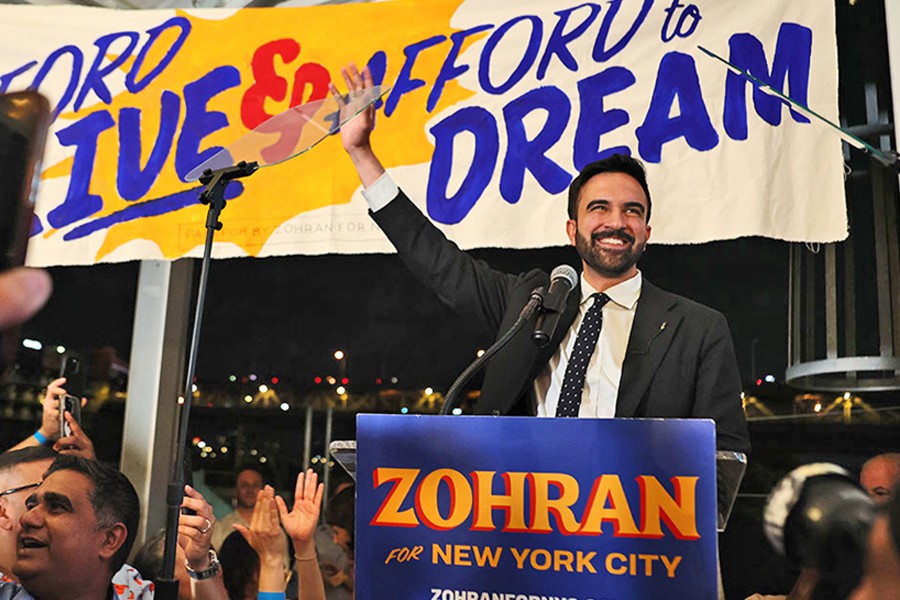
Now that the dust has begun to settle after Zohran Mamdani's decisive victory in the New York mayoral election, the question that looms large is whether he can deliver on his ambitious promises as a self-declared democratic socialist. His victory, though confined to one of the world's most diverse and complex cities, resonates far beyond its borders - symbolising both a resurgence of left-wing populism and a moment of reckoning for American politics.
Since Mamdani's sweeping primary win in June this year, the term 'democratic socialism' has surged into mainstream public discourse across the United States. For many, it embodies a renewed moral and political challenge to the country's widening inequality and corporate-dominated capitalism. Yet for others, it remains a misunderstood, even threatening concept - one that political opponents have eagerly weaponised.
In the final months of the campaign, President Donald Trump repeatedly derided Mamdani as a 'communist', reviving Cold War-era rhetoric in an attempt to undermine his credibility. Mamdani, however, retorted firmly. Appearing on NBC's Meet the Press in June, he rejected the accusation saying: "I am not." He then went on to define what his politics truly stands for - an ethos inspired less by ideology and more by empathy and justice.
"When we talk about my politics," Mamdani explained, "I call myself a democratic socialist in many ways inspired by the words of Dr. Martin Luther King Jr., who said, "Call it democracy or call it democratic socialism, there has to be a better distribution of wealth for all of God's children in this country." Drawing from King's 1961 speech, Mamdani highlighted the irony that while national income inequality has declined modestly in recent years, it has grown sharply in New York City - a city of immense prosperity but also of deep poverty. "What we need," he concluded, "is a city where every single person can thrive."
Defining democratic socialism, however, remains a bit tricky. There is no single doctrinal statement that encapsulates it. In essence, democratic socialists advocate for collective ownership or public control of essential services - such as health care, housing, energy, and transportation - to ensure that the basic needs of all citizens are met equitably. The goal is not to abolish markets, but to democratise them; not to suppress enterprise, but to subordinate profit motives to public welfare.
Mamdani's ideas align closely with the principles of the Democratic Socialists of America (DSA), an organisation that has, since the 1980s, been working to reshape the American left. The DSA describes its mission as promoting "a humane social order based on democratic planning and market mechanisms," rejecting an economic system "sustained by private profit, discrimination, and violence." With over 80,000 members across all 50 states, the DSA has become the largest socialist organisaation in the country, claiming a broad base of young activists drawn to causes like climate justice, affordable housing and labour rights.
Unsurprisingly, the DSA's New York chapter has celebrated Mamdani's triumph as a watershed moment. Yet, Mamdani has been careful not to become the organisation's proxy. While sympathetic to many of its ideals, he has deliberately positioned himself as an independent-minded reformer rather than a doctrinaire socialist. His stance on contentious issues such as policing, misdemeanour offences and urban development has often been more moderate than the DSA's, reflecting his pragmatic understanding of governing a city as complex as New York.
This balancing act - between idealism and realism - could define Mamdani's mayorship. Democratic socialists often argue that systemic change cannot be achieved overnight; it must be pursued incrementally within existing institutions. As such, they rely on tools like organising, advocacy, and legislative reform. Mamdani's challenge will be to translate those ideals into policy outcomes that tangibly improve lives - cleaner neighbourhoods, affordable homes, better public transit, and fairer wages.
Importantly, democratic socialists today are at pains to differentiate their philosophy from the discredited forms of socialism and communism that once dominated the 20th century. Those historical models, characterised by state control and authoritarianism, left deep scars on the term 'socialism' itself. The movement Mamdani represents seeks to reclaim the term as an expression of democratic renewal - a call for participatory politics, economic fairness, and social inclusion.
Still, questions remain about how far Mamdani's model can travel beyond New York City's progressive landscape. Political analysts caution that the blend of moral idealism and municipal pragmatism that underpinned his success may not easily resonate in more conservative parts of the country. The urban electorate that propelled him to victory is, after all, markedly different from the heartland voters who remain wary of anything branded "socialist."
Yet even sceptics acknowledge that Mamdani's leadership could reshape perceptions. If he succeeds in delivering efficient, equitable governance without alienating business or middle-class voters, he might well redefine socialism - transforming it from a taboo into a tangible promise of fairness.
In many ways, Zohran Mamdani's mayoralty will serve as a litmus test for the viability of democratic socialism within the framework of American democracy. For now, much of the world will be watching to see whether his "New York experiment" can reconcile lofty ideals with practical governance.
wasiahmed.bd@gmail.com
© 2026 - All Rights with The Financial Express

