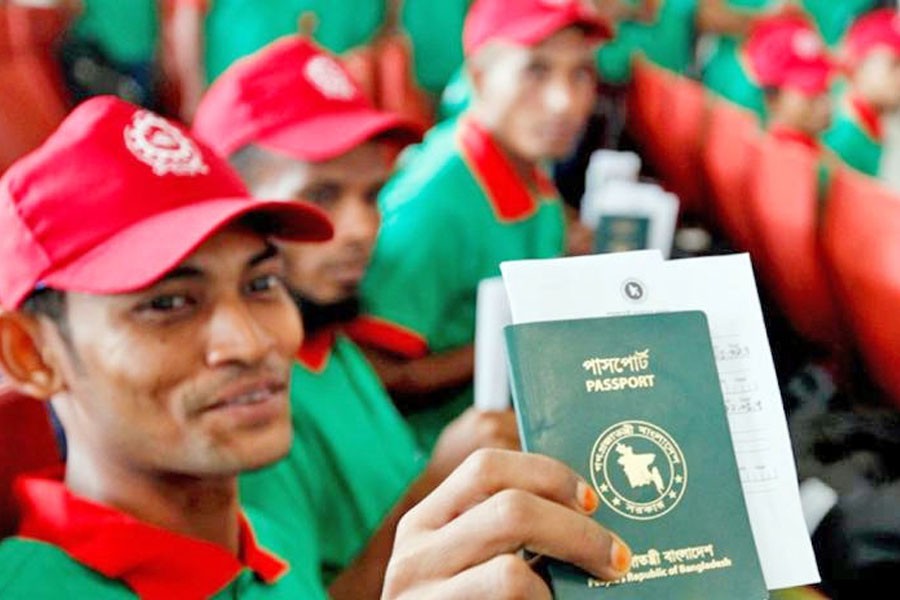
The year 2023 was supposed to be one of relief for policymakers as record numbers of people went abroad with employment. Data reveal that the nation's overseas employment hit a six-year high as more than 1.1 million people went abroad to work during FY2022-23 and the traditional overseas labour markets of the middle east hired higher numbers of workers from Bangladesh. The country sent some 1,144,993 workers in the last fiscal year (FY) compared to 989,014 in FY 2021-22. The bulk of the workers went to traditional job markets in the Kingdom of Saudi Arabia, followed by Oman, United Arab Emirates and Malaysia.
Unfortunately, though more people went abroad, the remittance in foreign exchange went the other way. According to the International Labour Organisation (ILO), the trend in expatriate workers from Bangladesh show that more unskilled people have been going to overseas labour markets than skilled ones. Hence, although more people have travelled to overseas destinations, their earnings are lower than those of other expatriate workers from Asia, which send more skilled workers than unskilled ones. The problem lies in the fact that manpower recruiters in the country bring home demand for less skilled workers in foreign countries. Bangladesh is at risk of being branded the supplier of unskilled workers, which in turn has its reflection on remittance earnings.
Of course, unlike its competitors Bangladesh has not been able to create enough skilled manpower in the country from which manpower recruiters can sufficiently draw from. This is reflected in the slowing down of remittance earnings steadily over the years. Remittance inflow shows that from peak earnings of US$24.77 billion in FY2020-21, it has decreased steadily to around $21.61 billion in FY 2022-23. Again, while all the focus remains on how many workers go abroad each year, the number of workers returning home from work has also increased to about 100,000 in 2022. Manpower recruitment agencies in the country have been concentrated on low-hanging fruits, i.e. the unskilled labour force. There is little investment to be made here and hence, agencies have not invested time and energy to develop the networks needed to concentrate on higher-skill bracket jobs abroad. This is evident from the fact that "the less-skilled labour migration from Bangladesh increased from 71.59 per cent in 2010 to 74 per cent in 2022."
There was a glimmer of hope in 2019 when Bureau of Manpower, Employment and Training (BMET) data pointed out that the rate of skilled workers increased to 43.55 per cent. Unfortunately that trend started declining soon afterwards and reached a record low of 22.22 per cent in 2022. The fact that Bangladesh has not been able to tap into the skilled job markets overseas adversely affects its inward remittance flow. One only needs to look at the salary scale of other countries in Asia, which are benefitting from sending higher skilled workers to the same markets where we send unskilled ones. According to a report published in this newspaper, "per capita average monthly income of Filipino migrants was $564.1, Chinese migrants $532.71, Indian ones $395.71, Pakistani ones $275.74 and Bangladesh ones $203.33, the International Organization for Migration (IOM)'s migration report - 2019 revealed."
So, the facts speak for themselves. Bangladesh has to increase its skills basket if it wishes to move to a higher plateau of earning more foreign exchange to be sent home as remittance. Technical education is an area that needs government patronage and the BMET has started to open up such centres across the country. Looking beyond what BMET is doing, technical training should be mainstreamed in regular education and the government needs to work with manpower recruitment agencies to encourage them to bring more technical jobs to Bangladesh.
mansur.thefinancialexpress@gmail.com
© 2026 - All Rights with The Financial Express

