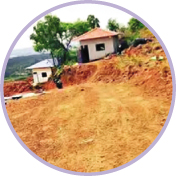
 Unlike the soil of Moti Jharna hill in Chittagong city which was hit by a landslide in 2008, the one of CHT has been dubbed by experts different in nature. The Moti Jharna landslide had left 11 dead. Meanwhile, six years have elapsed since a number of devastating landslides wreaked havoc on the Chattogram Hill Tracts (CHT) region on a fateful day in June, 2017. Thanks to their vulnerability, the three hill districts of Rangamati, Bandarban and Khagrachhari had to bear the brunt. The landslides triggered by continuous heavy rain destroyed a few settlements on hill slopes killing 168. Twelve people were killed in the Chattogram district at that time.
At the onset of the season of monsoon this year people in the Chattogram district and the CHT region, and elsewhere in the country, hope calamitous landslides would not visit the vast area once again. Their expectation stems from some facts gleaned from the country's weather pattern this year. But geologists say otherwise. According to them, the prolonged heat wave has turned the hills' typically swampy and soft soil layer into a fragmented dry mass. Upon coming into contact with torrential rain, the soil layers turn sodden and get loosened; and finally come crashing down on dwellings. Geologists have long observed that the components of the CHT hills' soil make it different from that found in other parts of the country. Thus they view the ambience, especially the soil, of the Hill Tracts as being highly vulnerable to the future bouts of landslides. A distressing aspect of landslides in the overpopulated hills in greater Chattogram is a section of people continue to return to the spots of the calamity. Most of these people are poverty-stricken and, thus, without shelter. This is a common scenario in the CHT in particular.
After the Moti Jharna hill disaster, the port city administration has slapped ban on living on the hill slopes. Moreover, hill levelling activities are now under strict prohibition in the city. In spite of that, the atrocious act could not be brought to an end. Influential persons involved in different organisations allegedly play the role of masterminds of the fresh spate of hill-cutting. In spite of their being identified as law-flouters, these persons go ahead with their acts with little compunction. As has been seen in the past, they remain beyond the reach of law. In the past years, a number of syndicates were said to be involved in constructing shanties on the hill slopes. They would rent those out to the lower-income people. As a consequence, whenever a landslide struck the hills, the victims would invariably be the class of the ultra-poor.
As part of an unwritten rule, the syndicates involved in renting out hill-slope shanties for some time are seen being replaced with others. A common trend which is found among them is the addition of new amenities to the existing ones. This feature attracts many relatively solvent shanty-dwellers to the hill slums. In order to attract new tenants, the shanty owners continue to add to the facilities available there. The tenants live in these hill slums, being fully aware of the risks of landslides. They have few options. Unlike the ever-increasing omnipresent slums in Dhaka, the shanty dwellings built on hill slopes in the port city have lately undergone a noticeable decline. The reasons are conspicuous --- drop in the number of hills.
Even two decades ago in many areas of the port city, lush green small hill clusters could be seen adding to its beauty. Most of them have vanished. In their place, arrays of high-rise buildings constitute a different cityscape. Many areas lie flattened as a vacant lot with no trees. Apparently, the owners wait for the right kind of developers. With hills gone, the anxieties over landslides no longer haunt people. But there is something amiss. It is related to the terrible impact of an atmosphere devoid of trees --- a prime source of the elixir of life. It doesn't need expert views to learn that it is trees which help keep ecological balance for mankind. Hills without trees are veritable traps poised to ensnare unwitting humans. As environmental experts observe, denuded hills are several times more prone to go through landslides than tree-filled hills. The CHT region's going through massive landslides in June, 2017, was no isolated event. It had been in the making for decades. Like in the Chittagong port city and the Cox's Bazar area, people without shelter chose the precarious hills to settle down. The landslides occurred in a vast area leading to 168 deaths.
According to the locals in Cox's Bazar district's Ukhiya, prior to the arrangements of their camps, the Rohingya refugees chopped trees on the hillocks indiscriminately to set up their temporary shelters. Likewise, a large section of the Bengalee settlers have long been living on the slopes and at the bottoms of the CHT hills. As per an estimate, the worst situation has been detected in the Rangamati district, with over 15,000 families living in a perilous condition at hill bottoms. This hill district is followed by Khagrachari (4,000 families) and Bandarban (more than 2000 families). As has been observed by the environmental experts and activists, an anarchic situation is prevailing in the CHT when it comes to hill encroachments for settling down. Unless the trend is dealt with stern measures, the hills might be in for more disasters. These desperate people should be told that landslides assault hills without any forecast.
shihabskr@ymail.com
© 2026 - All Rights with The Financial Express

