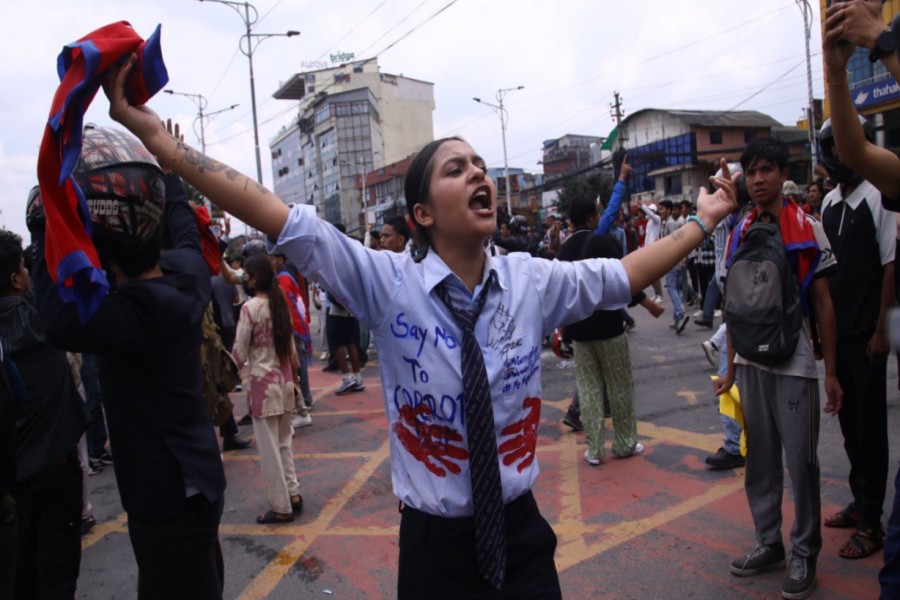
 A protester in Kathmandu, Nepal —Agency Photo
 Thunderstorms that batter South Asia each monsoon season now have a political echo: waves of popular revolt are sweeping away powerful regimes. After Sri Lanka, Bangladesh, and Nepal -- and to a lesser yet significant extent Indonesia -- mass upsurge by citizens has brought the collapse, or at least a serious weakening, of once entrenched governments. The common headline is clear: endemic corruption and yawning economic inequality are no longer tolerable. Young people -- often described as disillusioned, dispossessed, ignored -- are the spearhead of what may fairly be called a Monsoon Revolution.
In Sri Lanka, the 2022 economic meltdown (foreign reserves exhausted, shortages of fuel, medicines, food) exposed the Rajapaksa family's corrupt accumulation of power and wealth. Protests forced the exit of President Gotabaya Rajapaksa and the effective end of Rajapaksa dominance. The public outrage was not only about failing economy but about luxurious lifestyles of connected elites, foul loans, sweetheart deals, and gated impunity.
In Bangladesh, what began in mid-2024 as protests over discriminatory government job quotas rapidly turned into something far broader. Students first took to the streets demanding reform of the "freedom fighters' quota" in civil service positions. But the movement soon grew into a national uprising against authoritarianism, nepotism and corruption in the Awami League government. By August 2024, under pressure from mass protests, growing distrust in her rule, and apparently even the army distancing itself, Prime Minister Sheikh Hasina's 15-year reign came to an end.
In Nepal, in September 2025, protests led largely by youth and triggered by a social media ban erupted into violent confrontation, with images of elites' excesses providing fuel youth got infuriated with rising number of luxury hotels, and politicians' children flaunting status, while normal Nepalese suffered in poverty. Street protests left thousands injured, and dozens dead. The explosive situation forced Prime Minister K.P. Sharma Oli to resign.
Indonesia has not, so far, seen its regime fall. But protests there have been spreading -- over lawmakers' lavish perks, allowances many times local minimum wages, and policies seen to favour elites and conglomerates. The public anger is being channelled, and some reforms have already have taken effect.
It seems that inequality in these countries has become so visible that protest is turning into revolution.
In Bangladesh, the Gini coefficient (a standard measure of income inequality, where 0 would be perfect equality, 1 extreme inequality) is estimated at ≈ 0.499 in 2022 nationally, with 0.446 in rural areas but 0.539 in urban ones, according to the Bangladesh Bureau of Statistics. That puts Bangladesh precariously close to "high inequality" classification.
In Nepal Gini coefficient in recent years is lower -- about 30.0 in 2022 -- though poverty and inequality persist, especially between urban and rural, Hill vs Terai, and across caste and ethnic lines.
In Sri Lanka, the last reliably measured Gini (2019) was≈ 37.7, higher than Nepal or Bangladesh, showing more acute income gaps.
These numbers tell part of the story: many promise of growth and economic progress are experienced only by a small slice of the population. Despite GDP growth, rising per-capita income, dropping aggregate poverty, the wealth and power remain concentrated.
Inequality alone may simmer, but corruption provides the spark.
Nepal's recent upsurge was sharply triggered by the dominance of "nepo kids" -- heirs of entrenched political dynasties who stepped into power without proven merit. For citizens weary of corruption, inequality, and joblessness, these privileged successors came to embody a rigged system that denies ordinary people opportunity. Their visible entitlement and detachment from public struggles deepened frustration, especially among Nepal's younger generation. What began as isolated protests soon transformed into a broad-based movement. At its core was a demand to dismantle hereditary politics and replace it with accountability, fairness, and a democracy that serves people rather than family legacies.
Sri Lanka's Rajapaksa family was accused of hiding vast fortunes offshore, manipulating state contracts, and pushing the country into unsustainable debt (including large loans from foreign powers) to fund grand infrastructure projects whose benefits disproportionately went to elites. After the crisis, parliament voted to strip former presidents and their widows of state-funded perks: allowances, pensions, housing and staff. These were seen as symbols of elite impunity.
In Bangladesh, under Hasina's tenure allegations of rigged elections, enforced disappearances, violent crackdowns on dissent, suppression of media and internet blackouts all accumulated with corruption scandals. The job quota system, originally intended to help marginalised groups, became tangled in favouritism, political loyalty and exclusion. Students decried how quotas for descendants of "freedom fighters" (a small percentage of the population) took up a disproportionate share of opportunities.
Multiple reports (from civil society, Transparency International, etc.) show that property declarations by high officials are hidden, procurement contracts favour connected businesses, and middlemen are ubiquitous in government deals. The perception of corruption is high: Nepal ranks about 107th out of 180 in the 2024 Corruption Perceptions Index, with a score of only 34/100, placing it in the "high corruption" category.
In Indonesia protests were triggered when news broke that lawmakers were to receive a monthly housing allowance of about 50 million rupiah (roughly US$3,000), nearly ten times Jakarta's minimum wage
(≈ $337). That kind of disparity, especially when combined with austerity for ordinary services and rising cost of living, ignites public outrage. Transparency International notes Indonesia's CPI score at about 37/100, underlining that corruption remains systemic.
One of the distinguishing features of these revolts is that they are not led by established political parties (at least initially), but by young people tapped into digital media. The images of corruption, the bandwidth for comparisons (elite homes, flashy lifestyles, contrast with queues for food or medicine), spread widely via social media. What might once have been remote stories are now visceral daily evidence. This visibility erodes legitimacy.
The cost of living, rising inequality, and austerity measures have increased the burden on ordinary citizens. When lawmakers earn ten times the minimum wage for perks, while students, factory workers, small farmers struggle, legitimacy comes under threat. It may not lead immediately to regime change -- but maintaining status quo is becoming harder.
These revolutions are not spontaneous eruptions; they are outcomes of cumulative failures.
When corruption scandals implicate ruling families, ministers, officials -- yet investigations drag, or tied institutions are compromised -- people see a double standard. The law seems to apply selectively.
In Sri Lanka, former presidents and presidential relatives felt secure in erecting monuments, building palatial houses, investing in luxury overseas property. In Bangladesh, crackdowns on dissent, arrests of students and journalists, even internet blackouts, while elite patronage continues, raise the sense that rules are bent in favour of insiders.
In Nepal, declarations of assets becoming hidden, or procurement rigged, reinforcing the idea that the elite have built a shadow system.
Although many of these countries have posted strong GDP growth (Bangladesh in particular), and some poverty reduction, the benefits are deeply uneven. Jobs for youth are scarce; inflation, cost of essentials, housing, health are burdensome. Many young people have high expectations -- education, connectivity, exposure to global media -- which amplify the feeling that what is taken as "progress" has bypassed them.
Young people must have real voice in politics -- not just via protests but through formal channels. Job creation, affordable education, meaningful opportunities will sure to contribute.
Inflation control, price stability, social protection, public services -- these can act as buffers to prevent despair turning into desperation.
Corruption and economic disparity are not just grievances: they are existential risk factors for regimes hoping to cling to power. The lesson: living standards, fairness, transparency, rule of law are not luxuries; they are foundations of legitimacy. South Asia is being remade now, whether its old regimes like it or not. If the new political order fails those it promises to serve, the next revolution may be just around the corner.
mirmostafiz@yahoo.com
© 2026 - All Rights with The Financial Express

