Industry Minister Khandakar Abdul Muktadir after visiting the trading of rawhides of sacrificial animals a day after the Edid-ul Azha festival in the Lalbagh area of the capital city on Friday, May 29, said the government was going to unveil a comprehensive, long-term roadmap for the leather sector's development by July next. Notably, the said roadmap for the leather sector's development also includes preservation and processing of leather for expansion of export. There is no question that the leather sector needs a shot in the arm to be transformed into a thriving export-oriented one. But for the leather sector to thrive, first and foremost, the suppliers of rawhides of sacrificial animals collected during the Eid-ul Azha festival every year should also be enabled to at least survive, if not thrive. In fact, hides of sacrificial animals contribute 50 to 60 per cent of Bangladesh's annual rawhide supply as during each Eid-ul-Azha festival between 10 to 12 million animals including cow, buffalo, goat, sheep, etc., are slaughtered. This year, for instance, the tannery factory owners have set a target of collecting 7.5 million to 8.0 million pieces of sacrificial animal hide. And the number of animals ready for sacrifice during this Eid-ul-Azha was more than 12.33 million, while the actual demand for animals was about 10.10 million, according to the department of livestock services (DLS). Anticipating the supply situation against the backdrop of severe financial constraints being faced by the middle-and-low-income people, the tanners set such a conservative procurement target for rawhide purchase this year. That means though cattle traders could not make much profit during this Eid-ul-Azha sales, they did not at least go broke like the seasonal rawhide traders. Consider that the government has set prices for salted raw sacrificial animal hides from Tk 62 to Tk 67 per square foot (sft) for cowhide. This is an increase by Tk 2.0 per sft during this Eid-ul-Azha compared to the previous year. Similarly, the price for the skin of he-goat has been fixed from Tk25 to Tk30 per sft while that for per sft of she-goat skin between Tk 22 and Tk 25. These official prices for cowhide and goatskin were fixed for Dhaka market. This is to note that about 80 per cent of the sacrificial animal's hides are collected from Dhaka. Now, a big-sized cowhide is measured between 31 sft and 40 sft, while a medium-sized cowhide is between 21 sft and 30 sft. The small ones, on the other hand, range from 16 sft to 20 sft in size. In that case, according to the government-fixed rates, larger cowhides should be sold between Tk 1,900 and Tk 2,600 apiece, while each medium-sized cowhide should sell between Tk1,300 and Tk 1,850. Similarly, the small-sized cowhide's sale price should be from Tk 900 to Tk 1,200. But in reality, according to reports, the aratdars (warehouse owners) or tanners bought the small pieces of cowhide at Tk250-Tk400. Similarly, the medium-sized pieces were being sold at Tk500-Tk650, while the large pieces were reportedly sold between Tk700 and Tk800. The goatskins are of little value in the hide market. If at all, those are sold between Tk5.0 and Tk10 apiece. However, aratdars or tanners argue that unsalted or low quality rawhides are usually sold cheap or rejected by them. On the contrary, quality rawhides get the official or even higher rates. But the fact remains that quality or standard of the rawhides are determined by the buyers.
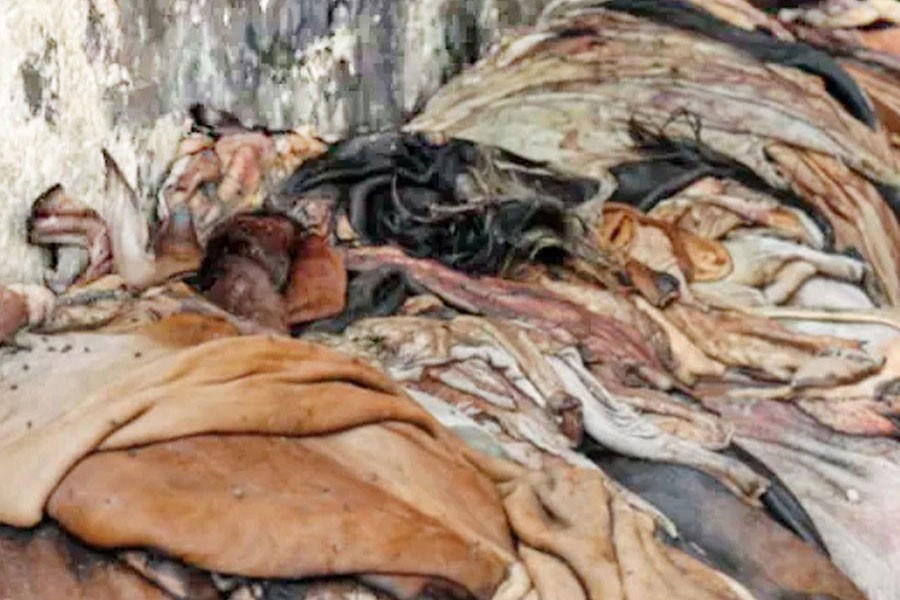
Small and seasonal rawhide traders in most cases complained that they had to incur big losses. In Chattogram the picture was reportedly still worse as hundreds of pieces of rawhide were found piled up on the roadside in Muradpur and Aturar Depot areas. Failing to sell those, the seasonal/small traders of rawhides had, according to locals, left those to rot. This is real bad news for the small-and-medium-scale rawhide traders of Chattogram (Ctg). As the warehouse owners were offering very low price for rawhides brought from different parts of Ctg, the traders in many cases could not even recover the transport cost against their cargo. This was the case, despite the fact that the government set the per sft prices of this year's cowhide between Tk57 and Tk62 outside Dhaka. The small and seasonal rawhide traders believe that the aratdars of Ctg were to blame for the crash of the rawhide market and the resulting disaster that struck them. According to Chattogram Greater Rawhide Merchants' Cooperative Society, out of some two dozen tanneries in the past, there is only one tannery left operating in Ctg. Since that one tanner buys between 100,000 and 200,000 pieces of rawhides a year, the entire supply of the district's rawhides cannot be absorbed locally. So, Dhaka is the actual market for Ctg's surplus rawhides. But small/seasonal rawhide traders with their small capital are not supposed to sell their cargo in Dhaka. But this is not just the story of Ctg, but essentially of the seasonal rawhide sellers across the nation. That is why, during every Eid-ul-Azha we hear of reports that unable to sell their rawhides, the small/seasonal traders dump their cargo on the road or bury it in the ground. This is no doubt a colossal loss to the economy that the government should not allow to happen. Clearly, the crash in the rawhide market during the Eid-ul-Azha stems from systemic problems in the leather supply chain. For instance, treating and preserving rawhides rapidly with salt require skill as well as labour that involves an additional investment of about Tk350 per piece of hide which the small/seasonal traders can hardly afford. That leads to quality deterioration and the resulting lower price or even outright rejection of the hides by buyers. So, small/seasonal rawhide traders need to be trained to acquire the required skill for preservation of rawhide and provided with the capital by way of low-cost bank loans.
Most importantly, to create demand for hides, the tanneries should attain international compliance through obtaining global environmental certification from the Leather Working Group (LWG). In this connection, the Savar Tannery Industrial Estate's Central Effluent Treatment Plant (CETP) must be made fully operational. In this manner, the compliant tanners will then be able to export their finished leather/leather goods in the world market. This is how the demand for sacrificial animals' rawhide could be enhanced in the local market. The government may also consider issuing temporary permits for exporting wet-blue or raw leather to boost demand as well as foster competition among local tanners to buy raw hides. This would help drive up rawhide prices in the market including at the field levels. At the same time, the government should provide the necessary support to improve leather perseveration infrastructure across the country to prevent post-slaughter spoilage of rawhides. Also, to control rawhide market manipulation by syndicates, the government should enforce rigorous market monitoring.
sfalim.ds@gmail.com
© 2026 - All Rights with The Financial Express

