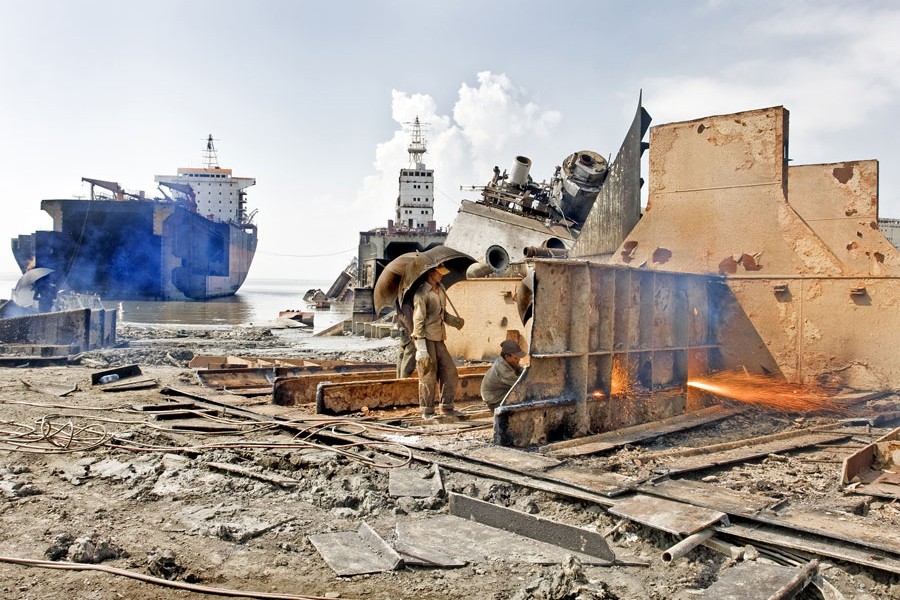
Ship-breaking, long recognised as one of Bangladesh's most promising industrial sectors, is currently navigating a difficult phase. Once hailed as a thriving source of raw materials and employment, the industry now finds itself slowed by regulatory hurdles and tightening global compliance demands. Unless addressed promptly, these challenges threaten to undermine the sector's potential to remain a vital contributor to the country's economy.
The industry's woes are tied closely to international scrutiny. The Norwegian Ship Owners' Association (NSA) has explicitly warned against allowing ships to be recycled in Bangladesh unless it is done in accordance with the Hong Kong International Convention for the Safe and Environmentally Sound Recycling of Ships. The European Union (EU) has taken an even firmer stance: accounting for nearly 20 per cent of global scrap vessel sales, it is moving towards banning the export of scrap ships to Bangladesh and other South Asian countries that are perceived as non-compliant.
These are not vague warnings but action-driven measures aimed at significantly reducing the number of vessels available for dismantling. As a result, the Bangladeshi ship-breaking industry is already feeling the pressure.
Data from the NGO Shipbreaking Platform (NSP) paint a stark picture. In the first half of 2025, imports of end-of-life vessels into Bangladesh dropped by 36 per cent compared to the same period in 2024. Only 57 ships were imported between January and June this year, down from 89 a year earlier. Annual figures also highlight the downward trajectory: Bangladesh dismantled 130 vessels in 2024, compared to 170 in 2023, 122 in 2022, and 254 in 2021.
Industry insiders point to the absence of the mandatory Document of Authorisation to Conduct Ship Recycling (DASR) as a key reason for the slowdown. Without this document, which is central to compliance under the Hong Kong Convention, yards cannot legally import ships.
The Ministry of Industries has recently instructed the Bangladesh Ship Recycling Board (BSRB) to take measures to issue DASR certificates for compliant yards. A notification has already been circulated, emphasising that DASRs will be issued once final approval of the Ship Recycling Facilities Plan (SRFP) is in place.
Bangladesh ratified the Hong Kong Convention in 2023, a significant step forward in aligning with international standards. However, the criteria for issuing DASRs have yet to be finalised, leaving local ship recyclers in limbo. As Kamal Uddin Ahmed, adviser to the Bangladesh Ship Breakers and Recyclers Association (BSBRA), observed: "We're unable to bring in ships because no yard has been issued the required DASR yet. Without it, imports are not permitted under the Hong Kong Convention that Bangladesh has ratified." He added that bureaucratic hurdles, including lengthy delays in securing environmental clearances, have worsened the situation.
Despite these setbacks, ship breaking remains an indispensable part of Bangladesh's industrial fabric. Since its emergence decades ago, the sector has created a mixed legacy-contributing significantly to the economy while raising serious concerns about worker safety and environmental degradation.
The economic upside is substantial. The industry employs around 300,000 workers and indirectly supports a wide range of heavy and light engineering industries. Iron rods and billets recycled from dismantled ships are of particularly high quality and supply nearly 80 per cent of the raw material required by domestic re-rolling mills. This, in turn, feeds the construction sector.
Bangladesh enjoys a unique advantage in ship breaking and recycling because nearly every component of dismantled vessels finds a local market. From steel to spare parts, furniture, and machinery, the industry ensures maximum utilisation of resources. Advanced economies have long abandoned ship breaking due to high labour costs and strict compliance requirements, making Bangladesh, along with a few other South Asian countries, a competitive hub for the industry.
While international criticism often paints the sector as unsafe and environmentally hazardous, there has been notable progress in recent years. Fourteen ship-breaking yards have already achieved "green yard" status, meeting international standards for safe and environmentally sound practices. Another dozen yards are reportedly in the process of upgrading their facilities.
This shift indicates a growing awareness among industry players of the need to align with global benchmarks. However, for this momentum to continue, supportive measures from the government are essential. Timely issuance of DASRs, streamlined clearance processes, and targeted investments in compliance infrastructure could rejuvenate the sector.
The ship-breaking industry sits at a crossroads. On the one side are the immense opportunities-continued employment for hundreds of thousands, self-reliance in steel supply and the chance to establish Bangladesh as a global hub for environmentally sound ship recycling. On the other side are significant threats-declining vessel imports, mounting international restrictions and bureaucratic inertia at home.
The path forward lies in proactive engagement. Bangladesh must ensure full implementation of the Hong Kong Convention, not only to satisfy global partners but also to safeguard its workers and environment. Establishing a transparent and efficient system for issuing DASRs is the first crucial step. Beyond that, greater investment in safety training, waste management, and yard modernisation will be vital.
Ship breaking in Bangladesh is too important a sector to be allowed to falter. The industry has supported the country's steel supply, created vast employment opportunities, and fostered allied industries for decades. But sustaining these benefits requires urgent attention to compliance issues and regulatory bottlenecks.
The choice is clear: either adapt swiftly to global standards or risk losing an industry that has been central to the nation's economic resilience.
wasiahmed.bd@gmail.com
© 2026 - All Rights with The Financial Express

