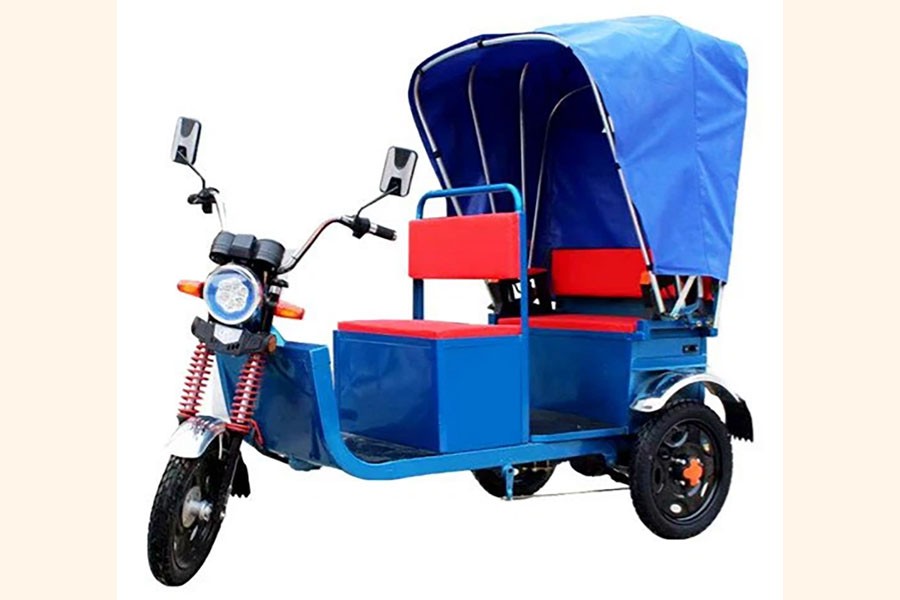
 The ban imposed on the operation of battery-run rickshaws in Gulshan and Banani took effect from Saturday last. This time the inhabitants of the two posh areas took the initiative for keeping the streets and alleys free from the illegal three-wheelers. On their complaint, the Dhaka North City Corporation (DNCC), the Dhaka Metropolitan Police and the Gulshan-Banani Society jointly enforced the ban. But it could not be enforced before the army intervened to disperse the protesting drivers of the battery-driven rickshaws. The inhabitants of the areas rightly pointed out the unregulated operation of such rickshaws posed safety concerns and also caused traffic jams.
During the unruly protests, the clashes that ensued between the drivers of these particular types of three-wheelers on the one side and the locals, pedal rickshaws and ride-sharing motor cyclists on the other clearly indicate how respective interests can be slid on a collision course. The locals certainly vented their genuine grievance against a growing menace on roads and streets. According to the president of the Gulshan-Banani-Badda Auto-rickshaw Easybike Drivers Association, 8,000 such rickshaws used to operate in the area.
The problem of menacing growth of the highly unsafe and trigger-happy three-wheelers is not confined to Gulshan and Banani alone. This mega city with its many other intractable problems has witnessed a booming proliferation of those over the past few months. But it was Nasrul Hamid, a former state minister of power, energy and mineral resources of the deposed Awami League government, who instigated the initial spur to go for conversion of pedal rickshaws into battery-run ones when he eulogised those as 'Bangla's Teslas'. The reference to Elon Musk's electric vehicle is not only inappropriate but can also be considered a joke.
Before Hamid's glowing praise, the handful of battery-operated rickshaws that plied on Dhaka streets tried to maintain a low profile and moved rather surreptitiously. His words acted as a blank licence and more of those rickshaws started hitting the road. Still they were mostly a suburban and locality-specific affair. But all other cities, towns and even villages started competing with each other to opt for conversion of the pedal contraption into electric ones. In cities like Dhaka and Chattogram, their explosive growth took off immediately after the July-August uprising and at one stage, the High Court (HC) ordered immediate removal of the battery-run rickshaws from the capital's streets on November 19 upon a writ petition submitted on October 27. In fact, a prior HC order issued in July 2014 banning all unlicensed mechanised and battery-run rickshaws nationwide was still in force.
It was, however, the government that filed a petition with the Supreme Court's chamber judge seeking a stay on the HC order and the apex court judge set aside the enforcement of the ban on battery-driven three-wheelers for a month. By December last year, that period came to an end. Since then about four months have passed and the issue has remained not only unsettled but confusing. Meanwhile, this particular mode of communication at a short distance has arrived in all shapes and sizes on the Dhaka streets.
Some of those have normal rickshaw wheels, others have stronger rickshaw-van wheels, still others have motor cycle wheels and then another type is fitted with pickup van's or microbuses' wheels and the last type runs on three car wheels. Some of those are colourfully decorated and some others are painted in glossy colours. Yet what has been grossly neglected are the aerodynamics of the vehicles and an effective brake system ---two most important factors for ensuring safety.
The running amok of a battery-run rickshaw into a ditch in Chattogram City recently has sparked a public protest following the death of a girl child, whose body floated about a kilometre away, in the accident. Reckless driving of these three-wheelers on side streets and alleys often gives a nightmarish experience to their passengers, other commuters and pedestrians alike.
If Nasrul Hamid is responsible for inciting 'Bangla's Teslas' to take to the street in an increasing number, this government is no less responsible for its laid-back action on the HC decision. It should have assigned a panel of urban planners and transport experts to determine if the battery-run rickshaws could be allowed to operate in city areas. If allowed, which type and in which designated areas their operation could be limited. Even more importantly, it was urgent to explore how their brake system could be improved to match their speed. Equally important was to fix the number of such three-wheelers.
Now there is a hotchpotch of assorted types, adding to the transport mismanagement and anarchy. True, drivers are spared from arduous labour they have to put in pedalling a rickshaw, particularly in high summer. But the risk to life cannot be ignored. Had a safe brake system been developed, all pedal rickshaws or manually operated three-wheelers with some adjustments to their body features would wisely be converted into battery-powered ones.
This has not happened but the unscientifically designed types are now ruling the roost in urban space. So, the argument that a large number of people now depending on these particular rickshaws deserve considerations is flawed and the excuse must not be advanced to leave the city to be held hostage by these illegal contraptions. Although late, yet these three-wheelers need to be taken off the busy urban streets before they bring the city life to a grinding halt.
nilratanhalder2000@yahoo.com
© 2026 - All Rights with The Financial Express

