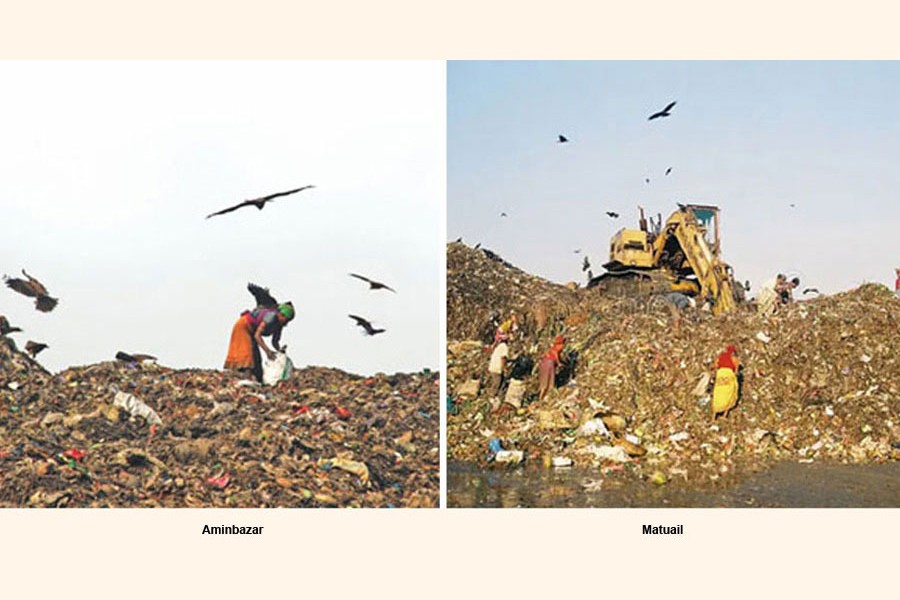
There are cities where garbage is a problem, and then there is Dhaka, where garbage has become a condition of existence. It lines the waterways, chokes the drains after moderate rainfalls and piles high on street corners waiting for collection that never seems to come. Much of it eventually finds its way to two vast dumping grounds on the edges of the capital. One, in Aminbazar, absorbs the waste generated under Dhaka North City Corporation, while the other, Matuail landfill, bears the burden of the South. These are the places where the grim work of waste management reaches its final, forsaken stage. However, if any single site captures just how catastrophic this condition has become, it is Matuail landfill. Originally designated a sanitary landfill, it has since degenerated into a sprawling 181-acre hazard zone, a menace that threatens the very air residents breathe and the water they depend on.
In recent months, methane accumulation beneath the waste at Matuail has caused the landfill to catch fire repeatedly and without warning. Thick plumes of toxic smoke rise from the site and drift across large parts of South Dhaka, seeping into homes, schools and hospitals. The smell of burning plastic and decomposing refuse becomes inescapable for those nearby, and breathing difficulties follow close behind. What makes these episodes particularly alarming is not only their intensity but their reach. The smoke has been known to travel as far as Motijheel, extending its impact well beyond its immediate surroundings.
The scale of waste that arrives at Matuail every day is almost unimaginable in its sheer volume. Between 3,200 and 3,500 tonnes of solid waste are deposited there daily, the combined refuse of over 20 million people living in one of the most densely populated urban agglomerations on earth. Over the past three decades, daily waste generation across the two city corporations has more than doubled to over 7,500 tonnes, but the infrastructure meant to absorb this relentless tide has failed to keep pace. The Matuail landfill was established in 1989 on 50 acres. Its designed capacity was exhausted by 2006. An additional 50 acres were subsequently added and by 2020 even the expanded site had been overwhelmed. Today, the garbage mounds at Matuail rise between 50 and 80 feet in many places, a physical monument to what decades of administrative and political negligence inevitably produce when left unchecked.
Understandably, what transforms a landfill from an eyesore into a public health emergency is its absence of scientific management. In a properly engineered sanitary landfill, waste is compacted and covered with soil at regular intervals, leachate is collected and treated to prevent contamination of groundwater, and gas collection systems capture methane produced by organic decomposition before it can reach dangerous levels. None of these basic standards are being met at Matuail landfill. Waste is dumped without soil covering while budget constraints and staff shortages have become the habitual official excuses.
In 2021, the Canadian greenhouse gas monitoring firm GHGSat (greenhouse gas satellite) estimated methane emissions from the decomposing organic matter at the landfill at around four tonnes per hour, a figure that has almost certainly risen since. This methane accumulates within the waste layers until it ignites. Sometimes this happens through solar heat and spontaneous combustion. Sometimes it happens because workers deliberately set fire to garbage to reduce its volume.
Environmental scientists describe the practice of burning waste at landfills as a crime against public health, and for good reason. The toxic plume rising from burning mixed waste, which in Dhaka's case combines organic material, plastic, polythene, metals and industrial residue all dumped together without any separation, releases dioxins, furans, heavy metals and fine particulate matter that are acutely harmful at any level of sustained exposure. Its consequences are devastating and also quantifiable at a city-wide scale. Dhaka regularly ranks among the most polluted cities in the world, with an average air quality index hovering around 200 and periodic spikes exceeding 600, well within hazardous range. The National Institute of Diseases of the Chest and Hospital, the country's primary respiratory care facility, treated around 195,000 patients last year, with doctors attributing the steady rise directly to worsening air quality.
This is the reality against which the current administration's recent initiatives must be assessed. The administrator of Dhaka South City Corporation has announced a signed agreement with a South Korean private firm to process the daily waste arriving at Matuail and convert it into gas, electricity and fertiliser. At the policy level, the BUET has been brought into discussions on whether the heavy machinery required for waste processing can be developed domestically rather than imported. In a separate move, prime minister Tarique Rahman has paid Eid bonuses to waste management workers from personal funds, a gesture that gave recognition to a long-neglected workforce. These are not trivial steps, and it would be unfair to dismiss them as purely performative. The intent behind them, if followed through with institutional seriousness and sustained political attention, could represent a genuine beginning.
One fundamental, indispensable requirement, however, continues to be ignored, and that is the source segregation of waste at the collection stage. This is the most elementary requirement of any modern waste management system and the one that remains entirely absent from Dhaka's practice. In countries with functional infrastructure, separating organic from inorganic waste at the point of generation is so basic it amounts to a civic habit instilled from childhood. In Dhaka, everything goes into the same bin, the same collection van, the same landfill, producing the methane-rich, fire-prone, leachate-contaminated disaster that Matuail has become. No processing facility, whether Korean-built or domestically engineered with BUET's assistance, can operate at meaningful efficiency on unsegregated mixed waste. The current administration's partnerships and pilot plants will succeed or fail entirely on whether the government is willing to invest in the upstream changes that begin at the household level, with every resident sorting what rots from what does not before it ever reaches a collection van. Without that foundation, the new facilities risks becoming yet another piece of underused infrastructure, another well-intentioned initiative that would never reach their stated purpose.
showaib434@gmail.com
© 2026 - All Rights with The Financial Express

