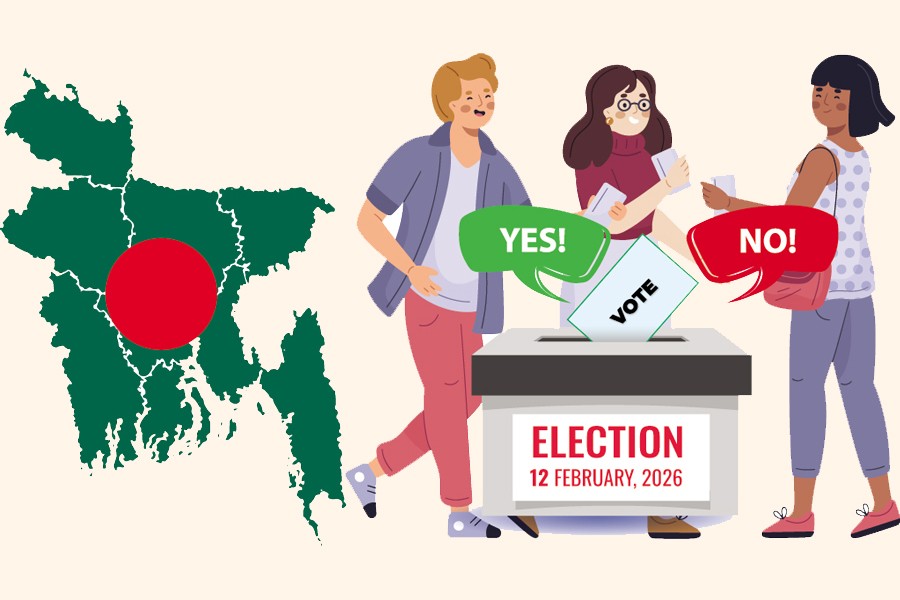
On the same day voters choose their representatives in the upcoming national parliamentary elections, a crucial and arguably more consequential vote on constitutional reforms will also take place. This referendum could well prove to be a turning point for democracy. Yet while the election dominates public attention, the referendum has struggled to find space in everyday political conversation. How many voters are even aware that they will also be asked to decide how power itself should be organised on election day? Only 40 per cent, according to a survey published by the Bangladesh Enterprise Institute barely two weeks before polling day. Awareness may have improved somewhat since then and the percentage may slightly rise, but the fact remains that a large share of the electorate is disconnected from or unclear about the stakes involved.
Aware of it or not, the voters on February 12 will decide the fate of 48 constitutional amendments derived from the July National Charter. That charter emerged from months of deliberation by the National Consensus Commission, which consulted more than two dozen political parties and eventually converged on 84 reform recommendations. Nearly half of these require constitutional changes. Consequently, the ballot will present a simple yes or no verdict on a package of reforms grouped under four broad points.
In the final days of its term, the outgoing interim government has engaged in limited campaigning to secure a "yes" vote, seeking public endorsement for the reforms. The Election Commission, however, has maintained that government officials must remain neutral and cannot take sides in the referendum, arguing that campaigning even for reform constitutes partisanship. Whatever the legal interpretations, the practical implications are plain enough. A yes verdict would authorise the next parliament to serve, for its first 180 working days, as both legislature and constitutional reform council, thus clearing the path for an overhaul of the nation's power structure.
So why exactly is this referendum necessary at this moment? The country's political experience over the decades provides the context. Governments in Bangladesh have repeatedly come to power through elections described as democratic, sometimes credibly and sometimes less so, only to centralise authority once in office. Pre-election promises have often given way to intolerance, concentration of power, double standards and institutional decay. This cycle has played out since independence with remarkable consistency, creating what many citizens view as a broken political system.
The July uprising marked a forceful rejection of that flawed system. It left a deep imprint on public consciousness and generated a mandate that demanded more than a mere change of rulers. To prevent a return to the "winner-takes-all" model, the proposed reforms aim to hardwire checks and balances into the structure of the state. If implemented, they would fundamentally recalibrate Bangladesh's power dynamics. The Prime Minister's authority would be curtailed while presidential powers would expand in specific domains. The reforms would also block arbitrary constitutional amendments aimed at extending executive power and institutionalise a caretaker government system for future elections, among other things.
Holding a referendum to restructure a constitution is fundamentally an act of popular sovereignty. It exercises the constituent power of the people to shape their political order. Across different historical settings, moments of profound political change have drawn their legitimacy from such direct public consent, as seen in South Africa's post-apartheid constitutional negotiations, for example. Yet referendums are also inherently uncertain instruments. They compress complex and often technical questions into simple binary choices, and their outcomes often yield unforeseen consequences, as the Brexit referendum decisively demonstrated.
In Bangladesh, this referendum has come to embody a contest between the momentum for reform and the pull of preserving the existing framework. A yes vote is increasingly positioned as support for the proposed changes, while a no vote aligns with maintaining continuity. Political scientists often describe such episodes as foundational political moments when the basic rules of the system are open to reconsideration. In practice, however, major political parties frequently adopt a strategy of constructive ambiguity during transitions, avoiding firm commitments in order to keep their future options open. This tendency usually works to the advantage of the no camp which benefits from uncertainty and inertia. A yes victory, of course, offers no automatic guarantee of meaningful reform. But without reform, the old pathologies are almost certain to persist.
In the lead-up to the referendum, NCP and Jamaat-e-Islami have been campaigning for yes vote while the Jatiya Party has positioned itself as the opposition. The greatest attention, however, has focused on the BNP. Given its central role in the July uprising, many expected the party to declare early and unequivocal support for reform. Its initial hesitation therefore triggered speculation that, as a leading electoral contender, it was wary of endorsing changes that might constrain the executive authority it hopes to exercise if it returns to power. Critics interpreted this caution as a retreat from the spirit of the uprising and a slide back into old political games. Whether driven by public pressure or other considerations, the party eventually shifted its stance. Tarique Rahman, whom TIME magazine has described as the clear frontrunner in the upcoming polls, ultimately endorsed the yes vote. This is definitely a step forward. But a handful of statements alone cannot make the party's position credible. To convincingly demonstrate a commitment to a New Bangladesh, the BNP must ensure its candidates undertake a sustained and visible campaign for reform until the end of the campaign period.
The truth is that no political party in Bangladesh has a record so clean that voters would trust it blindly. If their future actions simply repeat past behaviour, the promise of July will dissolve into disappointment. That is why parties seeking office must do more than gesture towards reform. They must convince voters that change will hold them accountable as well. Bangladesh today is not what it was. Even in suffering, the public is no longer passively silent and there is little reason to believe it will meekly welcome a return to old politics. The people have sacrificed too much to tolerate business as usual. Any party that fails to understand this should be prepared for the electorate to say no to them at the polls.
showaib434@gmail.com
© 2026 - All Rights with The Financial Express

