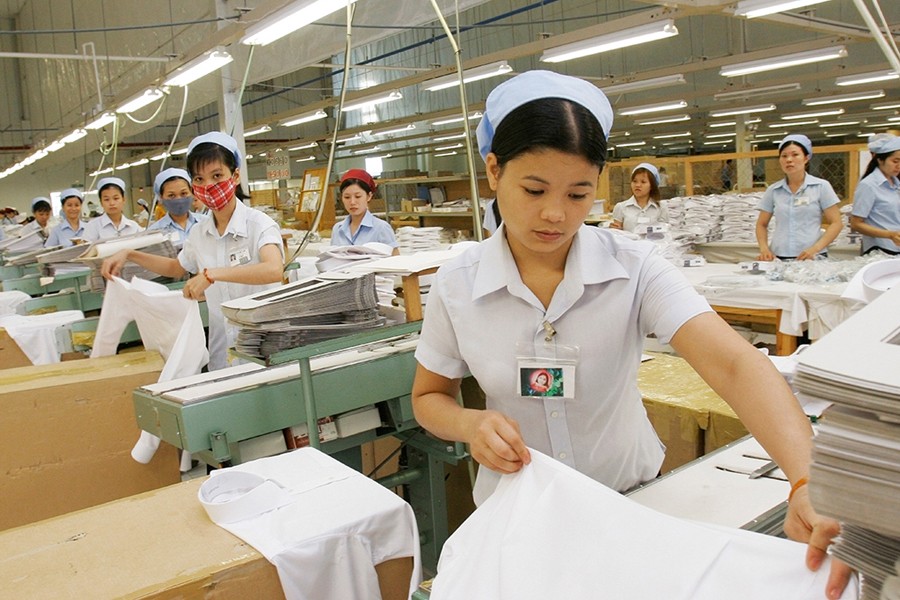
Bangladesh and Vietnam are often presented as close rivals in the global apparel industry, with export figures suggesting a neck-and-neck race for a larger share of global apparel market. In 2024, Bangladesh exported garments worth USD 38.48 billion, accounting for 6.9 per cent of the global market, closely followed by Vietnam's USD 33.94 billion with a 6.1 per cent share. Meanwhile, China remains dominant, commanding 29.6 per cent of global apparel exports, while India and Turkey trail with less than 3-4 per cent each.
On the surface, Bangladesh is slightly ahead of Vietnam. However, focusing only on headline numbers obscures a deeper reality: the two countries are competing under different trade frameworks. Vietnam is exporting from a position of strategic security, while Bangladesh remains heavily dependent on time-bound trade privileges that are nearing expiry date.
This contrast is most visible when export destinations are examined. Vietnam has built a dominant position in the United States, exporting USD 14.98 billion worth of apparel there in 2024, almost twice Bangladesh's USD 7.34 billion. Bangladesh, in contrast, relies overwhelmingly on the European Union, where it exported USD 19.77 billion, compared to Vietnam's USD 4.31 billion. This dependence has served Bangladesh well so far, largely because of duty-free access under the EU's Everything But Arms (EBA) scheme for least developed countries. But that advantage is temporary. Vietnam's access, by contrast, is contractual and permanent, secured through the EU-Vietnam Free Trade Agreement (EVFTA).
The EVFTA is steadily reshaping competitive dynamics inside the EU market. Tariffs on many Vietnamese apparel products have already been eliminated, while others are on a clear path to full liberalisation by 2027. As a result, trade patterns are beginning to shift. In product categories where tariffs were removed immediately or within four years, EU imports from Vietnam have grown faster than those from Bangladesh. More importantly, the most commercially significant apparel items such as cotton T-shirts, denim trousers, and knitt garments fall under tariff slabs that will soon be fully liberalised for Vietnam. Early signs suggest that Bangladesh's growth in these categories is slowing, while Vietnam is accelerating.
Beyond tariffs, the two countries differ sharply in product composition. Vietnam's apparel exports to the EU are overwhelmingly non-cotton based, accounting for more than three-quarters of its shipments. Bangladesh, by contrast, remains heavily concentrated in cotton garments, with non-cotton items making up less than one-third of exports. Although Bangladesh has made progress in recent years, Vietnam's head start is reinforced by deeper investments in synthetic textiles, stronger backward linkages and greater use of renewable energy, factors that are being increasingly valued in the EU market.
This structural gap becomes more problematic when rules of origin are considered. Future EU trade preferences, particularly under GSP Plus, require compliance with double transformation rules of origin. Bangladesh's dependence on imported woven and manmade fibre fabrics puts it at a disadvantage, while Vietnam's domestic textile base allows it to meet these requirements more easily. So, without accelerating investment in fabric manufacturing, Bangladesh risks losing competitiveness even if some preferential access is retained.
Vietnam's faster growth and higher-value product mix also pose a real challenge. In the EU, 100 kg of T-shirts from Vietnam earned $2,158, nearly double the $1,092 fetched by Bangladeshi equivalents. This reflects Vietnam's strength in value-added, synthetic and technical garments, in contrast to Bangladesh's dominance in cotton basics. Approximately 73 per cent of Bangladesh's export value comes from cotton garments, even though the global apparel market is increasingly shifting towards synthetics and multifunctional apparel. Bangladesh's advantage lies in scale, cost-efficiency and production reliability.
Policy risks are also looming large. The EU is set to review its Generalised Scheme of Preferences, with changes expected to take effect in 2028. Bangladesh has already exceeded safeguard thresholds that allow the EU to suspend preferences when import concentration becomes excessive. Its share of EU apparel imports under GSP far surpasses the established limits, creating a significant obstacle to securing GSP Plus status. When EBA benefits finally expire in November 2029, Bangladesh could face standard tariffs of around 12 per cent, while Vietnam will continue exporting duty-free under the EVFTA.
This looming asymmetry underscores a critical point: Vietnam is not merely competing on price or productivity; it is competing on certainty. Its extensive network of free trade agreements including the CPTPP, RCEP, ASEAN FTAs and agreements with Eurasian markets has sealed in access across major regions. Bangladesh, by contrast, is still navigating graduation-related adjustments without a comparable web of long-term trade arrangements.
The next five years, therefore, represent a decisive window. For policymakers, securing sustained access to the EU must be treated as an economic priority, whether through GSP Plus eligibility, a bilateral trade agreement, or an extended transition arrangement. At the same time, trade diplomacy must be matched by domestic reform, particularly in building backward linkages in woven and manmade fibre textiles, improving energy efficiency and aligning with emerging sustainability and traceability standards.
For entrepreneurs and manufacturers, the challenge is equally urgent. The future will reward those who diversify products, invest in technology and integrate more deeply into global value chains. Bangladesh's apparel sector has demonstrated resilience time and again, but resilience alone will not offset structural disadvantages in market access. Bangladesh must deepen its global integration, adopt high-value production, and differentiate itself through innovation and sustainability. The focus must shift from just scale to sophistication.
Vietnam's trade strategy offers a clear lesson: long-term competitiveness in today's global trading system is shaped as much by policy foresight as by factory efficiency. If Bangladesh can combine its proven manufacturing strength with proactive trade strategy and industrial upgrading, it can move from vulnerability to stability, and secure a strong foothold in global apparel trade.
aktuhin.fexpress@gmail.com
© 2026 - All Rights with The Financial Express

