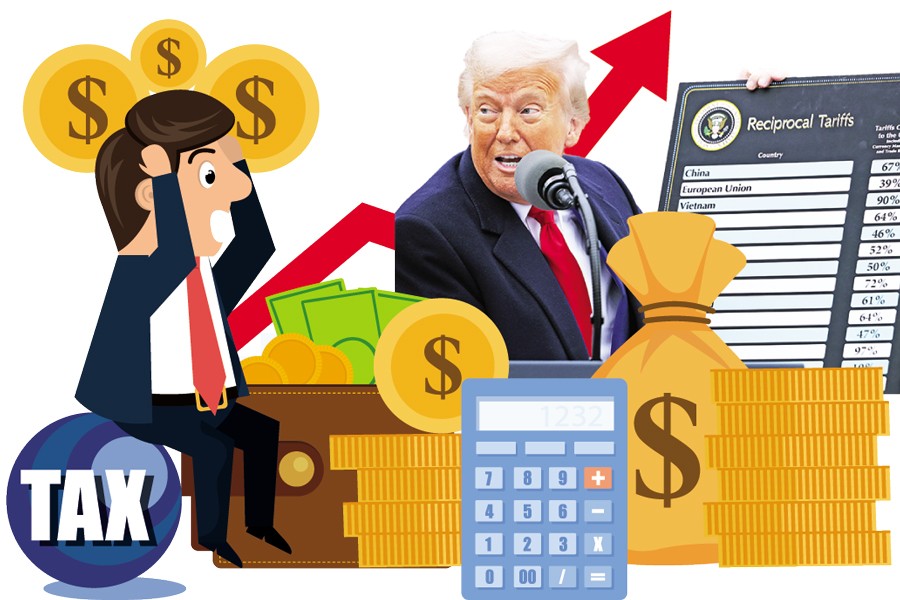
In his State of the Union address, President Donald Trump of America presented an update of the United States, highlighting his successes in the first year of his second term. But amid the rising tension over the conflict between the USA and Iran, he stopped short of mentioning the exact time for a possible attack on Iran. True, his 'America first policy' has earned him popularity at home but still the number of disgruntled people is growing. According to a survey conducted between January 27 and 30, the majority of US adults consider that their president is taking the country in the wrong direction. As high as 55 per cent adults think the change brought about by Trump is for the worse. This marks a 13-point increase from around the same time during his first presidency.
The State of the Union speech is made before the joint session of the United States Congress and support or opposition to the speech follows down the party line. Ninety per cent Democrats hold the view that the country is worse off than a year ago and 82 per cent Republicans consider the situation has improved. But a similar research in March 2025 found that 43 per cent of respondents expressed their confidence in the democratic system where there are checks and balance with the distribution of power among the president, Congress and the court. That percentage has dropped to 32 per cent after almost a year.
A Pew Research Center survey conducted in January this year finds that Trump's exercise of executive power was not popular. Only 27 per cent Americans endorsed all or most of his policies and plans. Even his agendas have fewer supporters among the Republicans, 75 per cent of whom thought he had enough mental fitness to do his job but after a year the percentage has dropped to 66 per cent. Trump won the 2024 national election with a plurality of 49.8 per cent. Roughly half of the votes cast or by extension half of American adults' verdict went in his favour. Assuming that the Republican voters and the swing voters endorsed his presidential credential, about half of the 173.85 million registered voters voted for him. Intriguingly, not all voting-age population registered to become voters; only 73.6 per cent of them registered and of them 65.30 per cent cast their votes.
Yet the percentage of American voters approving Trump as their president is quite high. That is an awful lot of people looking up to him as their deliverer. This means that his popularity base was broad and strong. Now his rating and approval may experience slight erosion but the development is far from alarming. His triumph in the 2024 election, therefore, proves the adage that people get the government they deserve. Sure enough, there are dissenting voices opposed to the presidential exercise of power beyond limit. At the State of the Union address, the Supreme Court judges are invited by custom and Tuesday's event was no exception to this rule. But only four of them including the chief justice and another who was an appointee by Trump but ruled against the president's reciprocal tariff attended the event. Trump reined in his lambasting of the judges but was still moderately critical of the SC ruling and briefly gave a confrontational look at his appointee.
The message is clear that more Americans than their domestic opponents now want to see that American interests are better protected by aggressive Trump policies even if the global order of business and relations are rendered topsy-turvy. Then are the surveys conducted by various independent agencies including the CNN and the Pew Research Center giving an indication of a change in public minds, the independent among them to be precise? The CNN poll conducted by SQL Server Reporting Services (SSRS), a Microsoft server-based platform, finds that only 32 per cent of Americans consider Trump has had the right priorities and 68 per cent reckon he has not paid enough attention to the country's most pressing problems. Such expression of no-confidence in Trump's governance is contrary to his election rating. What is remarkable is that not all such surveys can give a wrong indication.
Well, there is nothing wrong with the American interests proving an overriding concern for the president and the people of that country. But when it clashes with those of the rest of the world throwing all cautions in to the wind, the limit has to be wisely set. After the reversal Trump's reciprocal tariff met at the Supreme Court, he immediately found an alternative route to impose a 15 per cent tariff on all goods entering America. His invocation of the Section 122 of the Trade Act, 1974, allows him to impose up to 15 per cent for 150 days at the maximum. Its continuation depends on Congressional approval. Most importantly, this legal provision can be used only to address a "fundamental international payment problem". Here the issue is no such problem and therefore, like his International Emergency Economic Powers Act (IEEPA), is likely to prove illegal in court.
Whatever happens to the law, validating or invalidating the imposition of 15 or 10 per cent duty, its realisation makes it a complicated problem. FedEx has already sued US government for refund of money the logistics giant paid for tariffs Trump imposed under the IEEPA. If Section 122 is struck down by the SC, there will be double trouble for both the US government and the importing companies there. By this time, however, the damage global trade suffers will be incalculable. There is every possibility that Trump will have to pay a heavy price personally and as the leader of the Republicans in the forthcoming mid-term Congressional election.
nilratanhalder2000@yahoo.com
© 2026 - All Rights with The Financial Express

