At a time when job opportunities for educated youths are hard to come by, the government is going to launch a one-stop service for young entrepreneurs soon. To complement this initiative, career centres will be set up at universities to develop their skills. This was revealed by Professor Abdul Awal, Principal Coordinator for Sustainable Development Goals (SDGs) affairs at the prime minister's office while speaking at a seminar titled "Young Leaders, Sustainable Futures: Advancing the SDGs Together" held at the auditorium of the Bangladesh Institute of International and Strategic Studies (BIISS). Organised by the BIISS and the United Nations Office for Project Services (UNOPS), the seminar brought together a bevy of policymakers, development practitioners, academics, youth leaders, civil society representatives and development partners.
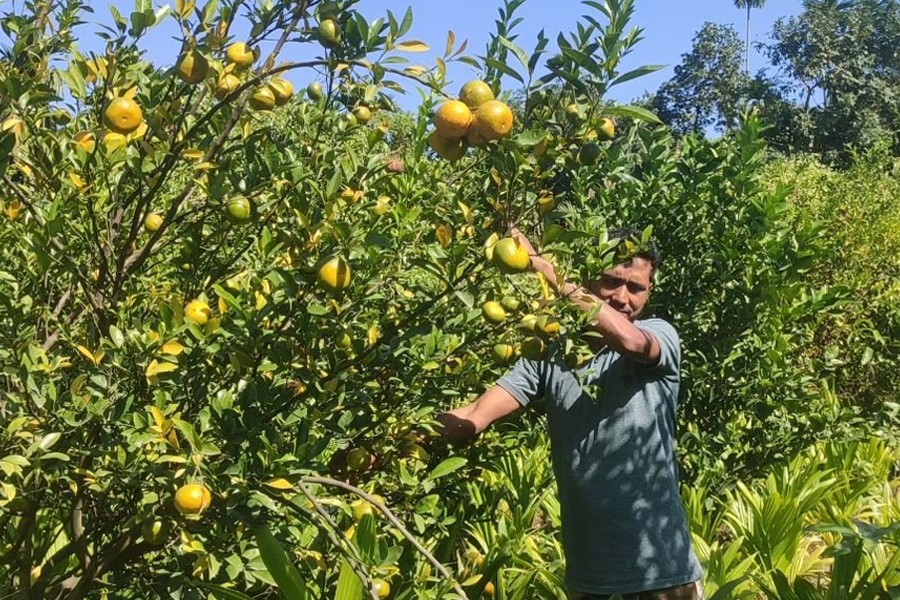
Dire necessity has already compelled some enterprising educated youths to take up ventures unthinkable in the past. From exotic agriculture to cattle farms, their success stories speak for themselves. They have pushed the frontiers of agriculture and livestock to a new horizon. What is most appreciable is that the introduction of advanced farming has inspired farmers to follow their models. They do not look for employment, instead they create jobs for others. Of course, they had to proceed and learn their trades through trials and errors. In rare cases, a few of them failed to develop their enterprises.
Now that the government is going to extend fund support alongside honing their skills at the career centres to be established at universities, entrepreneurial failure is expected to decline fast. In this context the provision of credit facility of Tk 1.0 million obtainable from the Bangladesh Bank without collateral at low interest may be of help. In a question-answer session at parliament, the finance minister, in his response to a query from a member of parliament, makes it clear that currently there is no scheme for any credit without interests for young entrepreneurs, aimed at addressing unemployment. But the soft loan at easy terms has been increased from 1.0 billion to Tk5.0 billion. Under this scheme, young entrepreneurs can receive Tk1.0 million and Tk3.5 million at 7.0 per cent interests without collateral and with collateral respectively. Startup entrepreneurs get the facility at only 4.0 per cent interest. Besides, free training is provided along with an allowance of Tk5,000. Creative contents should get similar treatments.
Clearly, the two initiatives are different but their objectives are same. The on-going BB-financed entrepreneurial ventures are, however, not widely published. But it has its merit because micro small and medium enterprises (MSMEs) can benefit from funds received from this source. If managed well, the small investment of money in this productive sector can prove highly beneficial for a take-off of enterprises in this sector.
Now the question is, how the one-stop service will help the cause of young entrepreneurship. Will it be a separate venture under the ministry concerned or get integrated with the existing BB-financed programmes? If operated separately, there is a chance of overlapping the credit schemes and the mission and vision of such schemes may get jumbled. Better it would be to get the existing one and the proposed schemes integrated together for a comprehensive coverage of the maximum number of youth-led enterprises.
In this context, in favour of the BB-initiated startup sector, with participation of 39 scheduled commercial banks, an equity investment company called "Bangladesh Startup Investment Company (BSIC) PLC" has been constituted. So, the ground works have already been done. If the one-stop service is introduced to expedite the process of credit disbursement and training for young entrepreneurs, the execution of programmes will gather the momentum needed. Although the details of schemes and programmes under the one-stop service are yet to be available, there is no doubt that it is an initiative to fast-track the process of young entrepreneurship. Let a coordinated approach to this issue be made.
No doubt career development is important but setting up career centres at universities alone cannot accomplish this challenging task. The existing mismatch between education and employment in industrial and business sectors poses to be the greatest stumbling block on the way to absorption of the roughly 2.0 million job-seekers entering the labour market annually with university graduates accounting for 700,000 of the new entrants. Job creation here is outpaced by the influx of legions of such new entrants.
So, mere career centres at universities cannot address this problem nor can development of entrepreneurship provide for all the new entrants. There is a need for reforming education and in certain cases fine-tuning the existing curricula in favour of technical and technological syllabuses. Right now more unskilled migrant workers than the skilled leave the country with or without jobs abroad. If the entire workforce was even semi-skilled with vocational certificates, they would have earned higher wages.
Without reforming the education system at the secondary and higher secondary levels, the career path will remain murky. The higher education too has to undergo closer review in order to make it relevant to the job market. The process should begin at the secondary level preferably from class IX when student grades will determine if the learners will pursue higher studies or technical and vocational education. The brilliant crops of learners would qualify for higher studies whereas the mediocre will be guided to acquire appropriate technical or vocational education along with skill training. That will allow them to get jobs both at home and abroad. Without such a comprehensive plan, the problem of unemployment cannot be addressed.
nilratanhalder2000@yahoo.com
© 2026 - All Rights with The Financial Express

