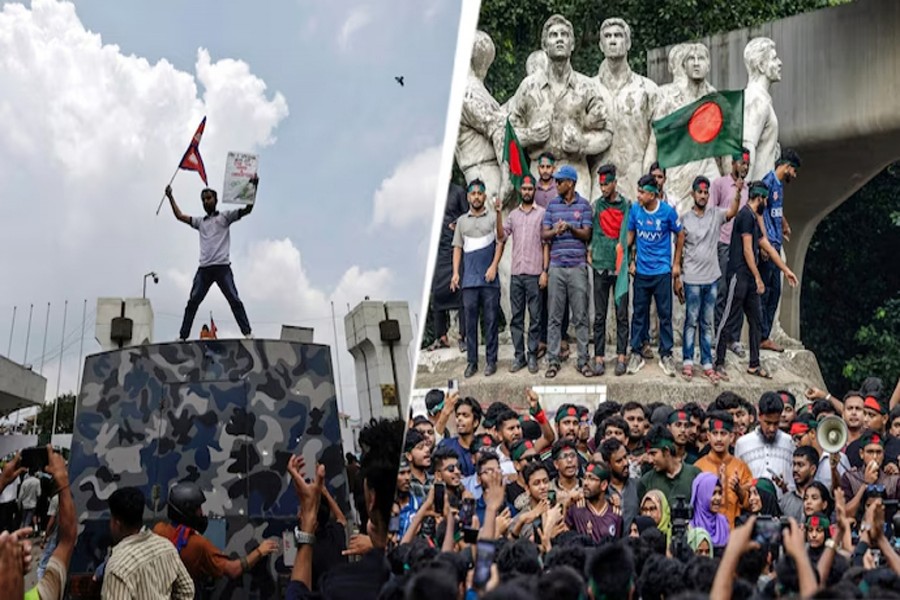
 In both Bangladesh (L) and Nepal (R), the uprisings were not led by established political parties, but by youth platforms - raw, spontaneous, and tech-driven.
 The Himalayan nation of Nepal is returning to relative normality after days of violent protests spearheaded by the Nepali youth, more particularly the Gen Z generation. It all started with a government's decision to ban 26 popular social media platforms on September 4. This triggered widespread street protests by Nepal's youths who were already irate over rising youth unemployment on the one hand and shameless display of pomp and power by the children of corrupt politicians and government bureaucrats (the so-called Nepo-kids) amid rampant corruption in the government offices. Within hours of the start of the violence on Monday last week it turned bloody as the government forces used every means at their disposal to quell the violent unrest. At a stage, they fired live ammunitions into the crowd of protesters leading to many deaths. So far, (till Saturday, September 13), 51 deaths and over 1,500 injuries have been reported.
The outraged protesters set fire to politicians' as well as ministers' residences, the parliament building, the supreme court building, headquarters of Nepal's Congress Party and the home of the former prime minister Sher Bahadur Deuba. Before the situation going beyond control, the Nepali armed forces intervened and called upon the protesters to engage in a dialogue to end the violence. Meanwhile, Nepal's prime minister KP Sharma Oli and his ministers resigned last Tuesday amid criticisms from home and abroad over the deaths of protesters.
Later, in line with the protesters' demand, former Chief Justice of Nepal, Shushila Karki, has been sworn in as the country's prime minister of the interim government. Immediately after assuming office, Prime Minister Shushila Kaarki recommended dissolution of the House of Representatives. President Ramchandra Paudel approved of the move. He has also appealed to all political parties and citizens of the country for calm so the House of Representatives election could be held on March 5 next year.
Do not the series of events that culminated in the change in the Nepal's government have a sense of déjà vu? Similar student unrests in July 2024 led to the collapse of the more than one and a half decades of old autocratic rule in Bangladesh, ouster of its prime minister Sheikh Hasina, who fled to India. In Bangladesh's case, too, the armed forces finally took the role of mediator to end the crisis that led to the formation of the interim government with Nobel Laureate Dr Muhammad Yunus at its head as Chief Adviser. In the bloody street protests that preceded the political changeover, more than 1,400 people died and nearly 15,000 were injured. However, the figures of death and injury may be still higher. Obviously, the street protesters of Bangladesh paid a heavier price than Nepal's in terms of the number of lives lost and the thousands of those who lost their vital organs like eyes, legs and hands.
How would political analysts describe these recent events involving Gen Z outrage in Bangladesh, Nepal and Indonesia? Clearly, in cases of Bangladesh and Nepal, the youths were disillusioned with the existing political order, and the disconnect between it (the political order) and the common people. In the case of Nepal, political unrests, like in Bangladesh, leading to mass uprisings are not new. The country's first uprising took place in 1990, which was called 'Jana Andolan'. The second such Jana Andolan happened in 2006 with the aim to overhaul the country's political system through reforms. Political stability has been the first casualty of the reform movements. The country meanwhile witnessed 14 governments in the last 15 years.
But no significant reforms or changes in the behaviour of the political class and bureaucracy which run the governments are evident.
Hence is this latest outburst of Nepali youths or its Gen Z.
What next?
In fact, these youths of digital era can quickly organize themselves through the various social media networks. In the case of Nepal, the protesters used Discord, an online gaming platform to organize and choose their new prime minister Sushila Karki on September 12. The most prominent was a server on Discord termed, 'Youth Against Corruption'. At its peak the server reportedly drew more than 130,000 members. According to another report referring to the South China Morning Post, more than 7,714 ballots were cast in the final round on September 10 with Sushila Karki winning over 50 per cent votes. The next steps of her meeting the President, the Army Chief, General Ashok Raj Sigdel, ahead of her official appointment as the country's first female prime ministers followed.
One can see similar developments in Bangladesh following the July 2024 upsurge which started with protests against the discriminatory quota system in government jobs. As the police and members of the security force began to use disproportionate force to crush the movement, the students' movement turned into one of doing away with discrimination in society and finally the resignation of the prime minister.
In all the cases, the movements are spontaneous with no definite structure of leadership. As a result, at the end of the successful street struggles, the movement leaders again approach the same old political establishment for reforming the existing political order! Formation of an interim government and holding of a parliamentary election after some months is too familiar a formula for a change after all the blood spilled over the days or weeks in the case of Bangladesh. Obviously, these stop gap measures cannot bring any meaningful change in governance. The deeply entrenched interests still maintain a firm grip on the different organs of the political establishment. These youth or student movements are basically without clear-cut goals. These are unlike the October Revolution of 1917 in Russia that overthrew the centuries old monarchy, or the Chinese revolution of 1949 that said a goodbye to the old China ruled by feudal lords. Small wonder that those revolutions brought about radical changes in governance and society or in short, political order. However, the French Revolution that started in 1789 and continued till 1794 was spontaneous and very bloody. So, lacking well-defined leadership and political agenda to begin with, it is not hard to foresee what awaits in the long run.
However, the Bangladesh case is somewhat different in that the students' street struggles could bring down a very powerful government with suspected foreign backing.
So, the people's expectations from the youths that led the struggle is no doubt higher.
sfalim.ds@gmail.com
© 2026 - All Rights with The Financial Express

