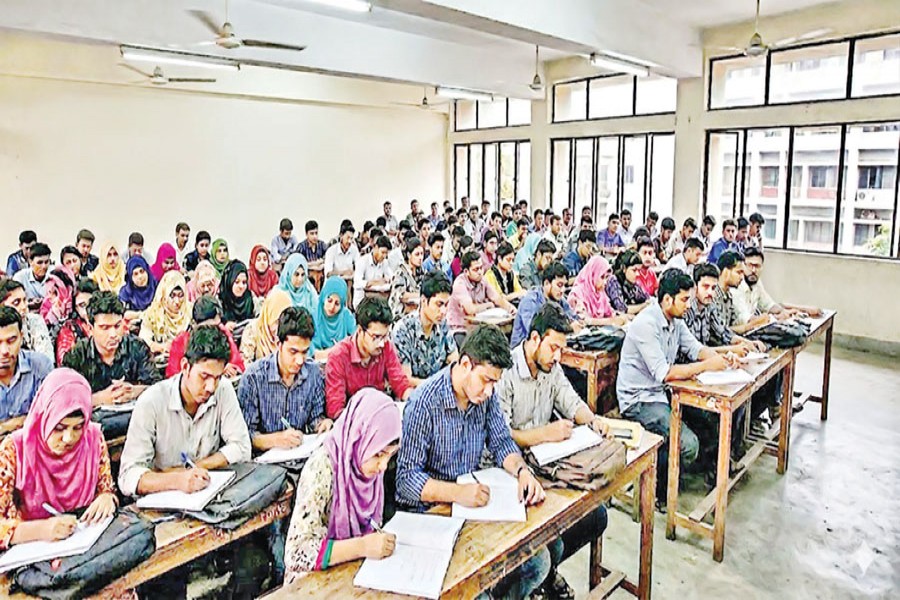
 -AI-generated photo
 The education crisis in Bangladesh cannot be defined only as a resource crisis, but also as a governance crisis. Money is budgeted and is not utilised. Reforms are announced but arrive without training or support. Until reforms are implemented, there will be a disparity between the hopes of policy and classroom reality. Recent policy pronouncements, nonetheless, still underline the government's aim to spend on education up to 5.0 per cent of GDP (gross domestic product), and there is a variety of initiatives to implement, starting with an increase in technical education and the encouragement of computerised classrooms and student support programmes. Nonetheless, fiscal reality does not indicate much of a substantive change. The amount of funds spent by the government on education is less than 2.0 per cent of GDP, with the budget actually dropping to 1.7 to 1.8 per cent over the last few years. Even with the growth in allocations in nominal terms, the percentage as compared to the economy as a whole has not been rising much. This is holding Bangladesh at a very below several regional counterparts to the established international target. The mismatch of the growing policy aspirations and limited financial investment is symptomatic of a persistent disconnect between the proclaimed concerns and the budgetary focus.
It is not just that the education budget is minor, but that it is not coherent. Themes highlighted in each yearly budget speech include digital transformation, skills creation, and keeping up with the fast-evolving world economy. Nevertheless, such priorities seldom have any well-defined, long-term roadmap. The allocation processes are usually incremental and reactive, but not strategic, and even within the education sector, it is fragmented among various administrative units, which in turn are most likely operating in isolation. There is a lack of integration in planning as well as execution in the education systems. This causes the investments made in one level not necessarily to be reinforced in another, creating ineffectiveness and a lack of high impact overall.
Another problem that arises, even on a restrictive budget, is a matter of poor implementation. This has resulted in several years of unused portions of allocated funds since most of this money is stagnant because of bureaucratic hold-ups, procurement inefficiencies, and a lack of institutional capacity. There is poor preparation in projects, and they are approved, and the execution is slow, resulting in cost overruns. There are cases where the funds are diverted to the administration instead of improving the quality, such as training of the teachers or development and improvement of the curriculum. This generates a paradox according to which the system seems to grow on paper, but does not bring any great improvements in the classroom. Reforms were implemented with a lack of training on its side, a lack of effective monitoring systems, and a lack of long-term financial commitments. The experience indicates that it is unlikely that reform will achieve lasting change unless it is based upon a strong fiscal and administrative base. The comparison of the countries shows what is lacking. Countries that have managed to bolster their education systems have not done it through increasing the amount of money spent, but also by putting spending in relation to strategic objectives. States such as South Korea and Finland allocated much of their funds to the development of teachers so that they were well trained, well paid, and professionally mentored. They designed coherent curricula, which related education to wider economic and social goals, and they also created powerful accountability mechanisms to measure the progress and alter policies to meet the requirements.
The examples used portray a key aspect of education policy theory that effective public expenditure would rely on its magnitude and form. The human capital theory is based on the fact that long-term economic growth, productivity, and innovation need human capital investment in education. Simultaneously, the idea of efficiency in allocation and implementation is emphasised in the context of the theory of public finance. On both ends, the education sector in Bangladesh is limited. The scarcity of resources hinders the potential of a system to grow and develop, and inefficiency in resource expenditure diminishes the effects of resources at its disposal. The combination has formed a structural bottleneck that may cripple the development path of the country.
To tackle these difficulties, a change in approach is needed. Marginal cost increases, though needed, are intensive. The desired is a detailed roadmap which connects financial promises with specific, quantifiable results. A roadmap like this would entail the identification of medium and long-term goals in education expenditure, with a gradual growth towards internationally suggested values. It would also need a change of priorities with increasing attention to quality-enhancing investments like teacher training, curriculum design, and a learning assessment system. Even more infrastructure cannot help in raising the standards of education unless there are competent teachers and strategies to teach the students.
Emphasis on better execution rates on budgets should be encouraged, and this may entail streamlining the processes of administration, capacity building in institutions, and accountability at all levels of the system enhancement. Decentralisation of some provisions of financial management may enable the local authorities to act faster in responding to certain needs, as long as they have appropriate checks and balances.
The other important aspect is the fit between education and the labour market. With the aim of Bangladesh making a transition to a more knowledge-based economy, the education system has to prepare the students with appropriate skills. This will necessitate more coordination between the policymakers, schools, and the industry players. The gap between education and employment can be addressed by expanding technical and vocational education, modernising education curricula to meet market needs, and combining practical training opportunities into curricula. In the absence of such alignment, the system runs the risk of giving graduates who are qualified academically but not economically prepared.
Education as a second priority, reforms without proper support, and concentrating on short-term benefits and not on permanent results have given rise to the latest scenario. To prevent such errors, there will be a long-term requirement to stay strategic and policy-focused. Reform of education should be regarded as a long-term investment that is not and will not be short-lived.
Finally, the problem of education budgeting is not simply technical, but it represents national priorities. Bangladesh has recorded significant improvement in its economic growth and social development. To maintain the improvements, the quality of its human capital will hinge on its vigour. The modern global economy is competitive and requires a knowledge-based economy to remain competitive, and this can be achieved through a well-endowed and efficiently run education system. Lack of it makes the country susceptible to stuttering in its growth and can pose problems related to a lack of skills and innovation ability.
The situation that prevails in the Bangladesh classrooms did not come up in a vacuum. They represent an aggregate product of political decisions that have never lived up to the promises affixed to them. The crowded classroom, the unused curriculum guide, and the anxious parents are inescapable. They are the consequences of the same structural deficits: a lack of a funded, coherent, long-term plan. Leaving rhetoric behind and going to the roadmap is not a choice. The conditions that make true progress possible must be in place.
imifan563@gmail.com
© 2026 - All Rights with The Financial Express

