It starts with a WhatsApp message from someone you trust - a cousin, a former classmate, a respected figure from the masjid. “Brother, this is fully halal. No riba. The returns are 20 per cent a month. I have already got my first payout.” You do the maths. Twenty per cent a month is 240 per cent a year. Your savings account offers four. You invest.
Months later, the payments slow. Then stop. The group goes quiet. The founder's number is switched off. You have lost money you could not afford to lose and you are far from alone.
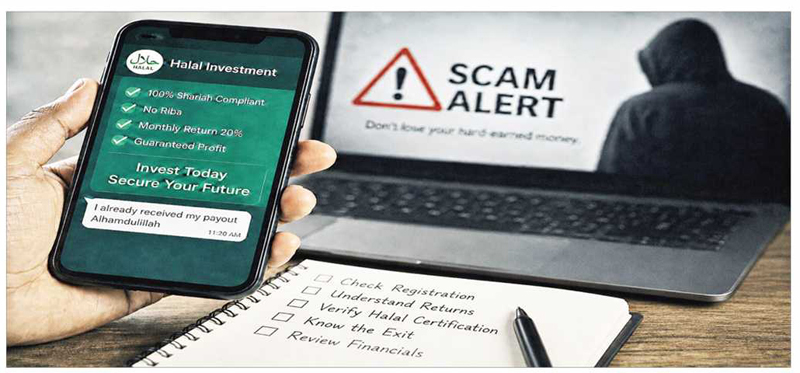
A perfect storm is building in Bangladesh. The country now has over 1,000 active startups, a young population hungry for alternatives to conventional banking, and a mobile money infrastructure - bKash, Nagad, Rocket - that makes transferring funds faster and easier than ever. Fraudsters have noticed and they have wrapped their schemes in the most powerful marketing language available to them: the promise of halal returns.
This is not a warning against investing. Bangladesh's startup ecosystem is real and growing, having raised nearly one billion US dollars over the past decade. But between genuine opportunity and predatory scheme lies a gap that most young investors do not know how to navigate.
WHY BANGLADESH IS ESPECIALLY VULNERABLE: Several features of Bangladeshi society converge to raise risk for small investors. Deep Facebook and WhatsApp penetration means a scheme can reach millions within days - through networks that carry implicit trust. A majority-Muslim population with a legitimate appetite for Shariah-compliant finance creates a demand that fraudsters exploit ruthlessly. And dedicated crowdfunding regulation - the rules governing who can raise money from the public online and under what conditions - remains largely undeveloped.
This is not unique to Bangladesh. In the UK in late 2024, a platform called Muslim Pioneer was accused of operating a Ponzi scheme, its founder reportedly acknowledging debts of five to ten million pounds. The Islamic scholar Dr Zakir Naik publicly stated the platform had used his image without permission, noting that such companies 'are mostly frauds'. In the United States, the SEC charged the founder of Halal Capital in 2022 with defrauding Muslim investors of over eight million dollars. These are not isolated cases - they are a global pattern that Bangladesh is actively replicating.
THINGS TO UNDERSTAND BEFORE YOU INVEST: Any one should have a clear understanding before investing in a startup.
Guaranteed high returns are the clearest red flag of all: Bangladesh's best fixed deposit rates sit around nine to 11 per cent per year. Nobody can guarantee you 15 to 20 per cent per month. Returns of that scale are not a business model - they are a recruitment model. The moment someone promises consistent, guaranteed gains on a startup investment, stop. You are almost certainly looking at a Ponzi scheme, regardless of what it is called.
'Halal' is a claim, not a certificate: Any operator can describe their scheme as Shariah-compliant or riba-free. These words cost nothing. Legitimate Islamic finance products are certified by a named, verifiable Shariah supervisory board. Ask for that board's name, then look up its scholars independently. If there is no named board, the halal label is marketing, not compliance. Before anything else, ask that question - and do not invest until you have a real answer.
Know exactly what your money is buying: Crowdfunding takes several legally distinct forms: a donation gives you nothing back, a loan means you expect repayment with profit, and equity means you own a share of the company. Many fraudulent operators blur these distinctions deliberately, presenting what is effectively a loan as 'profit-sharing'. Before you invest, get in writing exactly what you own - and what happens if the company fails. If the operator cannot explain this in plain language, that is your answer.
Check registration before anything else: Any investment platform in Bangladesh must be registered with the Registrar of Joint Stock Companies at roc.gov.bd. If it is raising money from the public in exchange for securities, it also needs BSEC authorisation. If a company is not registered, it does not legally exist - which means you have no recourse if things go wrong. This check takes two minutes. There is no excuse for skipping it.
Understand your exit before you enter: Startup investing is illiquid by nature. Your money may be locked in for three, five, or even ten years - or lost entirely if the company fails. Ask explicitly: how and when can I withdraw, and under what conditions? Any scheme that promises easy, fast withdrawals on a startup investment is either misrepresenting itself or paying exits from new investor money. Ask the question. If the answer is vague, walk away.
If they will not show you the numbers, you are not an investor - you are a target: Every legitimate venture capitalist and angel investor in Bangladesh's startup ecosystem receives access to a company's financials before committing a single taka and continues to receive audited reports, bank statements, and management accounts long after. This is not a privilege extended to the wealthy. It is the basic condition of being an investor rather than a mark. If a platform or founder refuses to share financial documents, deflects your request with vague assurances, or tells you the accounts are "being prepared," they are not treating you as a stakeholder in a business. They are treating you as a participant in something else entirely - and that something else has many names such as Ponzi scheme or an MLM business.
WHAT POLICYMAKERS MUST DO: Bangladesh Bank's July 2025 circular enabling startup loans at four per cent interest and allowing banks to make equity investments are welcome, but they do not touch the unregulated crowdfunding space where most ordinary investors are at risk. The reforms needed are clear and have precedent elsewhere. BSEC should require mandatory registration for any platform raising public money for startup investment, creating a traceable record that the US SEC and UK FCA both consider non-negotiable. Non-accredited investors should face legally defined caps on how much they can put into a single offering, calibrated to Bangladeshi income levels, as the US Regulation Crowdfunding framework does. The word "halal," when used to market an investment product, must carry legal weight: BSEC and Bangladesh Bank should establish enforceable Shariah board certification requirements, as Malaysia's Securities Commission has done for years, so that religious branding cannot be used as a substitute for financial scrutiny. A public investor alert register, searchable by mobile users via a simple web address or USSD code and modelled on the UK FCA Warning List, should be jointly maintained by BSEC and Bangladesh Bank and updated in real time. Finally, Bangladesh Bank should work with bKash, Nagad, and Rocket to flag transaction patterns consistent with Ponzi dynamics: large numbers of small inbound transfers concentrating into a single account. These patterns are algorithmically detectable. Proactive flagging is the only way to intercept a scheme before the damage is done.
The opportunity in Bangladesh's startup ecosystem is real. Legitimate funds, registered platforms, and government-backed pathways exist. But until crowdfunding regulation catches up, the burden of protection falls on the individual investor and that burden should never have been yours to carry alone.
The warning signs are consistent whether you are looking at a WhatsApp investment circle in Mirpur or a slick website with a teal logo and Arabic calligraphy: guaranteed returns that no real business can sustain, a 'halal' label with no Shariah board behind it, money collected into a personal mobile banking number, no registration, no documents, and an urgency that evaporates the moment you start asking questions. These are not coincidences. They are a playbook. Learn to recognise it.
hishamuddinkhan@gmail.com
© 2026 - All Rights with The Financial Express

