For much of the past decade, platforms such as Fiverr and Upwork were celebrated as the great democratisers of global labour. A graphic designer in Rangpur, a copywriter in Lagos, or a data entry clerk in Manila could compete on equal footing for the same client in London or Los Angeles. The model was, for a time, genuinely transformative. What has changed with startling speed is the competitive landscape itself, and for a significant portion of the freelance workforce, the change has not been kind.
The platform numbers tell an uncomfortable story: The headline figures are not ambiguous. Fiverr's active buyer count has fallen every quarter since its peak of 4.3 million in late 2022. By the end of 2024 it had slipped to 3.6 million, a 10 per cent year-on-year decline, and by December 2025 it had contracted further to 3.1 million, representing a loss of roughly 1.2 million buyers in three years. The company's total revenue has held up, not because more people are buying, but because those who remain are spending considerably more: spend per buyer rose from around US$ 242 in early 2023 to US$ 342 by the close of 2025, a 41 per cent increase over the same period in which the buyer base shrank by more than a quarter. The two trends together describe a marketplace thinning at its base whilst consolidating at the top, which is precisely what one would expect when artificial intelligence absorbs the most commoditised work and leaves only the complex commissions behind.
Upwork, which commands an estimated 61 per cent of the freelance talent marketplace by client volume, told a similar tale. An independent analysis of project postings on the platform found that 11 out of 12 job categories recorded year-on-year declines in 2025, with the overall market down by approximately 9.0 per cent. Entry-level projects, which once represented 15 per cent of all postings, shrank to less than 9.0 per cent, a figure that reflects how thoroughly AI tools have displaced the work historically used to introduce newer freelancers to the market. Freelancer.com, despite boasting over 70 million registered users, has seen comparable softening across its commodity services categories.
Writing, translation and administration— the first wave of casualties: The Upwork postings data makes the sectoral damage legible with some precision. Writing was the hardest hit category of all, with project postings falling 32 per cent year-on-year in 2025, the sharpest single-category decline on the platform. IT and networking work contracted by 27 per cent, translation by 20 per cent, and web and mobile development by 13 per cent. Legal, data science, and sales and marketing all recorded declines in the six to 14 per cent range. These figures are drawn from an independent analysis of 2.2 million project postings on Upwork and are consistent with the academic literature. A study published in Organisation Science and summarised by the Brookings Institution found that freelancers in occupations most exposed to generative AI experienced a 2.0 per cent decline in contracts and a 5.0 per cent fall in earnings following the proliferation of AI tools after 2022, with the effects, counterintuitively, most pronounced among experienced, higher-earning practitioners.
Data entry and administrative support have fared no better. On Upwork, transcription and data entry postings continued what the platform's analysts described as a "long decline," with the most automation-prone tasks effectively phased out. The economics are straightforward: when a client can accomplish the same outcome with a subscription to a software tool, the rational response is to cancel the freelancer's contract, not renew it.
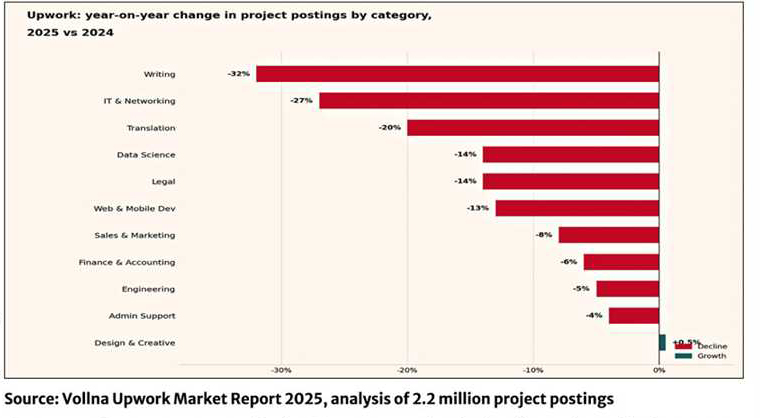
Graphic design and coding— a more nuanced picture: The picture is more complicated in sectors that require a degree of visual or technical judgement. On Upwork, the Design and Creative sector was the only category to record growth in 2025, albeit a modest 0.5 per cent. The engineering category contracted by just 5.0 per cent, well below the platform average, suggesting that technical complexity provides some insulation against displacement. The inference from the design figures, in particular, is that clients who once commissioned cheap, generic assets now want work that requires genuine taste and strategic thinking, precisely the attributes that AI cannot reliably supply. A client who has spent an afternoon trying to prompt their way to a coherent brand identity tends to arrive at a designer's inbox with a clearer brief and a larger budget than they would have brought three years ago.
Software development tells a similar story of hollowing out at the entry level. A Stanford study in 2025 confirmed that junior software engineering roles were contracting as AI coding assistants allowed companies to manage with fewer human hands, although demand for developers who could orchestrate, audit and extend AI systems was robust, with Python, Julia and Rust registering over 50 per cent growth in project postings on Upwork. The market is not collapsing uniformly; it is bifurcating.
The ascent of the AI-native freelancer: Against this backdrop of contraction, certain categories have expanded at a pace that strains credulity. Fiverr's own Business Trends Index reported demand for AI agent developers growing by nearly 18,000 per cent in early 2025, a figure that reflects not only genuine demand but also how underpopulated that skills category was to begin with. AI video creation surged 66 per cent in the second half of the year. On Upwork, AI-related work grew 60 per cent year-on-year in the fourth quarter of 2024, and freelancers undertaking AI projects earned 44 per cent more than the platform average. AI and machine learning specialists now command between US$ 100 and US$ 200 per hour, compared with a platform-wide median of around US$ 39.
What experienced freelancers can actually do: The instinct, when confronted with these numbers, is to reach for reassuring bromides about the indestructibility of human creativity. The more honest response is to treat the data as a set of navigational instructions rather than a source of comfort or anxiety.
The first and most durable piece of advice is to stop offering services defined by tasks and to start offering services defined by outcomes. AI can produce a draft; it cannot be held accountable for a strategy. Clients will pay a premium for a professional who absorbs risks and delivers a measurable result, and they will not pay for a professional whose sole contribution is to do what the software already does.
The second is to embed AI tools into one's own workflow before a client does it on your behalf. Research suggests that freelancers using AI save approximately eight hours per week on average. That efficiency, redirected into quality rather than volume, creates a compounding advantage over those who are still debating whether to engage with the technology at all.
The third is aggressive specialisation. The generalist corridor, where a writer offered "blogs, articles, and social media copy," is where the largest losses are concentrated. The growth is occurring in narrow, defensible niches: AI content editing, multilingual brand strategy, prompt engineering for regulated industries, video scripting for AI-generated content. AI-specialised freelancers now command 25 to 60 per cent higher rates than generalists within the same broad field.
The fourth, and perhaps the hardest to internalise, is that reputation and relationship are now the primary competitive moats. AI produces no track record. It cannot refer a client to a colleague, remember a conversation from six months ago, or interpret a brief that contradicts itself in three different places. A freelancer with a decade of reviews, long-term client relationships, and a portfolio of complex, contextual work is offering something that no current AI system replicates, and the market will increasingly price that accordingly.
The gig economy is not ending. It is shedding a layer of work. What remains is harder, better paid, and considerably more interesting, provided one is willing to make the journey toward it.
hishamuddinkhan@gmail.com