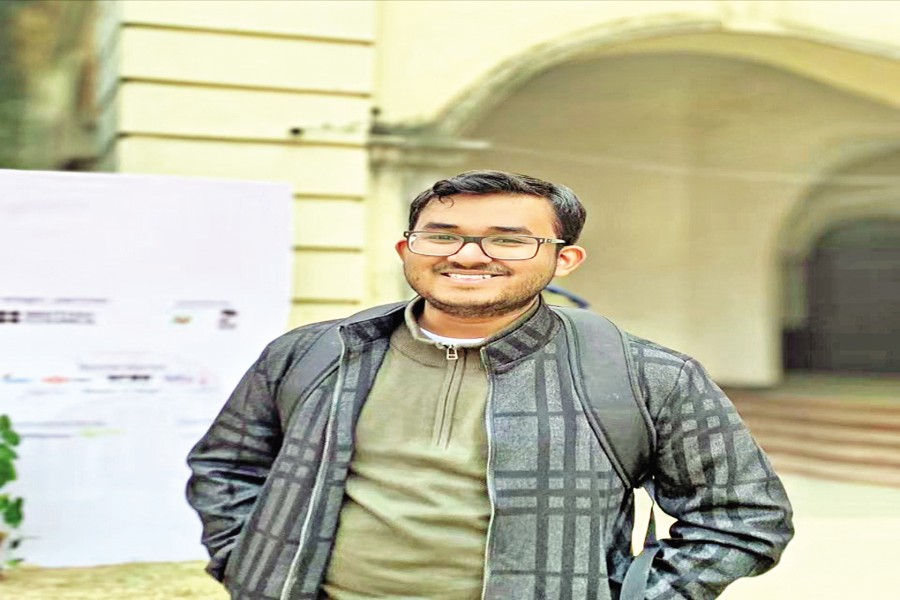
 Sabit Ibtisam Anan
 Something is shifting in the ambitions of Bangladeshi youths. Over the past 15 years, the number of Bangladeshi students pursuing higher education abroad has tripled, and according to the Open Doors Report, the number enrolled in US institutions alone reached 20,156 during the 2024-25 academic year. Bangladeshi students are no longer simply going abroad to study. They are going after the most selective scholarships in the world, and they are getting them.
Sabit Ibtisam Anan, an HSC-25 graduate from Dhaka Residential Model College, is one of them. He has been awarded the International Impact Award to pursue his undergraduate studies at the University of British Columbia; a university consistently ranked among the world's top public institutions. The full-ride scholarship covers tuition, housing, travel, and incidental costs, and fewer than thirty international students are selected for it each year on the basis of academic excellence, leadership, and community impact.
The journey to that offer began earlier than most people might expect. "Nine grade," Sabit says, when asked when he decided to pursue his undergraduate abroad. "Honestly, I didn't know how to prepare initially. I just knew that other than academics, extracurricular activities and exams like the SAT were important. So, I started doing a bit of everything to build my profile and figure out what I was good at." For anyone still trying to find their footing, he recommends the same wide-net approach at the start, with one important caveat attached. "Always keep in mind that you have to build up your focus soon."
Finding that focus, in his view, comes down to asking the right questions. "I believe one can find their focus by asking the right questions. Such as: what problem angers or affects me the most?" For Sabit, the answer was climate change. He started by building a theoretical foundation and, in ninth grade, attempted to qualify for the national team for the International Earth Science Olympiad. He did not make it that first year. He tried again, made the team, and eventually won a medal as its youngest member.
It is worth pausing on that detail, because the Olympiad route is one Sabit recommends seriously. "Olympiads are simpler, but in my opinion require more effort to excel at them," he says. "Find what interests you the most and really commit to that." Several international Olympiads exist across Mathematics, Physics, Biology, Earth Science, Astronomy, and Economics, among others. In a competitive admissions environment where the US, Canada, and the UK simultaneously tightened their international student intake in 2024, the credibility that comes from Olympiad performance carries real weight. As Sabit notes, there is now "a heavier emphasis on standardised exams and ECs like Olympiads, because they are credible indicators of a student's academic prowess."
Scientific competition was only one thread of his preparation. Sabit also wrote on climate-related topics across personal blogs and national dailies, developing his thinking on climate financing in public. His most recent project took him further still, working under an Oxford professor on carbon trading research. Getting to that point required initiative rather than formal introduction. "Finding a mentor helps immensely," he says. His first research experience came because a senior alumnus of Dhaka Residential Model College took him and a few other students under his wing. "That kind of guidance is invaluable at the start." From there, his advice is direct: "Don't hesitate to cold-email professors just to shadow them. Many professors are genuinely happy to hear from motivated students." He also points to the growing number of high school research competitions that can pair students across the world to work together on projects.
Alongside his research, Sabit built technology-driven community projects on issues he cared about. "I worked on tech driven social innovation projects across a range of issues that mattered to me, from medicinal inaccessibility, financial freedom for youths and gender-based violence," he says. The discipline behind those projects was consistent throughout: "Starting with a specific problem, and then shaping the technical and structural MVP (minimum viable product) across iterations is essential to building something actually useful."
On the formal requirements of international applications, Sabit is methodical. The term universities use is "holistic admissions," which means an applicant's full profile is judged together. "This includes academics, extracurriculars, recommendation letters, standardised tests, English proficiency tests, personal statement and so on," he explains. "So, other than school work, a great emphasis needs to be put on exams like SAT and IELTS as well."
He is equally candid about how the landscape has changed for students coming up behind him. "Compared to even just four years ago, the landscape has changed drastically." The numbers bear this out. Canada cut study permits for Bangladeshi students sharply after a record high in 2023, while the UK tightened sponsored study visas in 2024. At the same time, destinations like Australia, Japan, and Finland have seen significant growth in Bangladeshi enrolments as students diversify where they apply. "The best thing to keep in mind is to keep options open in terms of where you want to study," Sabit says. "Because other than lowering acceptance rates, there are also issues with insufficient funding and visa curbs in recent years."
On the question of balance, he resists any suggestion that he solved it cleanly. "I don't believe I perfected 'balancing'. It was always a constant effort, but that's just how it's going to be. One has to get creative with how they spend their time." At university, he does not expect the equation to change dramatically. "I think at university it will be much of the same," he says. He plans to study Data Science and Geophysics at UBC, with a long-term goal that ties everything together: "I want to ultimately use that to push for better climate financing for Bangladesh and other vulnerable countries."
Nearly half of Bangladesh's population is under the age of 24, and a growing number of them are looking outward for their education. The students who will compete most effectively for the world's top universities are unlikely to be the ones who prepared most frantically in their final year. They will be the ones who, like Sabit, started early, went genuinely deep, and as he puts it, cared about "a problem they wish to solve."
Ishtiak Alam writes about and photographs people doing interesting things. He is otherwise occupied with robots.
Ishtiakhit26@gmail.com
© 2026 - All Rights with The Financial Express

