Bangladesh's future rests on its youths. More than a third of the population is under 25, and how well this generation is educated and equipped will decide whether the country's much-discussed demographic dividend turns into real jobs, new businesses, and broader prosperity, or simply more graduates with nowhere to go. Every taka spent on education is, in that sense, a bet on the young people who will one day run the country's firms, farms, and start-ups. The latest national budget puts a record amount behind that bet. The question is whether the money is being spent in a way that actually helps.
The finance ministry's proposal to raise education spending to nearly 2.0 percent of GDP (gross domestic product) for FY2026-27 has been presented as a turning point, an increase of close to Tk 494 billion (Tk 49,400 crore) over this year's original allocation. After years of stagnation at around 1.4 to 1.5 percent of GDP, any rise is welcome, and officials have framed it as the centrepiece of a 13-point reform agenda. But a budget total is only the headline. The more telling story lies in how that money is split between operational spending, which covers salaries and running costs, and development spending, which funds actual projects, and what those projects are for. The FY2026-27 budget for two of the largest education bodies, the Ministry of Primary and Mass Education and the Secondary and Higher Education Division, looks less like a break from the past than a continuation of it on a larger scale.
Start with the development budgets. For Primary and Mass Education, FY2026-27 proposes Tk 214.41 billion (Tk 21,440.58 crore) for development. That figure alone suggests serious new investment. But this year's (FY2025-26) original allocation was Tk 113.98 billion (Tk 11,398.16 crore), revised down mid-year to just Tk 80.61 billion (Tk 8,061.04 crore), a cut of close to 30 per cent. For Secondary and Higher Education, the gap is wider still: an original Tk 171.13 billion (Tk 17,113.05 crore) was revised down to Tk 93.90 billion (Tk 9,390.42) crore, a cut of 45 per cent. In both cases, the new proposal is roughly two and a half times what the ministries actually spent last year, not what they were promised.
This is not unique to these two bodies. The Planning Division has proposed around Tk Tk 835.57 billion (Tk 83,557 crore) for combined education and health development spending nationally, nearly double the original FY2025-26 figure and close to four times the revised one. That low base reflects a wider pattern: government monitoring data showed overall project implementation running at well under half of what had been planned, and education's allocation was cut by roughly a third as a result. Put simply, the system proposes more than it can spend, spends less than half of what it proposes, and proposes even more the following year regardless.
The reasons are no mystery: land disputes, slow tendering, foreign-funded projects launched before financing is confirmed, and rushed feasibility studies have all been flagged in monitoring reports for years. What is striking is how little this affects which projects get approved next. The list of ongoing projects shows campus construction, hostel work, and a string of "further development" projects for the same universities running in parallel. Shahjalal University of Science and Technology, for instance, has two separate "further development" projects on the books, launched in 2017 and 2019, both still listed as ongoing through 2026. Development spending has effectively stopped being a one-off investment and become a permanent fixture, renewed under a new name every few years.
Some spending is for genuinely new capacity, such as a second campus for the Chittagong Veterinary and Animal Sciences University and several new polytechnic institutions. Each is defensible on its own. What is missing, however, is anything that tracks what happens after these institutions open: whether graduates find work in the fields they trained for, and whether industry was consulted on what they should be able to do. This matters because Bangladesh's technical and vocational sector already has a well-documented mismatch between what it teaches and what employers need, and manufacturers routinely report that diploma holders need months of retraining before they are productive. Adding more seats to a system with this gap does not close it for the youth entering it; it simply produces more graduates who fall into the same trap.
The contrast is sharpest against teachers' pay. A government primary school assistant teacher sits in Grade 13, with a basic salary running from roughly Tk 11,000 to Tk 26,500, and many report take-home pay closer to Tk 17,500 a month. Secondary teachers fare only somewhat better. A starting primary teacher's salary in India is close to double the Bangladeshi figure, and Bangladesh ranks near the bottom of regional teacher pay tables. This is why capable graduates avoid teaching, and why many who do enter the profession rely on private tutoring to get by. Of the dozens of projects under these two ministries, exactly one is aimed at the people who actually teach.
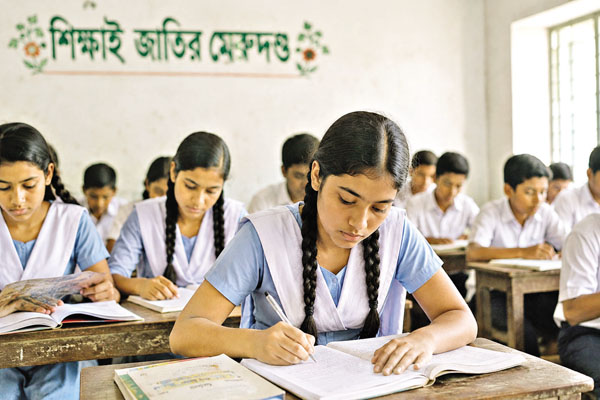
None of this argues against the higher allocation. Even at 2.0 percent of GDP, Bangladesh remains well short of the 4.0 to 6.9 per cent UNESCO considers adequate, and the rise is overdue. The argument is about what it is for. Before a new "establish university" or "further development" project is approved, it is fair to ask: who will teach there, what will they be paid, and where will the graduates work? If a project cannot answer those questions, calling it an investment in education is generous; it is closer to a construction programme that happens to sit inside the education ministry's budget.
For Bangladesh's young people, the stakes in getting this right go well beyond classrooms. A generation that leaves school without relevant skills or reliable teaching is a generation less able to start the small businesses, agro-ventures, and tech firms the country needs to absorb its workforce. Entrepreneurship cannot be built on a weak foundation; it needs literate, numerate, work-ready youths behind it. A year from now, the real test of this budget will not be the percentage of GDP announced on budget day. It will be whether the same projects are still "ongoing," whether revised figures show the same cuts, and whether the young people meant to inherit this economy are being given the tools, and the teachers, to actually build it.
Jahid Hossain is research assistant at Dacca Institute of Research and Analytics.
jahid@dairabd.org
© 2026 - All Rights with The Financial Express

