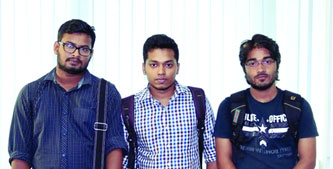
 Developers of ‘POTAKA’: (From L to R) Rakib Hasan Amio, Ikrum Hossain and Osman Goni Nahid
"Learning to write programmes stretches your mind, and helps you think better; it creates a way of thinking about things that I think is helpful in all domains," said Bill Gates, the chairman and founder of Microsoft.
Computer courses are taught in the secondary and higher secondary school level as optional subjects. Even then most of 'optional' coursework is based on text-books, enlarging the gap of practical skills. In case of 'coding' or learning how to write computer programmes, our students are behind. One major barrier is the language.
Several non-English speaking nations such as France, China and Japan have their own programming languages. However, Bangladesh did not have its own programming language in Bangla before 20th August, 2016. For the first time Ikrum Hossain, Senior Software Engineer of Telenor Health, launched the beta version 1.0 of Bangla programming language, "Potaka.io". He graduated from Daffodil International University (DIU) on Software Engineering. Potaka.io contains an editor with syntax importance. It has built-in Avro phonetic typing and autocomplete functions. It also hosts some learning games that the developers hope will make it enjoyable for young learners to pick up the language. Some interesting examples can also be found at: github.com/ikrum/potaka.
Hossain always wanted to develop programming related contents so that everyone can learn it. But he found that language was a big barrier for Bangladeshi students. So he ventured out on his own. According to Ikrum Hossain, "Many students do not understand programming language in English at the beginning and they become afraid of programming. This initial barrier kills the interest for school and college going students." He explained that even his sister found it hard even though he wanted to teach her. All of this worked as a motivation to create a Bangla programming language.
While discussing about the initial stages of 'Potaka' Ikrum said, "I tried to develop Potaka within six months with help of different expert programmers of Bangladesh. But some works were incomplete. After a lot of coder-hunting I finally found two good programmers that I could easily work with. And along with Rakib Hasan Amio, and Osman Goni Nahid, I could complete and launch the beta version"
The beta version is mainly developed for the students. This is designed to help every student and has the potential to bring out the interest for programming. The Potaka team is extremely satisfied with the response. The vision of Potaka is to get incorporated in mainstream education system. "If the Bangla programming language is added in ICT books of school and college then it will help the next generation to do coding in its own mother tongue."
Ikrum, Amio, and Nahid-- all of them are encouraging and inviting the programming community to contribute to its development by suggesting new features or pointing out bugs in the system.
On our victory day, 16th December, Potaka team plans to launch the stable version. Developers are relentlessly working on it to make it happen. Ikrum said, "After releasing the stable version, we will start to accept code from everyone. During this time, we encourage you to try out the code and give us feedback." The link of Potaka is www.potaka.io.
The writer is a second year BBA student at Bangladesh University of Professionals (BUP), arabid418@gmail.com
© 2026 - All Rights with The Financial Express

