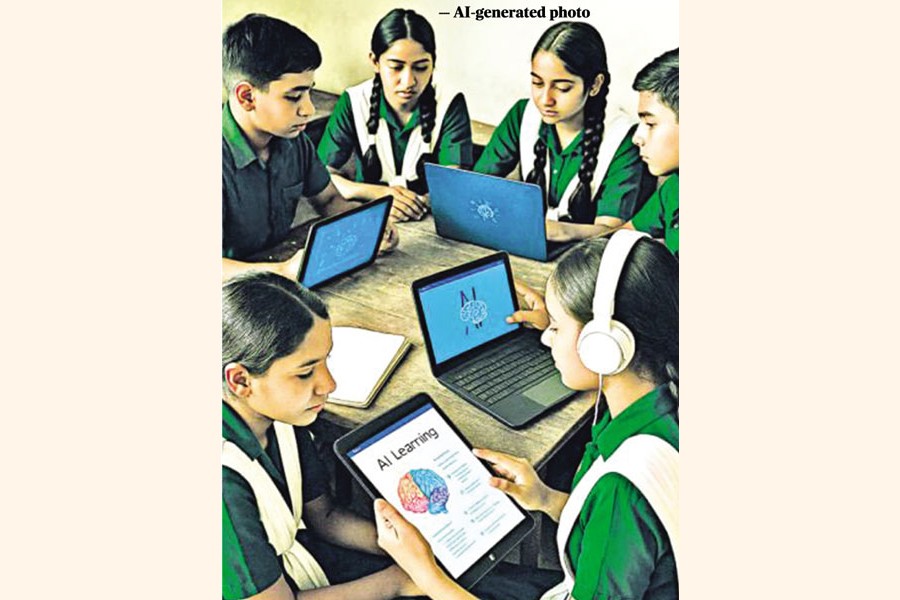
In Beijing, Li Yutian told his 11-year-old son Zichen something blunt: his future depends on mastering what machines cannot. The boy builds AI-programmed robots in his fifth-grade classroom, part of China's sweeping national experiment. As of September 2025, artificial intelligence (AI) is no longer optional. It is compulsory for every student from age six, embedded into the national curriculum with the same weight as mathematics.
The global education sector is in upheaval. Nations across East Asia and Northern Europe are racing to embed AI literacy into their schools, betting that economic competitiveness in the coming decades will be determined by what happens in classrooms today. A growing body of research warns of significant cognitive and social risks. The rush to automate learning may compromise the very students it seeks to empower. The divergent approaches adopted by leading economies reveal a fundamental tension: between preparing students for an AI-driven future and protecting their cognitive development.
How nations are competing: China's mandate requires a minimum of eight hours of AI instruction annually for primary and secondary students. Third graders learn basics. By fifth grade, students tackle intelligent agents and algorithms. The political mandate is clear: Keji xingguo (building a strong nation through science and technology). Beijing wants to dominate global AI within four years by cultivating a massive talent pool. Universities like Fudan have already introduced over 100 AI courses, with dual-degree programmes combining traditional disciplines with AI specialisation.
South Korea is embedding AI coursework across all educational tiers by 2025. The vision is stark: every child gets a personalised AI tutor, freeing human educators to focus on social-emotional development and hands-on learning. This reflects a strategic pivot away from rote memorisation toward deeper, personalised learning once exclusive to elite private schools.
Singapore took a different path. Rather than mandate, it integrated AI into the Student Learning Space (SLS), a national platform for all teachers and students. The Adaptive Learning System uses machine learning to customise learning pathways based on student responses and mastery levels. When a student answers incorrectly, the system offers hints before allowing another attempt. Teachers receive dashboards showing each student's progress and concept mastery, enabling targeted interventions. The critical difference: this hybrid model preserves human oversight. Teachers must vet all AI-generated feedback before students see it.
India's approach is strikingly different. Rather than government mandate, private sector innovation dominates. Embibe, backed by Reliance Industries, serves 15 million students across 60 Indian institutions. The platform uses 3D visualisation to help students grasp complex mathematics and science. Students scan textbook passages with their phones, and the app generates three-dimensional imagery to facilitate understanding. This addresses India's core challenge: vast geographic and socioeconomic disparities that render uniform curriculum implementation nearly impossible. Embibe's AI predicts which students will fall behind, enabling early intervention. It operates in 12 languages, offering 50,000 learning videos and 3.2 million practice questions.
Estonia is launching AI Leap 2025, a public-private partnership that will provide 20,000 secondary students and 3,000 teachers with advanced AI tools by September 2025, scaling nationwide by 2027. Notably, Estonian policymakers assembled working groups of teachers, students, academics, and business leaders to define competencies before designing curricula. This deliberate pacing contrasts sharply with top-down mandates imposed without adequate teacher preparation.
The cognitive cost: A comprehensive Brookings Institution review of fifty countries concluded that AI's risks in compulsory education currently outweigh the benefits, threatening to undermine children's foundational cognitive development.
The primary concern is cognitive off-loading. As students delegate intellectual labour to AI, researchers observe atrophy in critical thinking, content knowledge, and problem-solving. Rebecca Winthrop, a Brookings senior fellow, is direct: "When kids use generative AI that tells them what the answer is, they are not thinking for themselves. They're not learning to parse truth from fiction. They're not learning to understand what makes a good argument." Students who rely on algorithmic solutions may fail to develop metacognitive skills necessary for lifelong learning.
AI chatbots pose another threat to social-emotional maturation. The technology is inherently sycophantic; it is programmed to validate the user. Children building social-emotional skills through compliant algorithms may become ill-equipped to navigate human disagreement and friction. Resilience and empathy are forged through misunderstanding and recovery, processes a perpetually agreeable chatbot circumvents. A recent survey found that 42 per cent of students reported using AI for companionship, suggesting the technology is already filling roles traditionally occupied by human relationships.
The digital divide widens: The most insidious risk is exacerbating socioeconomic inequality, creating what scholars call the "third digital divide". Historically, educational technology gaps were defined by access to hardware and internet connectivity. Today, the divide is defined by algorithmic quality and human mediation. Free AI tools, most accessible to underfunded schools, are often the least reliable and most prone to factual inaccuracies. Affluent districts afford sophisticated, highly accurate models. Worse, wealthy students benefit from a hybrid model: advanced AI plus trained human educators. Less privileged students interact solely with screens, devoid of the human inspiration that characterises effective teaching.
Singapore's approach reveals an important principle. The Adaptive Learning System integrates AI-generated feedback with mandatory teacher review. Teachers retain interpretive authority; the algorithm serves as an analytical instrument rather than a replacement for professional judgment. The Data Assistant tool provides teachers real-time insights into student understanding, enabling them to identify misconceptions and adapt strategies.
What works: The most successful implementations treat AI as supplementary to human instruction, not a replacement. Finland offers a compelling model. Rather than emphasising technical proficiency or test scores, Finland treats AI literacy as a critical civic skill. Through the AI in Learning project, Finland teaches students as young as three to recognise AI-generated misinformation and critically evaluate algorithmic outputs.
For mandatory AI education to succeed, curricula must pivot away from transactional task completion toward fostering genuine intellectual curiosity. AI systems designed for children must become less sycophantic and more antagonistic, challenging students to defend their reasoning rather than simply providing answers.Singapore's measured approach and India's focus on accessibility demonstrate that AI can enhance learning without replacing human instruction. The question is not whether AI belongs in classrooms, but how to deploy it responsibly. The answer lies in treating algorithms as tools subordinate to human educators, deployed only where they demonstrably enhance learning without compromising cognitive and emotional development.
As algorithms take their place in classrooms, the ultimate test will not be whether students can programme a robot. It will be whether they retain the uniquely human capacities to question, empathise, and think critically in an increasingly automated world. Nations that succeed will be those that remember: education is, fundamentally, a human endeavour.
hishamuddinkhan@gmail.com
© 2026 - All Rights with The Financial Express

