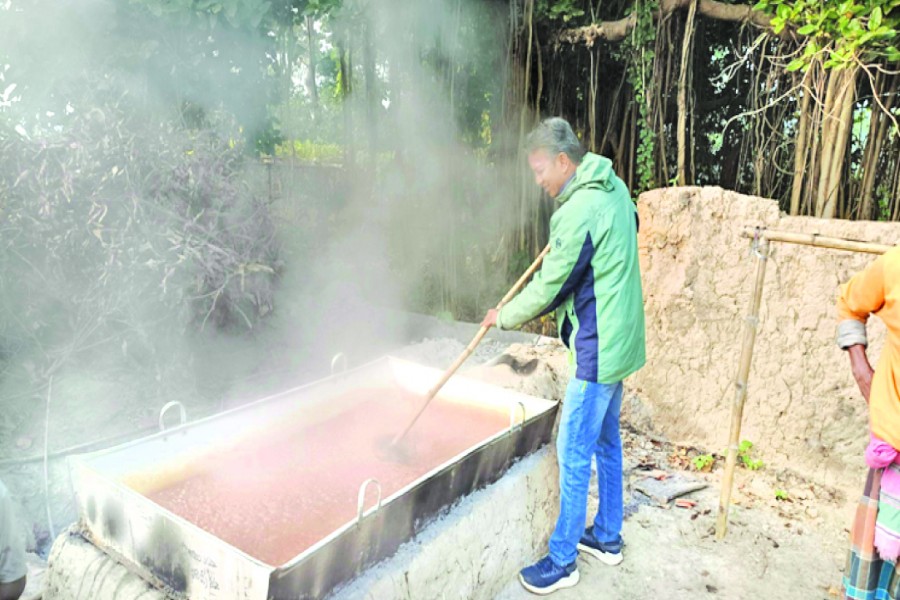
 Munjer Alam is turning sugarcane into jaggery in a rural corner of Chapainawabganj
 In a world where most people measure success in salaries and promotions, Munjer Alam chose a different path. Once the director of Finance at a prestigious multinational company, he turned away from the glow of corporate life to build something humbler, greener, and truer. An agricultural haven was born out of his hand.
The first seed of his new life was sown in 2010, when his son was born. "I wanted to feed my child something pure, not poisoned," he told me over a long phone call. That simple desire-a father's instinct to protect his child-grew into a vision for clean, honest food.
Before that moment, Munjer had lived a life that many would envy. He wore crisp suits, attended high-stakes meetings, and managed budgets worth millions. But in the quiet moments at home, he began to wonder if money alone could nourish his family or his soul. The answer came when he realised that the food on his son's plate, and in the plates of millions of others, was often compromised with chemicals and additives. This realisation would alter the course of his life.
Soon after, Munjer and four of his friends bought a piece of land in a rural corner of Chapainawabganj. They named their dream Barendra Krishi Udyog. The plan was straightforward: to grow food the way nature intended. But farming is never simple. Two partners left under the weight of uncertainty, and amongst the remaining three, Munjer became the one who refused to give up.
He remembers the early days vividly. Banks closed their doors when he asked for a loan. No collateral, no loan. Desperate to keep his vision alive, he borrowed from NGOs at high interest, sold some small plots of land, and used the money he had once saved for a car.
"My family sacrificed a lot," he said quietly. "My wife especially. When everyone doubted me, she didn't."
In exchange for his dream, Munjer gave up a comfortable salary, air-conditioned offices, and every bit of corporate certainty. But what he gained was something he says he can't put a price on.
Years of working side by side with farmers taught him to see them differently. "People think that farmers are just simple people. But what they don't realise is that they're the backbone of our country, the ones who keep us fed."
He learnt that despite being vital to the nation, farmers rarely receive respect or representation. They are left out of policy discussions, invisible in the systems they sustain. That realisation gave his work a deeper purpose.
Today, 30 people work on Munjer's farm. "I might not earn what I used to," he said with a small laugh, "but I'm richer in another way. I can support 30 families now. That's worth more than any paycheque."
Running a farm is not romantic. Rural labour is scarce, as many villagers leave for the cities. Fertiliser and machinery prices climb faster than crops can grow.
Despite these obstacles, he continues. Each day begins before dawn, checking irrigation lines, inspecting fruits, and coordinating labourers. "I realised farming is about constant attention, patience, and love for the land."
Every hurdle is, in his words, "a reminder that agriculture still waits for heroes."
Munjer's creativity didn't end with farming. He noticed that around 40 per cent of his mangoes went unsold and rotted away. Instead of accepting this waste, he began experimenting-drying mangoes, jackfruits, and guavas. This not only reduced loss but opened a new revenue stream.
That innovation became his next venture: Suddha, an online platform where he sells these natural, additive-free snacks. He also sells other products grown on his farm there. Last season alone, he sold nearly 700 kilogrammes of dried mangoes and 100 kilogrammes of mango powder.
He is now negotiating with foreign buyers to export his dried fruits, a step that could turn his quiet local idea into an international story. "If this works," he said, "it's not just profit. It's a chance to show Bangladesh's potential to the world."
Munjer's idea taps into a massive, underdeveloped market. According to research from various organisations, the global dried-mango industry is worth
US $2.24 billion, whilst mango-based products in general form a US $22.2 billion market in 2024, projected to reach US $36.3 billion by 2033.
Bangladesh, despite being the seventh-largest mango producer in the world with 2.7 million tonnes of annual output, lets about 40 per cent of its mangoes rot each year. In Munjer's district alone, mango production is valued at around Tk 70 billion (7,000 crore), and the surrounding region nearly Tk 220 billion (22,000 crore).
"To me," he said, "drying mangoes isn't just business. It's saving what we already have and turning loss into life."
Dr Muhammad Shahadat Hossain Siddiquee, professor of Economics at the University of Dhaka, sees entrepreneurs like Munjer as quiet revolutionaries.
"People like him have an innate entrepreneurial mindset," Dr Siddiquee said. "They're creating both financial and social value. Thirty workers means 30 families supported-that's impact beyond money."
He also noted the macroeconomic ripple effects. "Previously, when mangoes rotted, they weren't counted in GDP (gross domestic product). Now, through processing and sales, that waste becomes measurable economic output. And if he succeeds in exporting, Bangladesh will earn valuable foreign currency."
According to him, if more educated professionals like Mr Alam invest in agriculture, Bangladesh could fight unemployment and unlock rural potential. "Farming," he said, "should be seen not as survival, but as an opportunity."
Although he occasionally misses the predictable comfort of his corporate life, Munjer finds satisfaction in unexpected places. "When journalists call me, or people ask about my work, it reminds me that I made the right choice," he said with a smile. "I never dreamt I'd be on TV or in a newspaper."
He also spoke about the subtle joys of everyday farming: the smell of ripe mangoes, the laughter of workers in the fields, and the sense of rhythm that the land imposes. "It's hard work, yes, but it feels right," he said.
Munjer Alam's story is not just about leaving a high-paying job-it is about redefining success. His life shows that prosperity can grow from soil as well as spreadsheets. By converting unsold mangoes into dried products, employing 30 people, and negotiating exports, he has turned his personal conviction into a model for rural empowerment.
Looking ahead, he dreams of inspiring young professionals to see agriculture not as a fallback but as an opportunity. "I hope more people understand that farming can be smart, profitable, and meaningful," he said.
Munjer Alam's journey is a quiet rebellion against conformity, against waste, against the idea that ambition belongs only in offices. He turned a corporate title into a community, a salary into sustainability, and a personal conviction into public good.
His revolt wasn't loud. It came softly, through fields of mango trees and the hum of village life. But its message is clear: that sometimes, the bravest thing a man can do is to plant his own future and let it grow.
samiulhaquesami366@gmail.com
© 2026 - All Rights with The Financial Express

