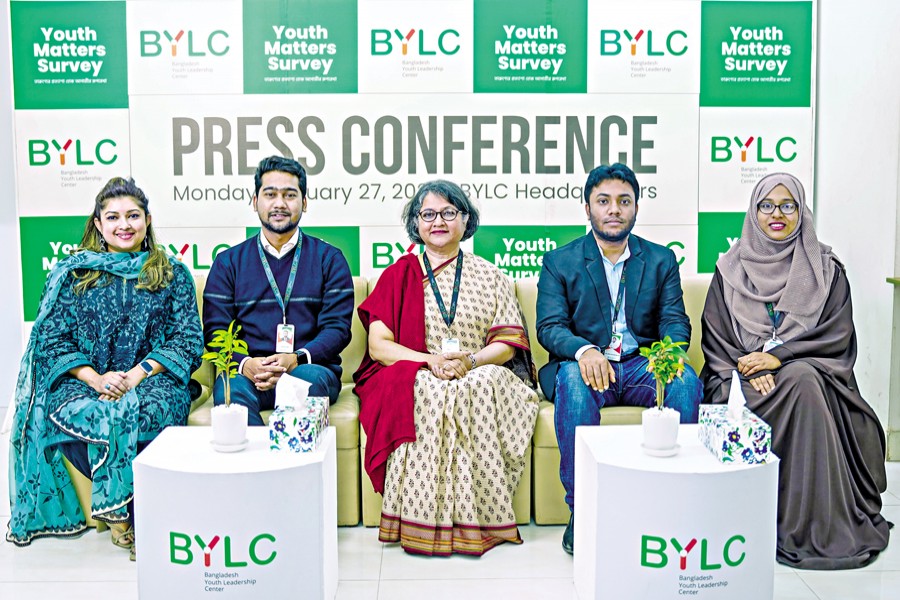
 Bangladesh Youth Leadership Center (BYLC) organised a press conference to share its latest Youth Matters Survey (YMS) in Dhaka recently
 Bangladesh is experiencing a pivotal moment, with its young population emerging as the catalyst for change. In light of significant political shifts and changing social norms, young people are expressing their opinions. They are advocating for reform and maintaining optimism for an improved future.
The latest Youth Matters Survey (YMS), conducted by the Bangladesh Youth Leadership Center (BYLC), captures many such sentiments. BYLC has been running this survey every five years near national elections to understand youth perspectives on governance, democracy, and socio-economic issues. The 2024 survey took place between October and November, gathering responses from 3,238 young people, out of which 1,575 in person and 1,663 online. The results were made public on January 27, 2025.
Youth voice and governance: More and more young people feel comfortable expressing their views today. About 73.6 per cent of in-person respondents and 81.5 per cent of online respondents said they feel safer voicing opinions than during the previous government's tenure. Then again, around 20.9 per cent of in-person and 54.4 per cent of online participants fear instability in law and order.
There is also a strong support for political continuity in the current setup. About 41.4 per cent of in-person and 50.9 per cent of online respondents want the interim government to remain for another one to three years. Youths believe reforms need time to take effect. Additionally, 68.6 per cent of in-person and 84.9 per cent of online respondents believe law enforcement should operate without political bias which reinforces the demand for institutional neutrality.
Economic concerns and career aspirations: Rising costs are a major point of tension for young people which is affecting their financial security and well-being. About 75.1 per cent of in-person and 64.8 per cent of online respondents see inflation as a serious issue.
On the other hand, entrepreneurship still remains a preferred career path for youths. About 52.5 per cent of in-person and 51.5 per cent of online respondents aim to start their own businesses. Unsurprisingly, 21.8 per cent of in-person and 47.8 per cent of online respondents are considering leaving the country. If economic conditions do not improve, Bangladesh risks losing its young talent to brain drain.
Education and student politics: Reforming the education sector is a top priority for many. About 71 per cent of in-person and 86.4 per cent of online respondents believe student politics disrupts the learning environment. There is also disagreement about the quality of education. About 77.4 per cent of in-person respondents believe the system prepares students for employment, while 79.3 per cent of online respondents disagree. This is an area that needs more probe by the authorities.
BYLC's Deputy Manager of Skills Development Munira Sultana addressed these concerns at the survey presentation. "Many online respondents believe our education system does not equip students for jobs," she said. She emphasised BYLC's focus on incorporating skills like problem-solving, conflict resolution, and public speaking into its training programs.
Social and environmental issues: Women's safety remains a serious issue. About 25.3 per cent of in-person and 70 per cent of online respondents believe the country is failing to protect women. Perspectives on communal harmony also differ. About 86.4 per cent of in-person respondents believe communal harmony prevails, but only 39.2 per cent of online respondents agree.
Environmental concerns are also on the rise. About 55.1 per cent per cent of in-person and 73.1 per cent of online respondents believe climate change is worsening conditions in Bangladesh. This suggests a growing awareness of sustainability issues among young people.
Media, misinformation, and political participation: Trust in the media is divided. About 28.9 per cent of in-person and 49.5 per cent of online respondents believe media coverage does not accurately reflect national issues. However, young people are taking a stand against misinformation. Kazria Kayes, BYLC's senior manager of Communication, Marketing & Branding, shared that many young people are actively supporting fact-checking efforts and transparency.
Even after having these concerns youths are still optimistic. About 95.5 per cent of in-person and 95.7 per cent of online respondents plan to vote in the upcoming elections.
A call for reform and optimism for the future: Young people are critical of existing issues but remain hopeful for progress. About 85.8 per cent of in-person and 82.9 per cent of online respondents are willing to return to Bangladesh if meaningful change takes place. They demand an end to corruption, prioritisation of merit, and reform within political parties to bring capable leadership to the forefront.
BYLC's Executive Director Tahsinah Ahmed summed up the survey's key message. "Young people want real change. They want to speak freely, contribute to national development, and see governance improve. While some advocate for new political parties, most prefer reforms within existing ones. It is our collective duty to make their aspirations a reality."
Founded in 2009, BYLC is Bangladesh's one of the first leadership institutes. It equips young people with leadership, employability, and entrepreneurship skills. The organisation focuses on social responsibility, sustainability, and economic inclusion. Its mission is to empower young people to drive change across public, private, and civil sectors.
As Bangladesh enters a new era, its youths are ready to shape the future. Bangladeshi youth voices are strong, their expectations are clear, and their demands must be met with real action.
hishamuddinkhan@gmail.com
© 2026 - All Rights with The Financial Express

