Prof. Dr. Akbaruddin Ahmad and Touhid Alam | June 10, 2017 00:00:00
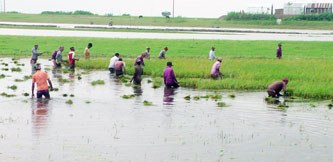 Farmers work on farmland.
Bangladesh on an annual basis is battered by floods, tidal surges and earthquakes that have become more frequent since the recent past. More than 300 rivers and alluvial soil with annual siltation of land and low -lying areas have become a boon for the agriculture sector. With high-yielding varieties of seeds and improvement in the food production practices, Bangladesh has become self-sufficient in food output and has started exporting aromatic rice on a limited scale. About 70 million people were involved with food production in 1971. In Bangladesh, a small country that is home to 160 million people, the food output has increased three times to cater to the increasing demand. Land earlier used for agriculture is now partly used for homesteads and factories. The adoption of modern technology and research has helped the country record the highest acreage of food grain production in the world. It has surpassed India, Pakistan, Sri Lanka and Myanmar. Bangladesh is considered one of the most densely-populated countries in the world with only 147,500 sq.km land mass. It has the largest mangrove forest in the world, the Sundarbans, with all its biodiversity and home to the famous Royal Bengal Tiger. Cox's Bazar with the longest unbroken beach of 125 km overlooking the blue water in the Bay of Bengal is an attractive tourist destination. The cultural, archeological and heritage sites have made Bangladesh a popular tourist hub. The per capita income has risen to US$ 1600 and has earned the country the lower middle income status.
The resilience of its population is praiseworthy. Despite all the natural calamities the highly-resilient people are motivated to move ahead facing all odds and rebuild their life and carry on with the farming activities within two months of a severe tidal bore or cyclone. The women are trained as garments factory workers. In this area Bangladesh is the top exporter after China. For girls, education up to the degree level is free and for boys it is free up to the high school level. Standard of living of the masses has improved considerably and there is no case of death on account of famine or malnutrition. Health care system in Bangladesh has expanded to the rural areas with hospitals and clinics set up for mothers and children. The child and maternal mortality rate has fallen drastically to 55 per 1000 due to better treatment facilities. The gross domestic product (GDP) growth has been over 6.0 per cent for a decade.
Agriculture is the mainstay of the majority people in Bangladesh. Nearly two-thirds of Bangladeshis are employed in the agriculture sector, 52 per cent of the civilian labour force of the country is engaged in agriculture and 14 per cent is engaged in the industrial sector. Agriculture contributes about 20 per cent to the GDP. The country has made laudable progress in agricultural development and food production in the recent decade. Within the agricultural sector, the crop sub-sector contributes 57 per cent, followed by fisheries (22 per cent), livestock (17 per cent), forestry and fruits (8.0 per cent). Rice crops cover 75 per cent of the cropping areas and contribute over 95 per cent to the total food grain production. All of these activities account for 17 per cent of the GDP. With its growing population and economy Bangladesh depends mainly on agriculture that is largely dependent on seasonal weather patterns and climatic conditions. This sector greatly influences the overall macroeconomic position of the nation as follows: poverty alleviation, improvement of health situation, food security and employment generation. For the agricultural sector specialised financial institutions are providing farm credits to the farmers. The procedure is simplified in order to help all the farmers open a bank account each with a deposit of minimum Tk 10. The Bangladesh Bank and other government banks like Janata, Rupali, Agrani, Sonali and Krishi banks and the private and foreign commercial banks have been directed by the Bangladesh Bank to provide farm credit at a reduced interest rate to support the farmers. The global climate change has also had a negative impact on the farming pattern in Bangladesh. Scientists have introduced high-yielding and flood-resistant varieties of seeds for rice cultivation to the benefit of the farming community in general and the country as a whole. The prevalence of heavy rainfall, floods, extreme temperature patterns and droughts have slowly changed the cropping patterns.
These phenomena will adversely affect the country's agricultural system through (a) reduction of crop productivity(Quantity/quality), (b) Changes of water use (irrigation); land use; migration, (c) increased frequency/intensity of floods. Water-logging, soil erosion and salinity have made the farming communities highly vulnerable and resilient. Besides the climate variability and uncertainties, such as temperature rise and erratic rainfall, the major weather and climate-related extreme conditions are frequent floods and river erosion, cyclones and tidal surges, salinity, drought, heat waves, cold and fog and water-logging.
The climate change is having an impact on the food security of the poor and marginal people. Protection of biodiversity and improvement of environment for preservation of the natural resources is a basic requirement as enshrined in the country's constitution. Use of advanced technologies that include satellite imageries and computer-assisted systems has been given due importance for the sake of enhancing the weather forecast capabilities.
Prof. Dr. Akbaruddin Ahmad is Chairman of Policy Research Centre.bd (PRC.bd) and also Chairman (Admn) of NAPSIPAG (Network of Schools & Institutes of Public Administration and Governance of the Asia Pacific Region, Colombo). Touhid Alam is a research associate of Policy Research Centre. bd and member of NAPSIPAG.
Email: akbaruddinahmad@gmail.com
© 2026 - All Rights with The Financial Express

