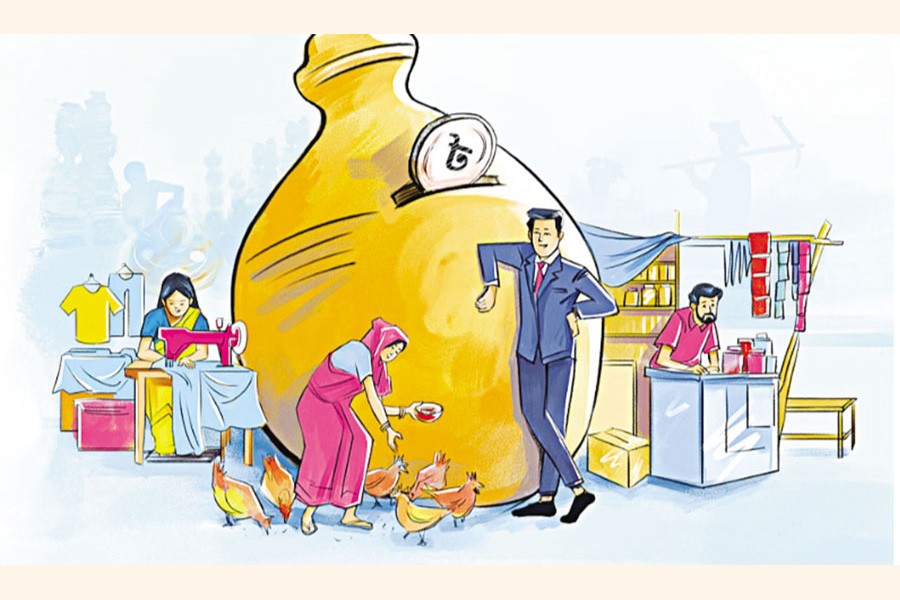
A rebound in lending to cottage, micro, small and medium enterprises (CMSMEs) during the first half of fiscal year 2025-26 signals a gradual recovery in business confidence and credit demand. However, sector experts caution that structural constraints continue to limit the flow of finance into smaller businesses as yet.
Latest data from Bangladesh Bank (BB) show that CMSME loan disbursement rose by 12.13 per cent year on year during the October-December quarter of FY26, reaching Tk 701.71 billion. The amount was also 45.75 -percent higher than the Tk 481.44 billion disbursed during the July-September quarter, indicating a strong quarter-on-quarter recovery in lending activity.
The increase comes after a challenging FY25, when total CMSME loan disbursement declined to Tk 2.05 trillion from Tk 2.25 trillion in FY24, reflecting subdued private-sector credit demand, macroeconomic uncertainties, high inflation and tighter liquidity conditions in the banking sector.
Industry observers say the latest quarterly improvement suggests that businesses are gradually resuming investment and working -capital activities following a period of cautious pause.
Bangladesh's CMSME sector plays a critical role in the economy, accounting for a substantial share of employment, entrepreneurship and industrial output. As a result, lending trends in the sector are often viewed as an important indicator of grassroots economic activity.
Despite the rise in disbursement, the stock of outstanding CMSME loans remained almost stagnant. Outstanding loans stood at Tk 3.14 trillion at the end of December FY26, only 0.35-percent higher than the Tk 3.13 trillion recorded a year earlier.
The modest growth in outstanding loans suggests that while banks are increasing fresh lending, repayments, loan adjustments and cautious credit expansion are preventing a significant buildup in the overall loan portfolio.
CMSME loans accounted for 16.76 per cent of total outstanding loans in the banking system at the end of last December. During the period, total outstanding loans across the banking sector rose to Tk 18.75 trillion from Tk 17.02 trillion a year earlier.
The figures indicate that the share of CMSME lending remains significant but has not expanded proportionately with overall credit growth in the economy.
A closer examination of the data reveals the dominant role of private commercial banks in supporting small-scale businesses. Private banks, including Islamic banks, held Tk 2.31 trillion in outstanding CMSME loans during the October-December quarter, representing 73.38 per cent of the total market.
State-owned commercial banks followed with Tk 575.60 billion in outstanding loans, while non-bank financial institutions (NBFIs) accounted for Tk 128.76 billion. Specialised banks and foreign commercial banks reported outstanding balances of Tk 92.24 billion and Tk 39.96 billion respectively.
The concentration of lending among private banks reflects their stronger branch networks, wider product offerings and greater focus on SME banking over the past decade.
However, experts argue that greater participation from state-owned banks and financial institutions could help broaden access to finance, particularly in underserved regions and sectors.
Another notable trend is the weakening recovery performance. CMSME loan recovery declined to Tk 554.98 billion during October-December from Tk 572.34 billion in the corresponding period of FY25.
The fall in recoveries may indicate that many small enterprises continue to struggle with rising operational costs, elevated borrowing expenses and weak consumer demand. Persistent inflationary pressures over the past two years have increased production and transportation costs, reducing profit margins for many businesses.
Bankers also point to structural barriers that continue to hinder CMSME financing.
Syed Mahbubur Rahman, Managing Director and Chief Executive Officer of Mutual Trust Bank PLC (MTB), says collateral requirements remain one of the biggest obstacles to expanding credit access for small entrepreneurs.
He notes that many promising businesses are unable to secure financing because they lack acceptable collateral despite having viable operations and growth potential.
"If banks rely only on collateral, many capable entrepreneurs will remain excluded from the formal financial system," he says.
According to Rahman, cash flow-based lending can provide a practical alternative by allowing banks to assess repayment capacity based on business performance rather than asset ownership.
He has also highlighted the importance of term loans in CMSME financing. Term loans currently constitute nearly half of the CMSME portfolio and help businesses undertake expansion, acquire machinery and improve productivity while managing repayments over a longer period.
However, access to finance is only one part of the challenge. Rahman stresses that improvements in financial literacy, bookkeeping, documentation and regulatory compliance are equally important for strengthening the sector's long-term sustainability.
Many small businesses still operate informally, making it difficult for lenders to assess creditworthiness and increasing the perceived risk of lending.
Women entrepreneurs face even greater hurdles. Limited asset ownership, small-scale operations and inadequate financial records often restrict their access to formal financing despite policy initiatives aimed at promoting women's entrepreneurship.
Experts believe targeted financial products, expanded credit-guarantee schemes and greater use of digital financial services could help narrow this financing gap.
Looking ahead, industry leaders argue that Bangladesh's CMSMEs must adapt to a rapidly changing global business environment. Rather than competing solely on low costs, businesses will need to focus increasingly on product quality, compliance, innovation and sustainability.
The latest lending data suggest that the CMSME sector is showing signs of resilience after a difficult year. Yet the slow growth in outstanding loans, declining recoveries and persistent financing barriers indicate that the recovery remains fragile.
Sustained policy support, innovative lending approaches and stronger institutional capacity will be crucial to ensuring that CMSMEs continue to serve as a key driver of economic growth, employment generation and industrial development in Bangladesh.
Dr Masrur Reaz, Chairman of Policy Exchange Bangladesh, sees the recent increase in CMSME loan disbursement as an encouraging sign, as small businesses are the backbone of Bangladesh's economy and employment generation. However, he cautions that the modest growth in outstanding loans suggests that the overall expansion of credits to the sector remains limited.
"The recovery in disbursement indicates that economic activities are gradually picking up, but access to finance remains a major challenge for many small enterprises, particularly micro-and cottage businesses operating outside major urban centres," he says.
According to him, banks continue to favour relatively larger and less risky borrowers within the CMSME segment, leaving many smaller enterprises underserved despite their significant contribution to employment and local economic development.
Dr Reaz notes that the declining trend in loan recovery reflects the pressure many businesses facing from inflation, rising production costs, exchange-rate volatility and weak consumer demand.
"Financial institutions need to move beyond traditional collateral-based lending and adopt more data-driven and cash-flow-based credit- assessment models. Greater use of digital transaction records can help reduce information gaps and improve access to finance for smaller firms," the economist suggests.
He has also stressed the importance of strengthening credit-guarantee schemes, expanding financial literacy programmes and improving formalisation among CMSMEs to enhance their bankability.
"Bangladesh's ambition to become a more competitive and diversified economy will depend significantly on the growth of its CMSME sector which influences supply-chain efficiency for leading growth sectors. Ensuring easier access to affordable finance, technology adoption and market integration should, therefore, remain a policy priority," he adds.
sajibur@gmail.com
© 2026 - All Rights with The Financial Express

