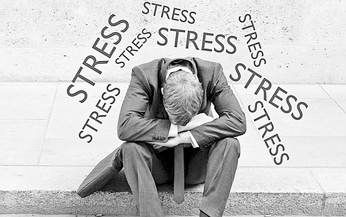
Stress is one of the most growing matters of concern nowadays. It has psychological, as well as physical effect on individuals. While some workplace stress is normal, excessive stress can interfere with your productivity and impact your physical and emotional health as well as your performance. Your ability to deal with it can make the difference between success and failure. You cannot control everything in your environment, but that does not mean you are powerless, even when you are stuck in a difficult situation. Finding ways to manage stress is not about making huge changes or rethinking personal or career ambitions, but rather about focusing on the one thing that is always within your control - "You".
There are some stressors that cause stress. Some of the common stressors are - Time Stressors which include work overload and lack of control; Encounter Stressors which include role conflicts, issue conflicts and action conflicts; Then Situational Stressors which include unfavourable working conditions and rapid changes and lastly, Anticipatory Stressors which include unpleasant expectations and fear.
There is a close relationship between stress and performance. Most people think that stress only causes bad performance, which is not true. Stress can cause both improved performance and decreased performance. The Yerkes-Dodson law states that performance increases with physiological or mental stress, but only up to a point, because to a minimum point stress can be handled and it will cause you some motivation to get the work done. But when the level of stress crosses that minimum point and become too high, performance decreases, as well as motivation decreases. But here, you should know that optimal stress and optimal performance depends on four different factors: skill level, personality, trait anxiety, and task complexity.
Now a question may arise, if the level of stress gets too high and as a result your performance gets suppressed then how could you overcome that? You can follow a seven-step process to reduce stress and thus improve your performance. The First step is - recognise warning signs of excessive stress. Some of the signs and symptoms of excessive job and workplace stress are feeling anxious, irritable or depressed, apathy, loss of interest in work, problem sleeping, fatigue, trouble concentrating, muscle tension or headaches, stomach problems, social withdrawal. So after you know that you are facing stress, you can take proper measures to eliminate or reduce it. The second step is - reduce stress by taking care of yourself. Start by paying attention to your physical and emotional health. When your own needs are taken care of, you are stronger and more resilient to stress. The better you feel, the better equipped you will be to manage work stress without becoming overwhelmed. Get moving, make good food choice that keeps you going, get enough sleep, and get support from others. The third step is - reduce stress by prioritising and organising. To prioritise and organise you need to do time management and task management, and for that you can take some simple measures. To manage your time you can create a balanced schedule, don't over-commit yourself, try to leave earlier in the morning, and plan regular breaks. Then to manage your tasks you can prioritise tasks, break projects into small steps, delegate responsibility, and try to be willing to compromise. The fourth step is - reduce stress by improving Emotional Intelligence (EQ). Emotional Intelligence consists of skills of self-awareness, self-regulation, self-control, motivation, the ability to understand others' emotional and behavioral cues (empathy), and interpersonal skills. The key skills to improve EQ is to realise when you're stressed, stay connected to your internal emotional experience, recognise and effectively use non-verbal cues and body language, develop the capacity to meet challenges with humour, and resolve conflict positively. The fifth step is - reduce stress by breaking bad habits. Many of us make stress even worse with negative thoughts and behaviour. So resist perfectionism, clean up your act, flip your negative thinking, and don't try to control the uncontrollable. If you can turn around these self-defeating habits, you will find stress a lot easier to handle. The sixth step is - reduce stress by interacting with others. You have to interact with others, develop good interpersonal skills. So take time away, discuss your problems with others, connect with others at work and outside the work, and look for humour in the situations. Lastly the seventh step is - learn how managers or employers can reduce job stress. You have to learn by monitoring others that how they manage stress. If a respected manager or employer can remain calm in stressful work situations, it is much easier for his or her employees to also remain calm. There is no limit for learning. Every day we learn new things. Maybe you did not even realise that even you can reduce stress just by monitoring and learning from others.
So by following these steps you can reduce stress and improve your performance and productivity. A person who is stressed takes so much away from his or her health and performance levels. Reducing stress could be as simple as adding exercise to your day or making new friends. To make the most of your life, limit your stress and of course for that stress that you cannot diminish, learn to manage it. If you can do so then your performance will be improved. So by taking control of your thoughts, emotions, and environment, you are controlling your life instead of letting stress control you! Remember what is truly important in life - Your Happiness!
E-mail: nagibfarhad@gmail.com
© 2026 - All Rights with The Financial Express

