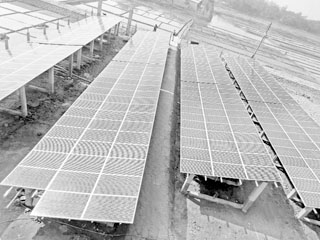
With much amazement and joy, inhabitants of Dhurong Bazar and its surrounding homes in Kutubdia were dazzled with bright lights last month -- there was no deafening noise and stiffening smug of generators burning away fossil fuel. The lights came out of pure solar energy stored in batteries. The amazing feat of bringing electricity on such remote location like Kutubdia is marvellous achievement by the parties involved in the project. On January 15th, the high-tech fully operational solar powered mini-grid (power generation station) was opened for commercial operation in Kutubdia. The inhabitants of Kutubdia have proved that consuming pure electricity is just as satisfying as drinking a pure glass of water.
The mini-grid was fully constructed from scratch by Green House Energy Limited (GHEL), a social business organisation based in Dhaka. GHEL is also responsible for running and maintaining the mini-grid. The project was made possible since it has been supported by Infrastructure Development Company Limited (IDCOL). Support came not only from the government, it was also financed by various organisations like International Development Association (IDA), KFW and the United States Agency for International Development (USAID) joined for the cause.
It was indeed a brave and timely initiative to set up the mini-grid because the initiative to bring electricity to Kutubdia isn't anything new. Bangladesh government tried its luck before with Hydroelectricity. Unfortunately, the high cost of maintaining gigantic windmills was too much to carry on. An article in a local daily pointed out, "It used to supply 1MW of power daily, enough to meet the needs of Kutubdia Sadar upazila. But sources close to PDB circle said that both Feni and Kutubdia wind power plants were not in operation now".
The ultra-modern technology used in the mini-grid is the first of its kind in Bangladesh. It is a failsafe system where both consumers and providers are being benefited by the new technology.
Smart card, which works somewhat like a mobile SIM card, has been introduced. In this method, consumers can buy electricity according to their need. The cost per unit is Tk 30 per kWh. Once the card is recharged, the consumer just swipes it on a pre-installed device- pre paid meter which works as an electric meter. This system is hassle-free and with no chance of fake meter readings. Most of all, this method saves energy by having the consumer mindful of wasting power.
The mini-grid generates energy entirely from the heat of the sun and the project is producing 100 KW energy. Solar energy is the most effective manner of power generation. Without any carbon emission and very limited maintenance requirement, solar energy is the best method to bring power to remote areas like Kutubdia.
The solar mini grid introduced in Kutubdia brings new promise. According to GHEL Founder and Managing Director Dr. Moshtaq Ahmmed, the mini grid is set up with the best and the latest technology. The equipment was brought in from Germany. It went into full commercial operation on January 15 last and the future looks not only promising but enticing. The mini grid was set up on 60 decimals of land which contains nine blocks or panel arrays and operating buildings. It houses 360 pieces of batteries to store energy. Adjacent to the battery room is the inverter room equipped with a cooling system. It has fulltime engineers and technicians stand-by in case of any technical difficulties.
This pilot project in Kutubdia expects to connect minimum 520 shops and households and the estimated number of total 2600 people will be benefited by the 520 connections.
Kutubdia lies just a few miles away from Cox's Bazar shore. With an approximate population of 95,055, the island could easily be a great tourist attraction. Apart from the obvious scenic sea shore it has a few of its unique charms. Its dried fish is a national delicacy. It also has the only lighthouse of Bangladesh; built by the British. So, why is not this island among the top tourist destinations even among Bangladeshis? Unfortunately, Kutubdia never was on the grid. The lack of electricity made it an ignored brushed off gem of the Bay of Bengal. Electricity on the island will transform the island into a romantic retreat. Its economy will flourish and new jobs will be there.
The writer is Managing Director of Green Housing and Energy Ltd.
Email: dr_mostaq.md@ghel.org
© 2026 - All Rights with The Financial Express

