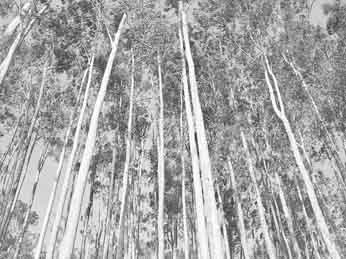
"Trees are Earth's endless effort to speak to the listening heaven." -- Rabindranath Tagore
Nature has bestowed and embellished Bangladesh profusely with her bulk of resources. Over the last three decades all sorts of natural resources have been decaying due to rapid population growth, urbanisation, unwise human behaviour and many more. Bangladesh's forests are exceptionally rich in biodiversity. Resource managers have identified 224 species of timber yielding plants (Mia, 1986), while Khan and Mia (1984) report 130 species of indigenous fibre plants. Bangladesh presents a long history of introduction of alien species of plants around the country, particularly those which were found productive and rendered economic benefits to people. It is quite painstaking to make a complete list of alien plant species in Bangladesh; again some species would be confusing to be identified as alien species. The list of invasive alien species demonstrates some popular species in Bangladesh including Akashmoni, Eucalyptus, Sissoo, Mahogany etc.
There are more than 700 species of Eucalyptus in the world and mostly native in Australia in the late 18th century along with a number of species in Indonesia, Papua New Guinea, and South America. Among them, three species are dominant in Bangladesh Eucalyptus brassiana, Eucalyptus citriodora, Eucalyptus camaldulensis. Height of Eucalyptus species varies from 10 metres to 80 metres. French botanist named L Heritier coined the generic name (Eucalyptus) from the Greek roots 'eu' and 'calyptos', meaning "well" and "covered".
In the Indian subcontinent Eucalyptus trees were first introduced in Tamil Nadu by state forestry officer Sir Henry Rhodes in 1830s. History of Eucalyptus in Bangladesh also dates back to the British regime. In early 1930s, it was first introduced in tea gardens of Sylhet as an ornamental plant. Several species of Eucalyptus had been planted up under the social forestry plantation projects since early 1980s. Following the government in association with NGOs, private entrepreneurs had advocated in favour and planted this tree around the country due to its commercial benefits.
Albeit, wide plantation projects in the mid-1990s the government imposed a ban on planting this tree after considering its negative impacts on the environment. Plantation of Eucalyptus causes adverse impacts on vegetation, birds, insects, soil fertility, biodiversity and ecosystem. The objective of eucalyptus plantation was related to mitigate the fuel wood and help the poor people. This is due to its fast growth in character and ability to withstand in the adverse environment.
Eucalyptus plantation has exhibited both positive and negative arguments around the world. It has severe negative impacts while it is planted on wrong sites, executed by the replacement of existing natural forest, coupled with poor management and 'silviculture'. Although it has some positive contributions which outweigh the adverse effects if it planted on the right sites with proper management and enough tending. Major positive sides include the meeting up the need of wood for energy, construction, income generation. More positive arguments on Eucalyptus offer transpiration rates from Eucalyptus species are similar to other tree species; the intercepted water loss from Eucalyptus is relatively lower than that for other tree species; the intercepted water loss from Eucalyptus is lower than that for other tree species; it might be used to reduce 'eutrophication'; light, moisture and minerals under the canopy of Eucalyptus are adequate to support other growth; it was found to have beneficial effects on soil structure and to improve soil fertility on treeless site; it is a species with low nutrient demands and some other contextual arguments. On the contrary, negative arguments encompass Eucalyptus needs plenty of water, and drains away sub-soil water and causes water scarcity; Eucalyptus trees suppress undergrowth and cause degradation of land. "Eucalyptus is nothing less than ecological fascism, which can be described as a species that destroys the hydrological balance, impoverishes ... biodiversity." (El-khawas, 2005). In addition, "Eucalyptus is not only a soil degrader but also a crop destroyer, a depriver of fodder, flattener of natural forests, destroyer of security, creator of poverty and dependence, and killer of knowledge of future generations about how to live on one hand and livelihood and environment on the other."
While considering the scenario of Bangladesh, it portrays that a great number of alien species namely Eucalyptus has been planted in the country over the several decades. But there is paucity of documentation of study on this sphere. Farmers, timber traders are persuaded to plant these species eyeing to one-sided economic benefit, other aspects on environment were paid little attention. Government agencies, NGOs with the support of development partners have promoted these trees widely around the country. But farmers, community people should have been communicated all faces of Eucalyptus plantation. Experts opine monoculture plantation of this tree is destructive to biodiversity, especially in a country that is already so threatened by population pressure. Hence, Bangladesh being a densely populated country, is not much suitable for this plantation.
The Forest Policy 1994 is not coeval enough to deal with inauspicious facets of alien species including Eucalyptus; the root of forest policy the Forest Act 1927 must be ameliorated to be apposite to this age. The 20-year-long Forestry Master Plan (1995-2015) is now at the terminal stage. If further master plan and policy action are to be taken for tree plantation much consultation, participation of all quarters should be ensured. Extensive study by a consortium of environmentalists, economists, botanists, sociologists, scientists, zoologists etc should be carried out to remove the knowledge-gap on exotic species, learn about cost-benefit analysis of alien species to indigenous species. Being an early signatory country to Convention on Biological Diversity (CBD), Bangladesh pledges to converse the natural and biological resources within the territory.
"He who plants a tree, plants a hope."
The writers are students at the Department of Development Studies, University of Dhaka. Email: arup_dds@hotmail.com
© 2026 - All Rights with The Financial Express

