It's a refreshing, busy, and truly once-in-a-lifetime experience, at least for now. I have just returned from Rangamati backwoods. Even after reaching Dhaka, the flashbacks are constantly running through my mind. I feel an urge to write them down, to put these thoughts into words, in hope that everything will appear clearer- at least to my own mind--and for those who have a penchant for serene, idyllic ambiance of nature.
As I floated with the wind along the occasional watery roads of Rangamati, in the scorching heat of the sun, a magical slumber was writ large all over my eyes, as there was no urge to go back. Hills do have magic as they are the favourite children of nature.
On the first evening, while traveling from Ubukchari to Fakirachari, the dreamy silhouettes started to fade, and our boat got stuck in a condition with less water and more sand. The boatman was least bothered about the situation, as every now and then, it happens and they have to tackle it anyway.
Reflecting as a development professional: Development, though this word has become somewhat ironic over time, the real development, I believe, is the combined development of one's inner persona and outer lifestyle. When I look at the indigenous communities of Chattogram Hill Tracts at large, so far people from Rangamati and Khagrachari, I feel like they are already a developed unit themselves. They do farming from the scratch, they take the necessary learning from whoever offers it, they absorb the knowledge and try their hardest to reflect it in the answers. How else could they be developed? Well, they would be at least benefited and provided with the most basic facilities to attain the basic human rights.
Let's take a glimpse into everyday hurdles the hill people face. From the very basic rights to own dreams, obstacles are in every way of their life. The most common necessities are not mostly fulfilled here. Malnutrition takes over the children as well as adults, and having a nutritious lifestyle is difficult. Pregnant women need regular ANC and PNC checkups. But patients from the remote areas do not have the facility of affordability to travel to clinics and receive service. Sometimes it is better just to stay at home as the journey is not an easy one at this state. To protect their future child, they choose to protect by not taking care- because only this seems feasible to them at the moment.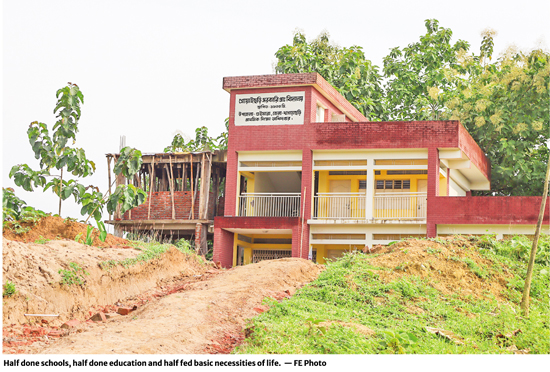 Life and livelihood of this region is also a challenging one as the seasons leave a noticeable impact and rainwater grabs almost every land worthy of farming. And that is why CHT farmers are always in need of a safety plan. They do Jhum cultivation in one hilly land and then do not use it for a certain period so that the land can recover. Most of them want to raise livestock in their home so that it can create a scope for a sustainable livelihood for them. But, for lack of capital, most often they are not able to do so. Generating homestead gardening in the yard is a common practice, but raising goats or pigs is a dream that the farmers carry along for a better income generation.
Fruit plants are not that much available in these areas and a paradox keeps going on between the short-term and long-term investment. Some believe that investing in wood trees such as Shegun (Teak) is a better way for the future generations to have assets and others keep saying that it is nothing but a mirage. Although most people believe that Shegun trees soak all the necessary mineral water from the soil so the other trees cannot grow- there are huge Shegun trees in the hilly stairs of CHT.
Another basic human right that needs a 'boost up' in CHT is education. Educating your child in the plainland is somewhat easier than in the hilly areas. There are schools, but most of them are junior high schools where a student can study till class VIII. To study further, even to complete SSC, they have to stay at the Upazila Sadar. The villages are so far away from the UZ headquarters that the conscious parents try harder to gather extra money and spend it to keep their children in the Sadar. But of course, this is not a regular case and the literacy rate in CHT is way lower than the other areas of Bangladesh. The Chakma community is better at literacy than the other indigenous communities as they seem as the majority of the hills in this region.
The isolation of the roads: If you do not have an easy road, then your journey can never be smooth and that is exactly what is happening with the rural CHT people. Most of the time, weather plays with the structure of the roads. Some months, it has enough water for boating though boats are a comparatively high-price vehicle for them. And from the month of March-April, the water dries up and those watery roads are then turned into paddy fields. On the dividers of the fields, one can walk for hours to reach their destination. There is also another alternative route.
They are the farmers that do not get to see those harvest on the plate. Though they do not think twice to deliver fresh fruits to any guest who comes to their doors as they all strongly believe in Garba Labiyat. This term in Chakma language means the art of hospitality. And if you ever went to the hill tracts of Chattogram, as a tourist or a professional, hopefully your experience was also nothing dissimilar.
A ray of hope glimmers on the horizons, after all this. On another visit to the same Upazila last September, I met a lady who runs a Bhaater Hotel in Jurachari Sadar. Her presence felt like such a strong force that could lead generations, even without one hand as she lost it long before. But more than her business-centric strong persona, the thing that inspired me was how she tries to help her community with making them aware of the government allowances and services. It is to be noted that due to various obstacles, most of the rural hill people are not even aware of the basic government services and they do not approach to receive these. People from different organisations and community levels need to take more steps ahead and make them aware about their rights.
In Chakma language, guests are called Garba and the people here give their best in the Labiyat (hospitality) for their beloved Garbas from the outer region. It is high time to give back to the hills and focus more on creating sustainable plans for the farmers who still work to keep the hills green.
anintopia3@gmail.com