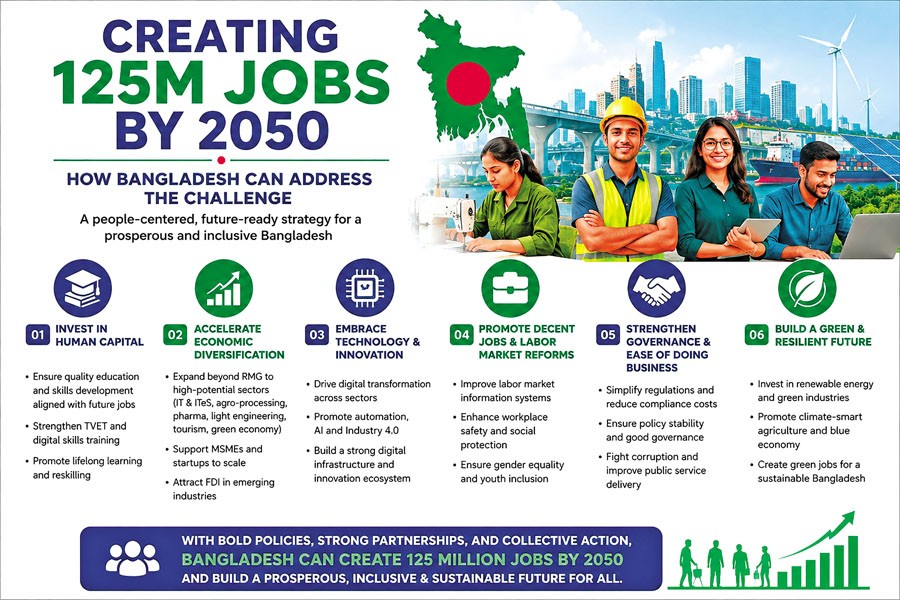
A United Nations Development Program (UNDP) report projects that Bangladesh's population will rise from 173.5 million in 2024 to between 230 and 250 million by 2050. The International Labor Organization (ILO) notes that the working-age population (ages 15 to 64) was 122 million, or 70 per cent of the total, in 2024. Although Bangladesh is expected to lose its demographic dividend by 2050, World Economics estimates the working-age population will reach about 140 million. Assuming 10 per cent to 11 per cent of youth aged 15-24 will continue education or training beyond primary school, Bangladesh will need at least 125 million jobs by 2050. Given the country's limited size and arable land, creating sufficient employment is Bangladesh's most critical challenge for 2050. Failure to do so could result in significant social, economic, environmental, and political crises.
There were 72 million people in the working population, and 84 per cent were engaged in the informal sector as stated in the Labor Force Survey 2024 conducted by the Bangladesh Bureau of Statistics (BBS). Furthermore, 2.62 million, or 3.66 per cent of the working population, were Not in Employment, Education or Training (NEET) and unemployed during the same period. The survey also revealed that the graduate unemployment rate in Bangladesh stands at 13.5 per cent, with tertiary-level educated individuals unemployed. Looking ahead, even if the current population growth rate, male-to-female ratio, and labour force participation rate remain unchanged until 2050, Bangladesh will face severe unemployment. However, it is important to note that things are unlikely to remain constant over the next twenty-four years. Bangladesh will begin to lose its demographic dividend; the aging population will grow; artificial intelligence (AI) will replace many jobs; and female participation in the workforce will rise due to economic hardship and women's empowerment.
A high population density presents significant challenges for Bangladesh, particularly when the country's human potential is not fully harnessed. The absence of a comprehensive and integrated national strategy to transform the population into productive human resources constitutes a critical strategic weakness. The education system fails to produce a skilled workforce, industries operate without cohesive planning, agricultural land remains underutilized, the service sector lacks organization, and remittance earners continue to encounter persistent difficulties. The existence of numerous isolated plans without integration or continuity has resulted in Bangladesh, even after fifty-five years of independence, continuing to face poverty, unemployment, unplanned development, and social unrest. These issues underscore the consequences of not prioritising employment-centered nation-building.
Currently, young people interested in robotics lack clear information on the employment scopes of robotic engineers in Bangladesh. Trained caregivers are often unaware of overseas employment opportunities. Investors do not have accurate data on the availability of nurses for hospital ventures. Universities are uncertain about the number of architects needed to meet local and international demand. The government lacks projections for future dairy farmer requirements to ensure national milk and nutritional security. The absence of a reliable database hinders effective workforce planning. As a result, Bangladesh faces a surplus of workers in some sectors and shortages in key fields, often filled by foreign professionals. This imbalance has led to both high unemployment and a lack of skilled workers. The primary cause is the lack of a comprehensive employment master plan.
As the world enters the fourth industrial revolution (4IR), automation, artificial intelligence, and robotics will replace many current economic activities. At the same time, new occupations related to 4IR will emerge. Employment projections must reflect these changes and consider local industry needs, global job market trends, technological advancements, and evolving skill requirements. Communication, technical expertise, critical thinking, emotional intelligence, and self-efficacy will be essential in the future workforce. To adapt, learners' mindsets, societal perspectives, education systems, and government policies must align with these shifts. A comprehensive twenty-year employment roadmap is therefore essential.
Bangladesh needs a Comprehensive Employment Roadmap (CER) to integrate 125 million working-age individuals into the economy. The Ministry of Labor and Employment, supported by the International Labor Organization (ILO) and the Bangladesh Bureau of Statistics (BBS), should lead this effort. The CER will address all sectors, including agriculture, industry, services, and overseas employment, and will consider all occupations, locations, genders, and enterprise sizes. It must align with the National Industrial Classification (NIC), Bangladesh Standard Occupational Classification (BSCO), and Bangladesh National Qualification Framework (BNQF). Researchers will project employment opportunities for each economic activity, with input from academics, industry experts, trade bodies, government officials, think tanks, civil society, and development partners. The CER will serve as the master projection for employment opportunities through 2050 and directly supports SDG 8, which promotes sustainable economic growth and decent work for all.
Following the implementation of the Comprehensive Employment Roadmap (CER), a central employment database should be established. The Bangladesh Bureau of Statistics (BBS) will conduct surveys of each economic activity and occupation every two years to update the demand-supply gap in the central database. A permanent national committee will review local employment demand, emerging job markets, prospective occupations, required skill sets, and instructional methods biennially. The Ministry of Education will coordinate the execution of new employment opportunities with relevant educational streams as appropriate.
Although Bangladesh's overall country ranking is projected to fall from 8th in 2024 to 10th in 2050, Dhaka's population is expected to increase significantly. According to a recent UN report, Dhaka could become the world's largest megacity by 2050, with over 52 million residents. Currently, Dhaka is among the most polluted cities globally, with a population of 25 million. If the population doubles, the city's infrastructure may be unable to cope. To address this, Bangladesh should decentralize economic activities and promote equal opportunities nationwide. Reducing Dhaka-centric development and prioritizing rural growth will help create employment and reduce urban migration. The Comprehensive Employment Roadmap (CER) can play a key role in mobilising human resources across the country.
While many countries have achieved the developed economy status since Bangladesh's independence through effective planning and execution, Bangladesh continues to face challenges due to the absence of a comprehensive and consistent national strategy. However, by adopting and implementing the Comprehensive Employment Roadmap, Bangladesh can still transform its population into a valuable resource.
Dr. Shayokh Ahmad is Assistant Professor (Adjunct faculty), BRAC University, and
Lead Consultant at Xurtials Limited
© 2026 - All Rights with The Financial Express

