 people per square kilometer, according to the Bangladesh Bureau of Statistics Population and Housing Census 2022 and the Independent Urban Research Institute's Population Density and Urban Expansion report published in 2023. Around 400,000 people migrate to Dhaka each year due to limited rural employment opportunities, frequent flooding, and land scarcity, according to the Bangladesh Bureau of Statistics' Migration and Urbanization Report published in 2020. This surge in population has created enormous pressure on land resources, especially in Dhaka, leading to widespread housing demand and industrial expansion.
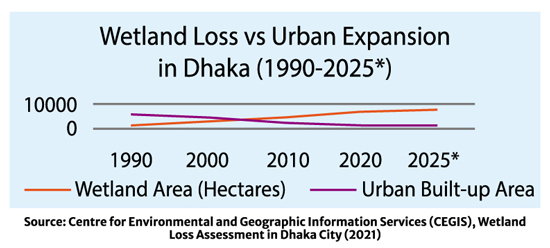
According to satellite data from the Centre for Environmental and Geographic Information Services (CEGIS), Bangladesh has lost approximately 1.2 million acres of wetlands and arable land since 1990, primarily around urban centers such as Dhaka, Sylhet, and Moulvibazar, as reported in the Wetland Loss Assessment in Dhaka City published in 2021. Dhaka alone has lost nearly 70% of its wetlands, equating to over 43,000 acres of natural floodplains and farmland converted to urban use. The loss of these wetlands translates directly into diminished flood protection and increased vulnerability during monsoon seasons. These wetlands provided crucial ecosystem services, including floodwater absorption, groundwater recharge, and biodiversity support. The loss of wetlands and arable land has intensified the frequency and severity of flooding, with over 7 million people displaced and 60% of Dhaka submerged in 2022, causing widespread damage, according to the Ministry of Disaster Management and Relief's Flood Report 2022: Impact Assessment. The following Figure illustrates the steady decline of wetlands in Dhaka alongside rapid urban expansion from 1990 to 2025.
The following pair of satellite images from Google Earth, depicting the Meghna River area in 2001 and 2025, reveal noticeable spatial changes over time.
Groundwater depletion compounds the crisis, as Dhaka's groundwater levels decline by approximately 3 meters each year, leading to land subsidence of around 1.5 centimeters annually, according to Hydrological Studies on Groundwater Depletion in Dhaka published in the Water Resources Journal in 2021. This lowers land elevation, increasing flood risk. Climate change poses an escalating threat to Bangladesh, with projections indicating that up to 17% of the country's land could be submerged by 2050 due to rising sea levels, potentially displacing more than 20 million people, according to the Intergovernmental Panel on Climate Change report titled "Climate Change 2021: The Physical Science Basis". Coastal cities like Khulna and Chattogram face intensified flooding exacerbated by land subsidence and saltwater intrusion. Urban heat islands in Dhaka raise temperatures by 2 to 3°C above surrounding areas, intensifying heat stress and increasing energy demand, as documented by Chowdhury and Hossain in their 2021 study "Urban Heat Island Effect in Dhaka City".
The health toll is staggering. Dhaka's air pollution, with PM2.5 concentrations reaching eight times above WHO guidelines, contributes to approximately 30,000 premature deaths annually, according to research by Rahman in 2022 and WHO Ambient Air Pollution Data from 2023. Contaminated drinking water contributes to a rise in waterborne diseases, affecting over 20 million urban residents, while the broader environmental challenges impose significant economic burdens on Bangladesh, with healthcare costs estimated at $1.5 billion annually and further billions lost to decreased productivity and infrastructure damage, according to the World Bank's 2022 assessment of air and water pollution impacts.
A key driver of land degradation in Bangladesh is the high economic and social value placed on land ownership, with prices in Dhaka's upscale neighborhoods such as Gulshan and Baridhara exceeding ?11,000 per square meter, as noted by Sharmin (2020) and Alam (2021) in their respective studies on residential property prices and urban apartment valuation. Economists employing hedonic pricing models have demonstrated that environmental amenities, including proximity to wetlands and green spaces, raise property values by enhancing livability and flood protection. Beyond environmental factors, owning land in Bangladesh is seen as a symbol of social prestige and financial security. As a result, land frequently becomes a vehicle for money laundering, which drives speculative demand and accelerates wetland destruction and rapid land conversion, with an estimated 250 acres of wetlands being filled each month, according to aggregated monthly reports from environmental NGOs such as BELA and BCAS. This phenomenon illustrates the externality problem where private interests in land ownership impose high social and environmental costs unaccounted for in market transactions.
Despite existing laws such as the Environment Conservation Act (1995) and the Water Act (2013), enforcement remains weak and fragmented. Institutional corruption, political interference, and poor land governance allow illegal land conversions and wetland encroachments to proceed unchecked. Regulatory bodies like RAJUK, Dhaka's urban development authority, have been criticized for approving developments that violate environmental protection guidelines. Even after eight wetlands near Dhaka were designated Ecologically Critical Areas (ECAs), encroachment continues largely unabated. According to RAJUK's 2023 Urban Development and Environmental Compliance Report, only 8 out of 346 protected ponds have been restored since 2020.Independent assessments implicate regulatory agencies in numerous wetland invasion cases, with corruption and political pressure frequently overriding environmental protections. Hundreds of cases remain unresolved years after filing, underscoring courts' limited capacity to enforce environmental laws. This institutional failure reflects a classic case of the tragedy of the commons, where common environmental resources are overexploited due to weak governance and misaligned incentives. Your sentence is clear and well-structured. In her 2021 study "Economic Valuation of Wetland Ecosystem Services in Urban Bangladesh", urban planner Ishrat Islam warns, "We're building on nature's safety net. Each acre of wetland lost costs Dhaka $1.2 million annually in flood protection and cooling services replaced with brittle infrastructure."
Bangladesh's water challenges are further complicated by the transboundary nature of its river systems. Over 90% of Bangladesh's surface water originates from rivers flowing through India, Nepal, and China, according to the Ministry of Water Resources' 2021 "Transboundary Water Sharing Report". Many rivers cross international borders multiple times, complicating water management. Upstream dam construction, diversion, and extraction reduce flows and disrupt ecosystems downstream. Regional tensions, such as recent disputes between Pakistan and India, highlight the fragility of transboundary water cooperation in South Asia. These realities leave Bangladesh at nature's mercy, vulnerable to upstream decisions beyond its control.
Yet hope exists in regional models like the Mekong River Commission, which has successfully promoted cooperation among member countries through data sharing, joint planning, and negotiated water-sharing, generating significant benefits such as improved flood management and sustainable water use, as highlighted in the MRC's 2020 Annual Report. Similar cooperative frameworks could provide Bangladesh and its neighbors a pathway to better manage the Ganges-Brahmaputra-Meghna basin's shared waters.
Likewise, the Dutch Delta Approach offers a proven, integrated framework- empowered basin-level water boards; a multi-layer safety strategy combining embankment reinforcement, designated floodplains and community early-warning; nature-based wetland restoration; real-time flood forecasting under a rolling five-year adaptive plan; and sustainable financing via modest user levies and stakeholder engagement. Piloting these elements in Bangladesh's Ganges-Brahmaputra-Meghna Delta could significantly enhance resilience to floods, land subsidence and climate change.
To halt environmental degradation and build resilience, Bangladesh needs integrated reforms. Establishing a dedicated, independent environmental enforcement agency empowered to act decisively against illegal land conversions and pollution is essential. Digitizing land ownership records will improve transparency and prevent fraudulent acquisitions. National wetland restoration programs aiming to recover 30% of lost wetlands by 2030 must be prioritized, alongside urban green infrastructure investments like permeable pavements, rainwater harvesting, and urban forestry to reduce flooding and heat stress.
Industrial expansion requires enforceable and state-of-the-art pollution mitigation systems, pollution standards, pollution taxes known as Pigouvian tax, and incentives such as subsidies to adopt cleaner technologies. Sustainable agricultural practices, including efficient irrigation, balanced urban-suburban-rural population migration, and soil conservation, will safeguard food security while reducing pressure on water resources. Climate adaptation must be mainstreamed into urban planning, focusing on flood resilience, coastal defence, and ecosystem conservation. Public education campaigns and community-led conservation initiatives are crucial to foster stewardship and ensure long-term protection of Bangladesh's natural resources. Balancing economic growth with environmental sustainability and governance reform is Bangladesh's pathway to a secure, prosperous future.
Rabeya Basri is a student of Master of Science in Applied Economics at the BRAC University.
atrabeya.basri@g.bracu.ac.bd.
Faizah Tasnim is a student of Master of Science in Applied Economics at the BRAC University.
atfaizahtasnim@gmail.com.
Muhammad Shafiullah, PhD, is an Associate Professor of Economics at BRAC University. muhammad.shafiullah@bracu.ac.bd.