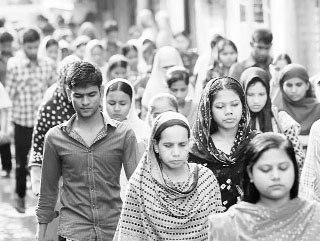
 Garment workers play a significant role in developing other sources of business
 The US$ 24 billion apparel industry of the country not only contributes to earning the largest share of foreign currency and creates employment of tens of thousands of garment workers but also plays a significant role in developing other sources of business. The growth of the readymade garment (RMG) sector has established a vibrant private sector producing thousands of successful entrepreneurs, millions of skilled workers and helped put the economy on a firm footing through contributing 80 per cent to the national export basket.
For the RMG sector, the backward linkages are weaving the fabric, spinning the yarn, and dyeing, printing and finishing operations. These operations can be combined into one composite mill or they can be established as separate units. The establishment of composite mills or individual units of weaving, spinning and processing would reduce lead time and increase value addition and employment, in addition to improving the cost advantages. With the expansion of the sector, linkage industries supplying fabrics, yarns, accessories and packaging materials have also expanded.
Now, the local primary textile sector supplies about 90 per cent of the required fabrics for the knit sector while it meets about 40 per cent woven demand, according to industry insiders. There are now state-of-the-art accessories factories which also meet the demand of local apparel manufacturers. In addition, demand for services like transportation, banking, shipping and insurance has also increased. All these have created additional entrepreneurs and employment.
Now, the industry employs directly about 4.0 million workers, about 80 per cent of them being women. The total indirect employment through the backward and forward linkage industries created by the RMG industry is estimated to be some 4.0 million while more 20 million people depend on this sector for their livelihoods.
Besides the backward and forward linkage industries, this vibrant sector has also boosted up the economy through the RMG workers' expenditure basket of an annual Tk 226.5 billion. The sector has boosted the growth of different kinds of businesses and trading like renting house, grocery shops, tea stall and makeshift markets for clothes, shoes, toiletries and kitchen items, educational institutions including madrasas and coaching centres. All of these have been established centring the hubs of apparel factories.
Along with these, when garment factories close late evening, temporary vendors of cosmetics and toiletries, clothes, utensils and vegetables are found between the factory location and the workers' residences. An RMG worker in his/her day to day life is spending enough money to make the overall spending go high up. They give rental for dwelling, use transportation for commuting, consume food for living, use consumers' goods for grooming and spend in recreational activities for refreshment.
Shahab Uddin, a grocery shop owner at the city's commercial area of Tejgaon, made the best use of the demands for daily commodities of the thousands of garment workers living there. He, who set his small shop a couple of years back, without mentioning any percentage said majority of his customers are garment workers.
Nurul Islam, who worked as a day labourer for loading and unloading raw materials and finished products at a garment factory, now owns a tea stall located at the apparel hub in Gazipur. The area is surrounded by many apparel manufacturing units which encouraged him to start his own business. A poverty-stricken man Nurul Islam came to Dhaka with his family in the middle of 2001 as he barely managed his daily expenditure in his village. In his family, there are three more livelihood earners, his daughters who work at different garment factories.
Renting house has become another source of income, though controversy still remains whether the land or house-owners are entrepreneurs or not. The garment factories have forced the migrant workers to dwell adjacent to their work stations which has created a large opportunity for the land lords or house-owners to turn it as a source of their income.
Parvin, a garment worker, lives in a small room of a three-storied building at Tejgaon with her husband and one baby boy. She has to share kitchen and toilet with six more families on the second floor. She has to pay Tk 4,500 per month for the room. There are a total of 18 families living in the same building. Her house-owner earns about Tk 81,000 only by renting his building.
Salma Khatun delivers lunch boxes (prepared food) in Molla Bazar area of Ashulia and 50 per cent of her customers are male garment workers who live alone or share a shade. Kashem Mia, a vegetable vendor at city's Mirpur, comes to the Kalshi road to sell kitchen items every evening. According to him, garment workers hardly manage time for daily kitchen items shopping. They usually buy daily necessary commodities when they go back home from their workplaces. Kashem Mia represents hundreds of such hawkers or temporary traders of low-cost clothes, shoes, cosmetics and toiletries whose businesses largely depend on the RMG workers.
Labour leaders have expressed opinion that garment workers are the main engine of the country's highest foreign currency-earning sector. But unfortunately, they are always being used as a tool of income by others. Khondaker Golam Moazzem, additional research director of Centre for Policy Dialogue, said linkage effects of the garment sector are probably the highest. Garment workers, through their expenditure, help to grow virtual cycle of retail trading thus having a positive influence both on urban and rural areas.
According to BGMEA, the 4.0 million garment workers in the country have created an annual local market of Tk 226.5 billion for different services and commodities. The sector's workers have created a market for food worth Tk 100 billion, accommodation of Tk 80 billion, clothing of Tk 15 billion, transport of Tk 13 billion, mobile of Tk 10.50 billion, entertainment of Tk 8.0 billion and another of more than Tk 13 billion for cosmetics and toiletries like soap, shampoo, hair oil, fairness cream and toothpaste, BGMEA statistics shows.
Email: munni_fe@yahoo.com
© 2026 - All Rights with The Financial Express

