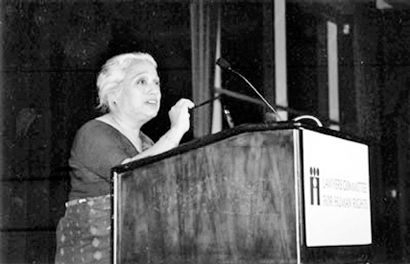
It is not easy to write a tribute for a public figure of significant importance. There are many attributes to choose from. While writing a tribute one faces a dilemma - as to which parts of the life of the deceased to accentuate, and which facts to omit. On this day I am being challenged with this task as I choose to write about Bangladesh's pioneer human rights activist the late Salma Sobhan, on the 11th anniversary of her death.
It was reported that on the night of December 29, 2003 Salma Sobhan had suffered a cardiac arrest and passed away in her Gulshan, Dhaka residence. Her death was felt by everyone from across the nation and by people of all backgrounds.
A voracious reader known for her great intellect, she was exercising her mind even minutes before her death. On that frightful night Salma Sobhan was reading a book. I often wondered what it was that she was reading. Was it Proust or Voltaire?
Salma Sobhan doesn't need an elaborate introduction. She was a friend of the invisible and the disadvantaged in Bangladesh. She is still very much with the people whom she had represented. Bangladesh is aware of the work she had done. Her legacy continues.
On the anniversary of her death, it is vital that we do remember her, pray for her, and pay our respect to her -- while we reflect on the social changes that she had brought through her activism.
I didn't know Salma Sobhan personally. Over the years, I came to know about her as the forerunner of human rights movement in Bangladesh through my readings.
I want to share with the readers my impression of Salma Sobhan as a person, a teacher, an activist, a wife, a mother, a niece and a friend of the people.
Salma Sobhan came from a prominent family in Pakistan. She was a graduate of Westonbirt School in England. She studied law at Girton College in Cambridge. In 1959, she was called to the Bar and at age 21 she became the first woman barrister in Pakistan. In Cambridge she met and later married Rehman Sobhan, an economist. After her marriage, she came to East Pakistan and made it her base camp.
I got a glimpse of younger Salma Sobhan from a letter that her maternal uncle Huseyn Shaheed Suhrawardy wrote to her from jail right before her marriage. There he described her as someone who was "preternaturally transcendentally intelligent." He advised her about her role of a future wife to her husband. He told her to keep it in mind and not to have any conflict of intelligences.
He prepped her about married life and its responsibilities, and instructed her to set her own house in order before embarking on social service. He warned her that many will find her intellect to be threatening, and she would be misunderstood.
I found Suhrawardy's elegant letter to be a roadmap and an insight to Salma Sobhan's personality. He called her a 'humble little creature' who dreaded to hurt people. He wrote to her to be sympathetic towards others, even when that person is not worthy of it. In the letter, he praised her humility and felt unperturbed that she will be able to use it in reaching out to people and living an exemplary life.
At age 25, Salma Sobhan started her teaching career at Dhaka University. She taught Jurisprudence, a tough aspect of law. Her students remember her fondly. After her death, one former student in a eulogy wrote that she recalls one vivid conversation that she had with her professor. During that meeting, Salma Sobhan confided that she regretted living abroad for years. As a result, she felt she had a late start in doing important work.
Because of her sobriety and seriousness, she was well-liked and respected by her students. She often encouraged her female students to undertake activism. She counselled them on how to fight for their place in our patriarchal society.
Subsequently Salma Sobhan worked at Bangladesh Institute of Law and International Affairs till 1988. She served as editor of Supreme Court Law Reports for several years. In 1986 she co-founded the Human Rights organization, Ain O Salish Kendro (ASK), and served as its executive director until her retirement.
Though Salma Sobhan came from a very privileged background, while living in Bangladesh - she symbolized anew spirit against the established elitism of that time. She was very interested in politics; yet, her activism wasn't ignited by political ideas. With her passion and commitment for social activism, she set out to bring change for the ignored women in our society.
Salma Sobhan was troubled by the way Bangladesh's unseen and excluded women and children were trapped in society's shocking and enormous wealth gap.
She saw how the underprivileged were separated and were left without any legal representation. Her legal mind found it to be repugnant. Until this feminist lawyer with a brilliant legal mind emerged, the deprived women in Bangladesh hardly had any idea about their legal rights.
Salma Sobhan was a voice for the people who had no voice, and stood up and gave those women, a status. She was unfazed when the critics said in a poor country like Bangladesh; the idea of human rights is a luxury, a Western concept.
Salma Sobhan's work became about protection of human rights and advocating women empowerment. She emphasized that without women empowerment, women would never be able to claim their rightful place in society. She pioneered this movement with enlightened personalities and other human rights activists in Bangladesh.
Salma Sobhan also became involved internationally. In 2001, she was given recognition for her work by the Lawyers Committee for Human Rights in New York. The ASK documentary 'Eclipse' earned a VH-1 Witness Award. The film focused on the injustices of fatwa on Bangladeshi women. Salma Sobhan went to California, USA to represent ASK to receive the award.
Under Sobhan's able leadership, ASK had developed into a major medium of human rights in Bangladesh. Today the activists and the lawyers associated with ASK regularly participate in activism and represent the under-privileged and the poor women of Bangladesh. The organization also serves as a legal aid service and gives free legal advice to the uneducated poor women.
For example, the organization's lawyers help women to settle marital disputes, and take action against violence on women. They work hard to preserve the childhood of the under aged domestic workers. A while back, I read that a poor widow was evicted from her house by the landlord and ASK came to her aid and found her housing.
Through ASK, Salma Sobhan implemented another programme for BRAC where neglected rural women are taught about their legal rights. She was directly involved in supervising this project. Without having information, the poor women would never know about their legal rights and the choices that are available to them. Because of this legal education programme, "20 lakh rural people across the country are now receiving law education."
This champion of human rights also took on a very prominent role in the development of 'Women Living under Muslim Law' network. She wrote and spoke against religious injustices and extreme religious beliefs. She strongly felt about women's equal rights to inheritance.
Salma Sobhan knew that repressing women by denying their rights and by ignoring the 'disenfranchised communities' will be counter-productive for the progress of our nation. To have an optimum result, a nation must include the women as equal partners.
Her background did not distort her perception about the conditions of the poor. With her passion and hard work, she brought the inequities around her into focus. Because of her sensitivity and dedication to her mission, their lives became better.
In 1981, tragedy struck Salma Sobhan in the worst possible way. Her firstborn died in an accident in England. Unquestionably to any mother, it is a loss that is irrevocable. A loss of such magnitude is not comparable to anything else. I had read that Salma Sobhan faced this unimaginable heartbreak with valor and dignity.
After her passing in 2003, in a memorial service, a lot of her peers and people who knew her well came together in celebration of her life.
I remember seeing a photo of the hall in preparation prior to the service. The stage was filled with flowers of many colours. Salam Sobhan's portrait was decorated with garlands. The huge number of oil lamps complemented the celebratory, and yet, a somber mood.
At the memorial service, activist Hameeda Hossain shared her impression of Salma Sobhan, 'She was a wonderfully warm person, with a great sense of humour. She had a lot of friends all over the world and used to spend time mailing to them. She was very keen in swimming and loved sight-seeing.'
At the end of the service her husband spoke. He talked about her with great warmth. 'Salma Sobhan considered her subordinates as friends and always believed in collective efforts to achieve success,' he said. Later in a book he wrote about her love for her family. He revealed that more than anything his wife wanted a 'tranquil' family life.
The cotton sari wearing grand dame has passed on. Today, we the nation remember her with affection. We feel blessed for the time she was with us. We remember her for her kindness, her intellect, her tenacity and for the strength of her character. We admire her courage and for her dedication to improving the lives of the poor women through her activism work.
Salma Sobhan touched many lives; she changed the fate of many. On the anniversary of her death we the nation salute her for her service to our country.
Email: zeenat.khan1983@gmail.com
© 2026 - All Rights with The Financial Express

