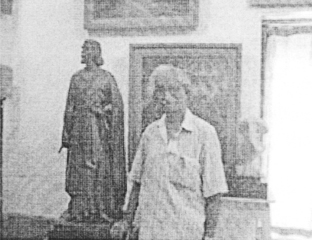
 Selim Munshi with statue of Rabindranath
A stranger taking a casual walk past an unassuming building called Niharika Gallery, in a cul-de-sac of Guru Polli, Shantiniketan, can be forgiven for never suspecting that it contains some of the finest specimens of art in the entire country ... by a single artist, Professor Selim Munshi, former student and teacher, of Kalabhavana, Biswa Bharati University.
In Selim Munshi's work genius goes hand in hand with variety of form and medium. Works of art as diverse as line drawings, charcoal sketches, water colours, oil and acrylic paintings, pastel drawings, etchings, washes, wood-engravings, lino-cuts, as well as sculptures in marble, mortar, plaster-of-Paris decorate the north wing of the house, and the stairs leading to it, now converted in to the gallery called after the artist's beloved wife "Niharika," who is alive not only in body but also very much in the mind of the artist.
Famous men of his time who touched his life have a place in portraits - former President Lal Bahadur Shastri, Prime Minister Rajiv Gandhi, famous Canadian writer Eric Anderson and of course his tosso-guru, Rabindranath Tagore.
Yet deep inside Munshi's heart lies his true love for the rural landscape and for the country-folk in their daily activities. A charcoal sketch of a beggar woman with a sixty degree bent back delights by its mastery of line and its utter simplicity; a soft-ground etching of a beggar man in acqua-tint colours in Turk hat, beads and robe appears, the head and shoulders of the man bent in utter supplication, yet with an indefinable dignity about his bearing. After the day's labour, a large fishing boat throws anchor in the telltale sparkle of the setting sun, the black-and-white etching detailing in full the activities of each fisherman.
Different from these drawings is the impressionistic drawing in pastels of women bathing in the Kopai river - the yellow and brown, mingling with the green, blue and white in the soft play of soil and sky that merge into each other and with the women.
Apart from its value as a collection of art with originality and outstanding quality, Munshi's work is also a historical document in more than one sense. He has captured Tagore's Shantiniketan, as it was when he was a young man in the fifties and sixties, before it was slowly transformed by Time working through the hands of the administration.
The Boshonto-utshob, or Spring festival in Amrokunjo with women clad in yellow gold sarees, dancing under the mango trees shows us the festival as it used to be in bye-gone days - today the women dance on stage.
The lost forms of the landscape have been caught in the 1967 khoa or wasteland scene the cattle herd driving the cattle home in rich tints of browns, yellows, and pinks. Today the khoa scene is no more, for trees have been planted here by the hand of man. The buildings of Shantiniketan Ashrama that no longer stand and are lost to posterity reveal themselves in Munshi's paintings - such as the naib's residence, and the shomobai- bhandar.
Of human figures, Munshiji appears to have done sketches of the female nude model because it is the done thing, that every artist does. But there are human figures in action that take on a special meaning by reason of the artist's sympathies.
The cyclist's pose in deft charcoal lines, as he makes a turn, (cycling being a popular means of transport here), the more detailed pencil sketch of a sleeping woman whose breast disappears inside the neck of an apparently headless child, delineate at once the common event, and the singular impression that it makes in the artistic imagination.
Likewise the tender feelings of the artist for a revered guru are manifest in the pencil sketch of his teacher Nityanondo Binod Goswami, done when the latter was in hospital.
Munshiji is a sculptor par excellence. His sculptures make powerful statements about the observed world as seen through the lens of the artist's beliefs, his interests, and sentiments.
A sculpture in black-coloured cement of the famine stricken mother and child leaps to the eye. With breasts devoid of milk, the mother with her child screams at Heaven. The one cannot give, the other cannot take, nourishment. It is impossible to gaze at that piece of work with dry eyes.
A sketch bearing the same theme also appears, reminding the observer strikingly of the work of our renowned artist Joynul Abedin.
The chubby looking white owl fluffs its feathers in marble chips and white cement, the fish-figure in bronzed plaster-of-Paris has scales like a harp, and the human figure does yoga in the dog posture.
Munshiji's bird figures in cement, bronze, wood, and plaster, are a significant aspect of his sculpture. Just about to fly, just alighted, head cocked at the sky, or turned over in the final act, they seem to substitute for Munshiji the variegated poses of the traditional human nude.
His tosso-guru Rabindranath appears in drawing, painting and sculpture again and again. One of the most striking sculptures in the entire repertoire that greets the visitor at the entrance to the gallery is the 3-foot statue of the famous bard in bronzed plaster-of-Paris, mounted on a pedestal. The poet stands in animated pose, looking slightly heavenward with his right forefinger pointing to the ground - this soil - this Shantiniketan. There is a look of concentrated thought and anxious concern on his face - the lips are pressed in some tense apprehension. The fine shape of the lotus eyes has been chiseled remarkably well - with the amply rounded curvature of the whites that is common in the Tagore family.
The sculpture carries a load of political meaning to the discerning eye. Tagore was, in his final days, disillusioned and frustrated with the administration of Biswa Bharati University, that he had founded. Selim Munshi too, has had many embittering and disillusioning experiences with the administration that have made him withdraw and lie back. This parallel in concern and feeling between guru and disciple toward Shantiniketan is indeed remarkable, and remarkably blended by the artist in his art.
Born in 1938 in an aristocratic Muslim family at Horipur in the district of Birbhum, Selim Munshi was introduced through Aditi Tagore of the Tagore family to the artist Nandalal Bose who had designed with Rabindranath the architecture of Shantiniketan. Nandalal was impressed by the young Munshi's talents and succeeded in persuading his unwilling parents to get their son admitted to Kalabhavana of Viswa Bharati University in 1956. Here Munshiji's youthful talents flourished under teachers as great as Ramkinker Beij, Radhacharan Bagchi and Dhirendranath Krishna Burman. Munshi passed out with a diploma, then got admitted to the Government College of Arts and Crafts, Kolkata, from where he passed out with a Diploma in Fine Arts and Crafts in 1963.
In his student days, Selim Munshi had close association with Rathindranath Tagore and Pratima Tagore, son, and daughter-in-law, of Rabindranath Tagore, both of whom praised, encouraged, and promoted Munshi's art.
Subsequently Munshiji joined the Pathyabhavana under the University as teacher of sculpture, then the University itself as Reader, then Coordinator, and subsequently as full Professor. Viswa Bahrati honoured his genius by arranging for his solo exhibitions in Rabindrabhavan, and in Parliament House, New Delhi, at its seventy-five years Diamond Jubilee celebration.
Critical acclaim for Munshi's work came from many contemporary men and women of renown, like O C Ganguli, famous artist, who specially praised Munshiji's 'great originality' in clay modelling, and his 'non-representative sculpture and wood-carving.'
Sunti Kumar Chatterjee, National Professor of Humanities, stated that: 'It is a great relief that he has abstained from sinking into the morass of what is modem and abstract and not always art.' The Canadian author Eric Anderson constantly encouraged Munshiji and believed that he will one day get the recognition he deserves.
As an artist Selim Munshi believes first and foremost in the integrity of craftsmanship. According to him an artist must be over and above the lure of fame, money and power, anything that can diminish the state of total dedication, or the artist's 'sadhna'. Upright, outspoken, and intellectually honest, the artist was pained to see, since 1966, malpractices in the administration 'by a few high ranking personnel, in the administration of Viswa Bharati, both academic and administrative.'
Selim Munshi's love for Rabindranath and dedication to the cause of the University he had founded compelled him to raise his voice against such irregularities at the expense of earning the enmity of some powerful people and consequently causing injury to his own career. Likewise the true artist in him has consistently refused to take sides with, or to be part of, any politicized grouping. Such involvement is, according to him, tantamount to compromising the artist's position and betraying his unalloyed commitment to his sadhna.
Today, Selim Munshi stalwartly runs a private gallery named after his beloved wife to whom he is deeply and romantically devoted. In the name plate that declares: 'Niharika Art Gallery - a permanent gallery on and around old Santiniketan.' The single adjective old carries loads of political meaning. It is and was old Santiniketan that Selim Munshi loved, adored and venerated in his drawings and etchings, his paintings and his sculptures, that, according to one distinguished visitor, '… are really exceptional and rare. This artist deserves the highest honour from all quarters, including the Government of India. He is living history of India.'
Like 'A violet by a mossy stone/Half hidden from the eye/Fair as a star, when only one/Is shining in the sky' the work of the septuagenarian Selim Munshi blooms and blossoms in the shade, waiting for the one knowing glance of recognition that will proclaim it for what it is, exceptional and original art, of rare craftsmanship and beauty, to publish which before the famed art galleries of the world would be a privilege for generations to come certainly an increase in the storehouse of culture and learning.
Email: thumbelina005@gmail.com
© 2026 - All Rights with The Financial Express

