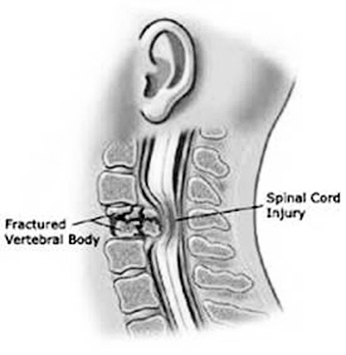
 Figure shows Spinal Cord Injury
 Spinal Cord is the important part of human body. But it can be injured due to different reasons. That's why a great change can occur in life. It can cause paralysis of the body part or whole body. A patient with spinal cord injury needs to compensate his or her life with paralysis. Sometimes patients of SCI may die.
According to medical science, the role of the central nervous system is to control the majority of the functions of both the body and the mind. Simply put, the brain interprets all the information we receive from our senses and internal organs, processes them, then tells our body how to react. For example, if your hand touches a hot stove, your brain will tell your body to move your hand away as quickly as possible. So where does the spinal cord enter into the picture? Well, the spinal cord acts as the main conduit between the brain and the body. In other words, it is through the spinal cord that the messages from the brain to the body travel. If the spinal cord becomes injured, then the messages between the brain and body are no longer clearly relayed.
This injury also has a major impact on our health care system and society as a whole. The incidence of SCI in Bangladesh was found by Hoque (2002) to be approximately six persons per million.
Causes of SCI in Bangladesh include:
l Fall from height: Its very common in our country to fall from tree or roof
l Road Traffic Accident
l Carrying heavy weight over the head
l Bull attack
l Diving into shallow water
l Sometimes different disease process causes SCI e.g. Spina bifida.
Symptoms of SCI include:
l Both hand and leg or both leg (lower half of the body) can be paralysed
l Difficulty to control body movement like a person may not work with his hands, can't sit, can't walk etc.
l Difficulty to understand sensation of the whole body or parts of the body e.g. the person may have not bowel or bladder control
l The person may have problem to do daily activities like eating, dressing, bathing, toileting, combing hair, brushing teeth and so on.
l However the person also face difficulty to continue job and other work.
Why need Occupational Therapy?
Occupational therapy helps to solve the problems that interfere with your ability to do the things that are important to you. It can also prevent a problem or minimise its effects.
When an injury, illness, disability or other problem limits your ability to:
l Take care of yourself,
l Participate in paid or unpaid work, or
l Enjoy your leisure time, e.g. hobbies, sports, spending time with family, then you may want to learn some new skills for the job of living from an occupational therapist.
Occupational therapists believe that occupations (activities) describe who you are and how you feel about yourself. If you are unable to do the things you want, or need to do, to live and enjoy your life, your general well-being may be affected.
Occupational therapy for SCI patients
The occupational therapy (OT) services in the spinal cord injury start from admission to discharge into the community. The main areas of OT intervention are:
Bed mobility and functional transfers: for example, training and practice in bed mobility and in getting to and from the bed, wheelchair, shower chair, toilet, bath, stair lift, sofa, car and other transfers for daily living.
Daily living skills: for example, training and practice in self-care and domestic tasks such as washing, dressing, feeding, drinking, grooming and housekeeping.
Wheelchair, posture and cushion requirements: for example, trial and assessment for a wheelchair (manual and/or powered) that allows maximum independence. Identification of appropriate pressure relieving cushions. Posture assessment and identification of correction/support systems required. Liaison then takes place with each patient's local wheelchair service for provision of equipment.
Hand therapy: for example, maintaining range of movement, oedema management, assessment and training of functional potential, splint provision to prevent deformity, maintain aesthetics and replace function.
Communication aids: for example, trial of equipment to aid communication such as telephone adaptations, writing splints, computer keyboard hand splints, mouth sticks, environmental control units.
Community living skills: for example, advice on returning to work, returning to driving, training and practice in advanced wheelchair skills (slopes, kerbs, rough terrain, stairs), arranging driving lessons, assistance with establishing routines and problem solving.
Leisure & Vocational Training: Involve the patient in different leisure activities as well as select vocational training area according to preference.
Home Modification: Occupational Therapist modifies the patient's home according to needs.
From where you will get the treatment:
In Bangladesh, only Centre for Rehabilitation of the Paralysed (CRP) is working with this type of patients from acute phase to community reintegration phase. We have four phases of treatment. An occupational therapist works in these four phases: Acute Phase, Active Phase, Rehabilitation Phase & Community Reintegration Phase. All phasess are of equal importance.
If you have any relative with SCI, then please refer to following address for proper rehabilitation:
Centre for Rehabilitation of the Paralysed (CRP), Savar, Dhaka.
The writer is a Clinical Occupational Therapist at
Centre for the Rehabilitation of the Paralysed (CRP),
Mirpur-14, Dhaka. Email: rabeya1988@gmail.com
© 2026 - All Rights with The Financial Express

