In 1862, Britain's colonial rulers laid the first railway tracks in what is now Bangladesh. The Financial Express speaks to George McCrudden, a young train driver in London whose work contributes to the continuation of a long legacy that is cherished in both countries
Dense fog hung over the tracks on the very first day George McCrudden drove a passenger train in the British capital, London. Visibility was poor, which made him a little nervous. He took it slowly and felt comfortable in the cab after a few stops.
Today, the 36-year-old works as a train driver for Great Northern under Govia Thameslink Railway (GTR), the UK's largest train operating company. Great Northern services operate on the southern side of Britain's East Coast Main Line, with trains running to and from London King's Cross and Moorgate. Many of the services also run through parts of Greater London, Hertfordshire, Bedfordshire, Cambridgeshire, and Norfolk.
Although driving trains now defines George's professional life, it was not something he imagined for himself when he was young. He grew up near Custom House and Canning Town stations in London, but railways were not part of his family life. He remembers taking the Docklands Light Railway - a driverless, light metro system - and the London Underground - a rapid transit system serving Greater London and some other areas - on school trips.
"At the time, my entire focus was on education. I seriously considered a career in train driving only after becoming a station assistant for the London Underground in March 2015," he says.
"It was because the natural progression from that job appeared to be to go into driving. When the Night Tube - a 24-hour London metro service on select lines on Fridays and Saturdays - opened up in 2016, I applied and got the role," he adds.
What attracted him most to the job was the idea of transporting people. He wanted to be of benefit to society. There was no discouragement from family members or others when he chose this path.
His move from the Night Tube to GTR in 2021 came with challenges. He was worried about the pay cut involved in switching to mainline operations. As licences could not be transferred between the two systems, he had to endure a trainee wage for two years.
The formal training began at Hornsey Training Academy in London, where he spent 14 weeks learning railway rules, regulations, and personal track safety (PTS). At the end of this period, he sat the final rules exam, passed it, and had to wait for an instructor. Once he was assigned an instructor, it took four to five months to get to his final driving exam.
Completing a set number of routes and accumulating at least 250 hours of driving time were part of the requirements. The final step involved a manager assessing his driving ability, route knowledge, and understanding of rules and traction. Having passed all these, he was given the "handshake" that confirmed he was a fully qualified driver.
"Moreover, I failed my traction exam, which led to massive self-doubt. I was not sure what I could do to fix it, but my instructor and I went over it again and again. By the time of the resit, I was ready and passed."
On one occasion during training, he encountered serious operational problems as his train failed completely at Bowes Park, requiring assistance from another train. After carrying out the assistance protection procedures and coupling the trains together, the fault unexpectedly transferred to the other train too. Eventually, the crew were able to shunt the combined 16-car formation into Hornsey.
George only works afternoon shifts, booking on between midday and 5pm. He arrives at work, chats with fellow drivers, changes into his work clothes, and gets on his train. After several hours of driving, he takes his lunch break and usually finishes the shift at Finsbury Park or Welwyn Garden City, from where he heads home.
"It feels pretty great to sit alone in the cab. I love time to myself. To stay focused on long routes, I use a range of personal protection systems - tapping, pointing, self-directed commentary, and even singing," explains George, who loves modern electric trains and does not drive the diesel-powered ones often.
Technology has significantly changed the job since he started. His route has begun operating under the European Train Control System (ETCS), which is a digital, in-cab train signalling and automatic protection system designed to standardise railway safety across Europe. He will soon learn Automatic Train Operation (ATO), a method of operating trains automatically where the driver is either not required at all or serves a supervisory function at most.
Despite the technological progress, he anticipates a very slow transition to ETCS in England, estimating it could take at least 50 years to cover just the country's southern part. He also believes self-driving trains are feasible on small sections but not across long, hundred-mile routes. In his view, passenger safety should remain in the hands of trained humans with the support of appropriate safety systems.
King's Cross is his favourite station, and approaching it, he sees the units of various train companies. Then the gigantic roof looms over him as he exits the tunnel and enters the platform. The station always hums, and he often gets longer breaks there, which allows him to enjoy the sights and sounds of central London.
He loves the Eynsford-Sevenoaks route, especially the latter part of Sevenoaks. It is in Kent, which is called the Garden of England due to the abundance of lovely gardens and lush landscapes. But he thinks the routes in and around Wales are the most scenic ones.
"I have not driven there. But I have been to Wales by train. It has gorgeous, natural views," he says.
One of the most memorable incidents in his career occurred after he departed from Wimbledon and was informed of an attempted terrorist attack up ahead at Parsons Green. The day was chaotic and involved close coordination, helping passengers, and working under instructions. The events remain etched in his mind.
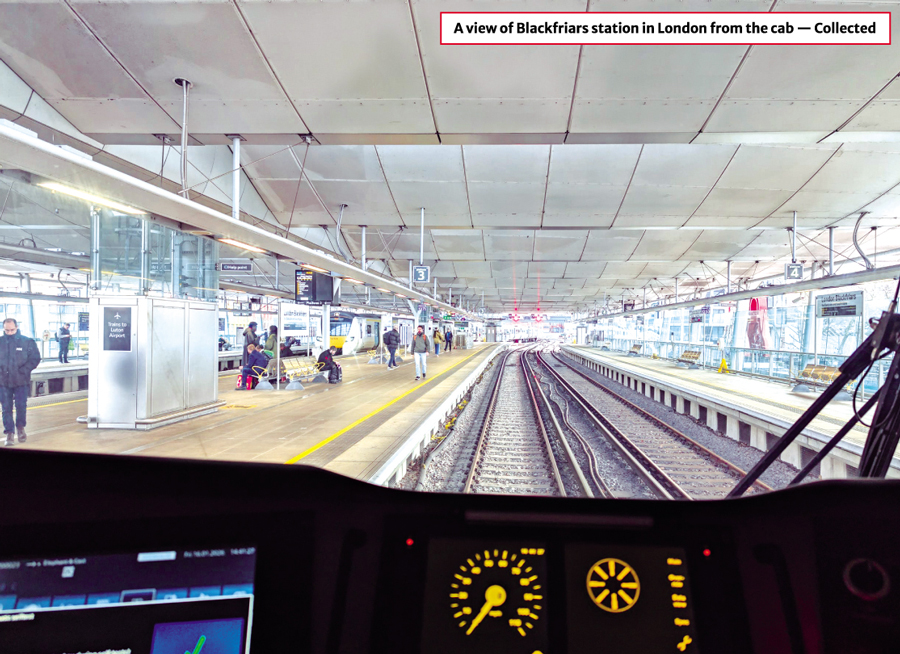
To him, being a train driver means having job security and feeling a sense of worth. He also likes the fact that he works with a "fantastic" group of people. His greatest pride comes from knowing that he helps people get to and from events that matter in their lives.
"I think the job has made me much more aware of the changes in society. As I drive, I see the shifts in demographics, fashion, trends, beliefs, and even people's work schedules," he notes.
If he could speak to his younger self, he would still recommend this career. Despite the shortcomings, he believes a railway job has brought many positive aspects into his life. However, he wishes passengers had a better understanding of the harsh realities of this job, particularly the shift work, the lack of flexibility, and the possibility of facing a fatal incident that can affect a driver for life.
From the historic dawn of steam in 1825 to today's electrified networks, Britain's railways evolved dramatically over two centuries. Modernisation has resulted in faster journeys and increased capacity. Yet, George insists the old-world romance of train travel - often characterised by slow journeys, scenic views, and on-board socialising - is still very much alive.
"Both my wife and I love travelling by train just for the enjoyment and pleasure of it," he concludes.
r2000.gp@gmail.com