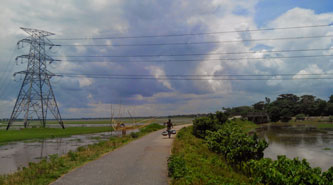
 A road runs through a sleepy village of Brahmanbaria
We six friends - Jamil Mazid, Tazul, Jamal Khan, Yasin and Bashar - were returning to Dhaka after spending a three-day vacation at a tea garden in Moulavibazar. Jamil Mazid wished that our vacation would be wonderful if we could visit a typical village. Ambassador Jamil Mazid was a career diplomat and spent his life time abroad and his visit to a village was a distant memory. So was the case of Dr Jamal who returned home sometime back after teaching management in a university in Barbados for thirty years. We were driving past Brahmanbaria town 20 km from my village home in Saydabad which I had not visited, for inexplicable reasons, for a long time. My father was doing a transferable job and put me up in a hostel of Brahmanbaria Annada High School, from where I finished my school education in 1951.As my father was posted in distant Faridpur, I often visited my village home during vacations. I told the driver to take the bypass road connecting the Brahmanbaria - Comilla Highway. Now it took only 20 minutes to reach the doorstep of my village home while it took me half a day in the past to reach home by train to the Gangasagar Railway Station and walk five miles over narrow edges of paddy fields. During monsoon when the land was submerged in water, the boat journey was arduous with heavy accumulation of water hyacinth. .
We left the Brahmanbaria Comilla Road, entered my village and went past Saydabad Adarsha Biswabidyalay, the high school for boys and girls, the old madrassa buildings, and lo and behold, a kindergarten school. What a change! My father had to walk 10 miles up and down to his high school in Kasba every day. The village now had a new look, a new landscape beyond recognition, mostly with brick-built homes connected with electricity and TV antennas and metalled roads instead of thatched huts and narrow dusty footpaths of the past, thanks to remittance sent by migrant workers from the village.
We drove our transport right to the doorstep of our home. We found a tractor at the entrance of our home. Sharif, my cousin, said he rented the tractor to others in our neighbourhood as nobody now used plough and bullocks to cultivate land. All the houses of my cousins were now semi-brickbuilt connected with electricity and television antennas. Sharif asked us to wash before tea. The bathroom had modern sanitary toilet facilities with a wash basin. The change was stark and unmistakable. As a child I used to go to the jute field to answer to the call of nature.
We were chatting in the veranda when the wife of Sharif wearing salwar kamiz and dopatta came with a tray of cups, saucers, tea and a packet of Haq biscuits. Sharif informed us that she was teaching in the kindergarten school. Soon my other cousins and their sons showed up all wearing shirts and jeans and shoes in sharp contrast to my childhood memory of grandfather and uncles Anis, Abikul and Zahir clad in lungi, gamcha and ganji, all barefooted.
It was past noon. Sharif called us at his home for lunch. In the room there was an almirah containing plates, cups and saucers. Beside the almirah there was a small sofa set. We took our lunch at a dining table. Sharif's son was watching the TV and changing channels. He switched on the fan. The lunch was no different from ours in the city, cultivated fish, Telapia and Pangas, farm poultry and vegetables bought from our village market and cooked with Soyabean oil. Sharif brought out a dish of Firni from the refrigerator to serve us dessert.
It was evening and time for our departure. My cousins and their wives and children gathered together for a group photo with us from their mobile phones. Darkness was gradually descending down the horizon. We started back on our journey through the paddy fields in the village and in the twilight saw a villager with his wife thrashing paddy in a husking machine. I left the village with a long lingering look behind. . A sense of sadness gripped my mind.
There was silence in the car we were driving. Jamil Mazid broke the silence when he asked me why I had a melancholy and pensive look on my face. I said, "It is because I failed to keep my promise to show you a typical village". He was surprised at my disappointment. He said, "It is alright. Yours is a very modern village with all signs of development. We thoroughly enjoyed the visit. We missed nothing". I looked at him with a mixture of disbelief and dismay. I said, "It is true ours is a modern village with all signs of development. It is true modernity has given speed and convenience, shine and dazzle to village life but I have a feeling, I cannot fully explain why it has taken away its innate and eternal charm. It is no more a village where we seek refuge from the artifice of mad and heartless city life. It has lost its character of love, simplicity and innocence. The distinct dividing line between the village and town is now blurred. Development has now snatched away the pristine glory and beauty of the village life. The simple, placid and tranquil lifestyle in the village has disappeared. The village would be found only in a museum in future."
I said, "I am sad as I missed my village of childhood. I missed the chattering of sparrows and chirping of dove, parrots and pigeons on the banyan tree now gone at the entrance of our home. The old mango tree at the centre of our home which provided me shelter from the sweltering summer heat had now disappeared. I missed the cows in the cowshed, the plough, the ladder and the haystack at the corner of our home. I missed the smell of mud and manure, the stench of cowdung and wet jute. I missed the chickens in the courtyard and ducks, dahuk, heron and machranga birds in our pond. Here was God's plenty of splendid nature.
I missed the dheki in the kitchen used by aunt Rashida to husk paddy. I missed the harvesting of corn and winnowing of rice in the courtyard. I missed the fishing net and Polo a fishing gear, used by Abikul Chacha to catch fish from the marshland near the bank of Titas not far away from our village. I missed our family boat tied at the rear pond and the majestic palanquin ride by mother visiting our home from her father's place during holidays of my father. I missed the dinner with unadulterated fish from our pond and home grown vegetables, the pumpkin, bottle gourd and beans on the tin roof, cooked with mustard oil obtained from mustard seeds crushed by cattle-driven crushers in our village. I missed the dim light of oil lamp in the evening casting panic and emptiness in my mind.
I said, "I am sad as I missed the gramophone borrowed by Zahir chacha to listen to songs Toofan mail jai and Ei ki go shesh dan sung by Kanon Devi in Sesh Uttar and Mukti cinemas. I am still haunted by the magic and mystery of grandmother's large-size wooden chest which, as a child I always imagined, was available in a treasure island only. I missed the tender love and affection of grandmother entertaining me with pithas, not Haq biscuits, in an earthen pot. Every time I read the poem 'The Solitary Reaper' by Wordsworth, it evokes my memory of the shy and coy look of a village damsel, Rokeya, my cousin hiding her face behind the veil of her simple handloom saree."
Today's development and progress in the village are welcome. But poor still how sincere and warm, loving and intimate was my village in my childhood! How sweet, serene and breathtaking was the pastoral beauty of the lost, peaceful arcadia of my childhood seventy years back!
Abdul Hannan is a columnist and former diplomat.
Email: hannanabd@gmail.com
© 2026 - All Rights with The Financial Express

