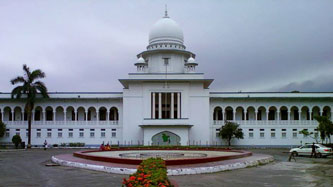
 Bangladesh Supreme Court: Upholding the rights of the people.
 Access to justice is still a major challenge pertaining to the discourse of good governance, rule of law and democratic values as core ethos of liberation struggle in Bangladesh even after 45 years of Independence. Judiciary is considered the last resort of hope to address the grievances of millions of downtrodden, though they have to endure a number of obstacles to get remedy from the highly-centralised district-based sub-ordinate court structure in Bangladesh.
To ensure 'access to justice' is a global and national goal (Articles 7,8 and 10 of the UDHR and articles 14,27,31and 35 of the Constitution of Bangladesh) in every part of the world, at least in book, but the civilised nations (nations which have ensured rule of law and justice) of the world have translated this objective into reality and so these nations are frequently exemplified as pathfinders for the nations like us. But the pertinent question arises: how long should we wait to get access to meaningful justice for the wider hapless community of the nation who have long been waiting like skylarks to have 'sustainable justice'.
The upazila is the second lowest tier of regional administration in Bangladesh as it has local level head offices of almost all the major ministries which have to address daily issues of citizens inside the country. But for some mystique and unreasonable excuses, the judiciary of Bangladesh is not physically present at the upazila level except some 'Chowki'Adalats.
'We are champions to demolish instead of building an institution' as critiques rightly observed. In 1983, the upazila level courts started to work formally in Bangladesh and that system was just taking shape with reforms and it was correcting past mistakes. But all on a sudden, it was ditched for some lame excuses ignoring the local demands. If we had continued the upazila court, the history of access to justice in Bangladesh would have been a far different success story.
To enhance beauty and glimpse of judiciary with access to justice, there is no alternative but to ensure its upazila level presence which would bring enormous advantages to the stakeholders at large. Setting up upazilla level courts can further brighten the image of the entire judiciary in Bangladesh as it could ensure access to justice with amelioration of confidence of the owners of the republic. The local people after doing their daily household chores and necessary activities in fields or elsewhere can go to the court as stakeholders and it would save time, money and energy many times more than the present district headquarters-based sub-ordinate judiciary does. Lack of presence/availability of witnesses required for completion of a case/suit in time is one of the core problems leading to the 'backlog of around 3.5 million cases' in Bangladesh. There are many cogent reasons behind this challenge whereof minimum 1-3 days' income loss of an ordinary/layman justice seeker/witness is a major obstacle. The active and functional upazila level court can alleviate, if not eradicate, this perennial time-consuming process of litigation in many parts.
Functional upazila courts can create a new avenue of enhancing legal awareness amongst the ordinary people who are highly suppressed due lack of necessary legal knowledge which is presumed to be attained by the individual citizens. But the fact is that the majority of us do not have the basic legal orientation, culminating in colossal deprivation and frustration where some profligates, touts and go-between triumph for vested interests. Local economy and law-order situation could also be aided by the presence of upazila court. In view of sections 22 and 25 of the CrPC, 1898, the judicial magistrates of the upazla court can also work as 'Justice of Peace' in the concerned jurisdictional territory of an Upazila which would quench the necessity of mobile courts in a very efficient manoeuvre based on law and only law. Thus, the government's efforts to establish good governance, rule of law and justice can be boosted in its true sense.
Having experienced 'Chowki Adalat' at the upazila level, it is highly explicit that there are some crucial impediments prevailing at present to work there but those could be overcome for the sake of access to justice for the grassroots. The judicial officers of Bangladesh have the track record of working in any kind of uneasy atmosphere. The judicial officers of Bangladesh have proved their commitment to justice in consonance with patriotism setting aside multifaceted impediments. Young judicial officers have been sacrificing various flamboyant and lucrative options of their lives for the devotion to justice and judiciary of the motherland.
To have a functional and time-befitting upazila court, its organogram should have minimum one assistant judge with the power of senior assistant judge, judicial magistrate with the power of senior judicial magistrate and one joint district and sessions judge. Basic logistics, such as transport, court building, residence, security and others are sine qua non to launch upazila level courts and it is not so difficult for today's Bangladesh which has the national budget worth more than Tk 4.0 trillion.
The concerned policy makers in collaboration with Supreme Court of Bangladesh can take all the necessary steps to set up functional upazila courts without further delay to ensure prolific access to justice for the owners of the republic. Necessary consultations with leaders of bar associations, civil society groups and other stakeholders can help in arriving at a better and prudent decision.
The writer is a member of Bangladesh Judicial Service, at present pursues on deputation LLM in International Economic Law in East China University of Political Science and Law, Shanghai, China under the YES China Scholarship programme.
E-mail:Kohinoorgazi@yahoo.com
© 2026 - All Rights with The Financial Express

