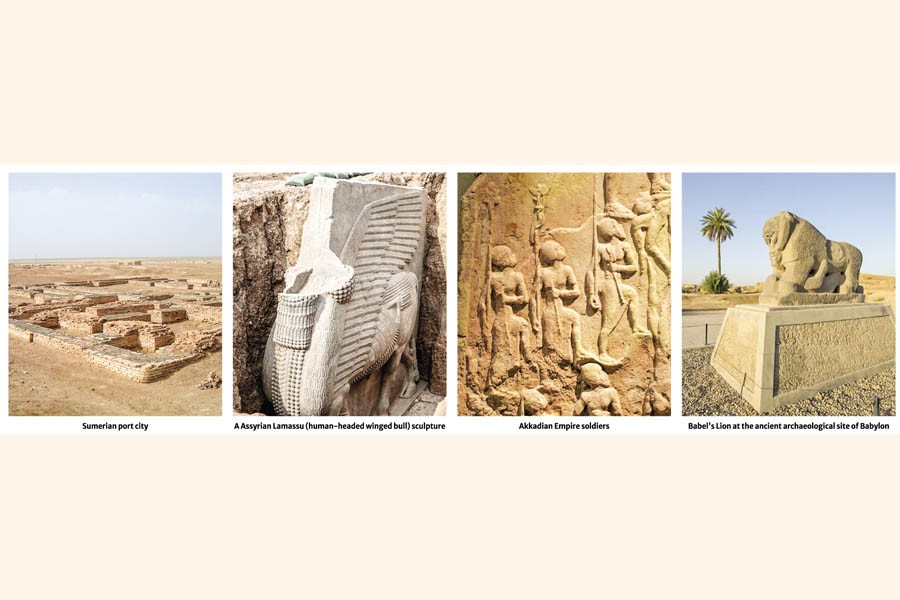
Evolution of civilisation is a long process. From its tentative beginning, a civilisation also ascends its summit at certain point and then the decline of the process also begins. Like human species or any other living being a civilisation sees many ups and downs and ultimately meets its end. Several civilisations flourished and perished before the current modern one dawned. Its roots trace back to Mesopotamia around 4,000 to 3,000 BCE. Interestingly, Mesopotamia is the cradle of civilisations. At least four civilisations ---Sumerians, Assyrians, Akkadians and Babylonians---had their origins there.
Mesopotamia means between two rivers (Tigris and Euphrates) and the area it covers is modern-day Iraq, Kuwait and Syria. It is here that the first urban cities came up. The first writing system was developed here and the wheel was invented along with early law code called the Code of Hammurabi.
However, Mesopotamia is not the only centre of ancient civilisation. There are five more such civilisations. The Nile Valley (modern Egypt) civilisation has to its credit mind-boggling achievement. This civilisation dates back to 3,000 BCE and is known for monumental architecture such as pyramids, hieroglyphic writing and 'advancements in timekeeping and medicine'. The rise of Ptolemy there later between 100-170 AD as an astronomer, mathematician, geographer and astrologer is a continuation of Alexandria's scholarly achievements.
A little earlier around 3,300 BCE, the Indus Valley Civilisation flourished. The valley comprising today's India, Pakistan and Afghanistan saw the rise of an enviable civilisation. Highly organised urban planning with sophisticated sewage and water supply systems was perfected at the hands of people living there in that hoary past. What is particularly notable is that the people were not engaged in any large-scale war.
Then comes the Yellow Valley civilisation of ancient China. An inherited agricultural culture was developed further around 2,100 BCE. It has acted as the source of many enduring cultural and philosophical traditions.
Another one belonging to the earliest civilisations is called Caral-Supe civilisation that flourished in coastal Peru around 3,000 BCE. Peru is home to several civilisations like Chavin, Moche, Nazca, Wari, Chimu but Caral-Supe predates them all including Inca. During the Caral-Supe civilisation, the people developed complex societies with sophisticated cultures backed up by incredible engineering, art and agriculture.
Finally the Mesoamerica civilisation in modern-day Mexico flourished between 2,000 BC and 200 AD. It is known by its ancient temples and script. The Maya script is considered was a sophisticated and highly developed writing system in the pre-Columbian Americas. The people made tremendous progress in art architecture, mathematics, calendar and astronomy. Surprisingly, descendants of Mayan civilisation still live in areas where their ancestors lived.
On this count, the rest five civilisations are not as fortunate as the Mayan to show the specimens of the lost world. It is the remains of the antiquity that indicate the status of civilisation that once existed. The civilisations' footprints tell a story of developed societies. If the Maya or Inca civilisation invited their downfall through constant warfare, the Indus Valley civilisation made a mark by not engaging in wars. The ancient people there are thought to be the first ever to have fallen victim to climate change. There are other reasons for their decline, though.
Now do the civilisations that once were offer any lesson for the present civilisation that on the one hand is witnessing the ushering in the artificial intelligence (AI)-driven 4th industrial revolution and on the other on the brink of collapsing because of climate change? However, climate change is not the only danger they confront; they are virtually digging their own graves by stockpiling nuclear weapons enough to destroy this planet many times over. During the cold war between the United States and the Soviet Union, at least there was restraint from mutual destruction.
Now the quality of leaders across the Pacific or the Atlantic leaves much to be desired. Their latest postures and in certain cases outrageous actions have the potential to trigger the World War III anytime. They resort to provocative language and moves in a manner that is highly dangerous as well as naive.
When both Nature and humans behave capriciously, there is no knowing when things go out of hand and rivals embark on a perilous course leading to the destruction of this AI-driven human society. It is time the powerful people of the leading nations reined in their aggressive advancement of economic and commercial interests. At the same time people should be made aware of the consumerism at its worst. Overheating of the planet is the result of burning fossil fuels but burning the avarice for consumerism is the prime task.
© 2026 - All Rights with The Financial Express

