Global history shows that energy has always been at the center of geopolitical tensions. Today's instability in the Middle East once again reminds the world how fragile global energy supply chains can be.
For countries like Bangladesh that relies heavily on imported fuel, the situation presents serious risks to energy security and economic stability.
Bangladesh's primary domestic energy source is natural gas. However, gas reserves have been declining steadily. Current domestic production stands at roughly 2,000-2,100 MMCFD, while national demand exceeds 3,800 MMCFD, creating a significant supply gap.
To bridge this gap, Bangladesh imports LNG, much of which passes through the Strait of Hormuz, one of the most strategically sensitive shipping routes in the world. In times of geopolitical tension, this route becomes highly vulnerable.
Alternative LNG imports from distant suppliers such as the United States significantly increase transportation costs.
At the same time, Bangladesh's coal-based power plants depend largely on imported coal. Foreign currency shortages and logistical challenges sometimes disrupt supply chains.
Although the country has domestic coal reserves in Barapukuria, expanding extraction remains technically complex and time-consuming.
Overall, Bangladesh's annual energy import bill has reached approximately USD 14-15 billion, putting significant pressure on foreign exchange reserves.
Currently, Bangladesh operates two Floating Storage Regasification Units (FSRUs) with a combined regasification capacity of about 1 BCF per day, which is already close to full utilization.
Building new infrastructure such as land-based LNG terminals, new pipelines, and refinery expansion requires both time and substantial financial investment.
Strategic Steps for Energy Security
To strengthen energy security, Bangladesh must pursue a diversified strategy.
Coal-based power plants should be prioritized as reliable baseload generation, supported by long-term coal supply agreements.
LNG should remain the second major energy source, but the country must move forward with land-based LNG terminals to increase supply security.
The construction of the third parallel gas pipeline between Chattogram and Dhaka should be accelerated.
The long-discussed Phulbari coal project also requires a decisive policy direction.
Domestic oil and gas exploration must be expanded, including offshore exploration in the Bay of Bengal.
At the same time, the capacity of Eastern Refinery Limited should be expanded to meet growing demand for refined petroleum products.
Gas resources in Bhola could also be integrated into the national grid through river-crossing pipelines.
Finally, modernizing the power system through smart grid technologies is essential to support increasing shares of renewable energy.
Renewable Energy as a Strategic Opportunity
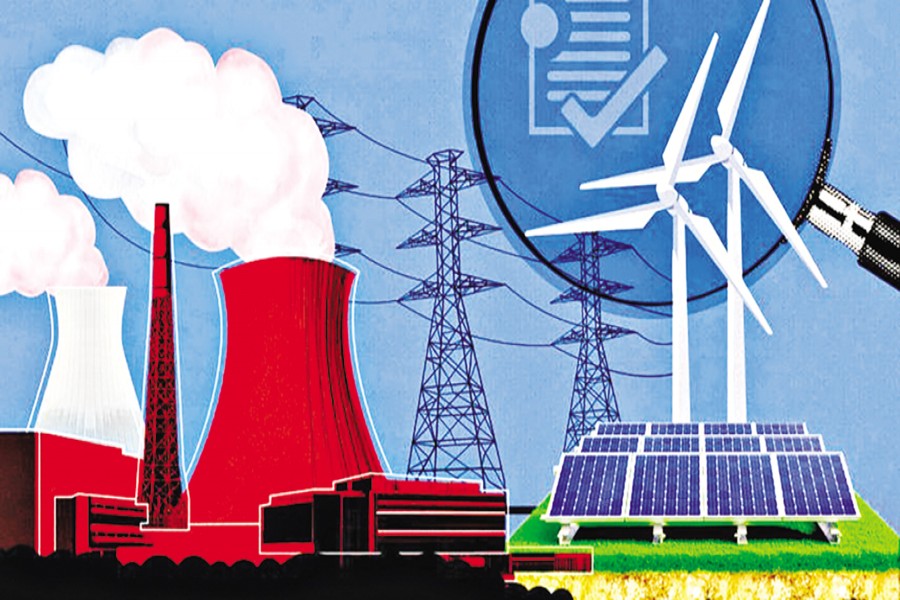
For energy-import-dependent countries, renewable energy represents a strategic opportunity.
Bangladesh receives an average solar radiation of 4-5 kWh/m²/day, making solar power particularly promising.
Rooftop Solar
With proper policy support, Bangladesh could generate 3,000-4,000 MW from rooftop solar installations across industrial, commercial, and residential buildings.
Key policy measures include:
l Zero import duties on solar equipment
l Long-term bank financing with interest rates below 5%
l Fast-track approvals from SREDA and BSTI
Utility-Scale Solar and Wind
Non-agricultural government land can be identified through district administrations and allocated through competitive bidding for large solar and wind projects.
If land and grid connectivity are provided by the government, electricity tariffs could fall to 7-8 BDT per kWh.
Solar Irrigation
Bangladesh has around 1.5 million diesel irrigation pumps. Replacing these with solar irrigation systems could significantly reduce diesel imports and save foreign currency.
River-Based Solar Development
Large river systems such as the Jamuna offer opportunities for innovative solar installations combined with river management and land reclamation.
Battery Energy Storage Systems (BESS)
Battery storage will be critical for grid stability as renewable energy expands. Providing duty-free import facilities for BESS can accelerate adoption.
Bangladesh stands at a critical moment in its energy transition. Continued reliance on imported fossil fuels exposes the economy to global market volatility and geopolitical risks.
Renewable energy offers a pathway toward energy independence, economic resilience, and environmental sustainability.
With the right policies, strong political commitment, and strategic investments, Bangladesh can transform its energy sector and become a regional example of a successful clean energy transition.
The writer is President of BSREA
© 2026 - All Rights with The Financial Express

