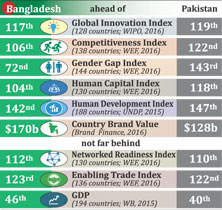
The size of economy does not necessarily reflect the vibrancy of a country. As such, despite the size of Pakistan's economy bigger than Bangladesh, the former significantly lags behind in many development indicators.
According to the World Bank's estimate, Bangladesh was the 46th largest economy in the world in 2015, with the gross domestic product (GDP) worth US$ 195.07 billion.
At the same time, the GDP of Pakistan stood at around $270 billion, which put the country in the 40th position in the global economy.
But, in the 45 years after achieving the Independence in 1971, Bangladesh has now emerged a more vibrant country than Pakistan.
On December 16, 1971, Bangladesh achieved its final victory over oppressive Pakistani occupation army. During the nine-month war, started on March 26 in the same year, millions of people from what was then East Pakistan fled away and took shelter in India as refugees while Pakistani army killed three million people.
Two hundred thousand women were violated by the occupation army and their local collaborators.
The Liberation War of Bangladesh left almost the whole physical infrastructure destroyed across the country. Thus, the people of Bangladesh started another prolonged war to build the country with very limited resources despite many hurdles.
Now the country is doing much better in human development as compared to Pakistan and in some cases India.
In 1972 the average life expectancy of Bangladeshi people was 45 years against 51 years in Pakistan and 50 years in India.
Today, according to the Human Development Report (HDI-2015) of the United Nations Development Programme (UNDP), the life expectancy at birth in Bangladesh stood at 71.6 years is against 66.2 years in Pakistan and 68 years in India.
In 1975 the adult literacy rate was only 27 per cent in Bangladesh, 24 per cent in Pakistan and 37 per cent in India. Four decades later, the rate is 58.8 per cent in Bangladesh, 54.7 per cent in Pakistan and 62.8 per cent in India.
The progress in human development is also clearly reflected in the latest Human Capital Index of the World Economic Forum. Bangladesh ranked 104th among 130 countries. Pakistan ranked 118th.
Immediately after the Independence, Bangladesh suffered a huge food deficit while food aid was not available. Serious problems like hunger and malnutrition cropped up over this shortage. Today, the country is enjoying food autarky and doing better than Pakistan in fighting hunger.
The latest global hunger index, prepared by the IFPRI, placed Bangladesh in a better position in addressing hunger as its score fell to 27.1 this year from 32.4 in 2008. At the same time, Pakistan's score declined to 33.4 from 35.1 and India's to 28.5 from 36 (A lower score indicates improvement in hunger condition).
The slow and steady economic advancement along with social progress, thanks to successive governments' supportive policies despite a lot of political disruption, has fetched Bangladesh the second best country brand value in South Asia after India.
According to Brand Finance, the world's leading independent branded business valuation and strategy consultancy based in London, the country brand value of Bangladesh is much higher than Pakistan, which is approaching its 70 years of independence.
Even in 2011, Pakistan's country brand value was $54 billion. It has increased by 137 per cent in five years to $128 billion. But during the same period Bangladesh's brand value jumped by 261 per cent to $170 billion in 2016 from $47 billion in 2011.
Continuous reform on the economic front and progress in areas of social development contributed to such improvement in brand value.
Many other international indicators also reveal that Bangladesh is gradually outnumbering Pakistan, especially on the socio-economic fronts, and it emerges a much more vibrant country.
Be it competitiveness or innovation, Bangladesh is ahead of Pakistan in these global indices. Being the third largest global exporter of clothing after China and the European Union, the country also pioneered in green garments in the world.
Bangladesh's success in reducing gender discrimination is quite high (72nd) while Pakistan stands at the bottom (143rd) of the 144-country index. The graduation into the Lower Middle-Income Country category in 2015 is a reflection of such vibrancy. The country is also on the path to graduate fully from the Least Developed Country (LDC) status by 2024.
asjadulk@gmail.com
© 2026 - All Rights with The Financial Express

