For umpteen people, BNP's return to power represents far more than a routine change of government rather an aspired upgrade in their standard of living.
 It marked the culmination of a political struggle that had stretched over a decade and a half and culminated in the student-led uprising of 2024.
The election that followed brought with it hopes of economic relief, institutional renewal and a fresh start for a country weary of prolonged political turmoil.
Expectations were high.
Households hoped for respite from years of soaring cost of living. Many middle-income families, whose purchasing power had steadily eroded under persistent inflation, looked for measures that could ease their financial burden.
Young people sought employment opportunities, while businesses anticipated reforms that could spur sagging investment, restore confidence and put the economy back on a path of sustainable growth.
Yet Prime Minister Tarique Rahman's administration had little time to enjoy a political honeymoon.
Within days of taking office, a crisis erupted thousands of miles away.
War in the Middle East sent global energy prices spiraling, raising import costs and threatening to widen fiscal and external imbalances as well as threatening overseas employment.
The shock arrived at a particularly fragile moment-when the nation was passing by a crossroads.
The new government inherited an economy struggling with stubborn inflation, a banking sector burdened by rising non-performing loans, weakened institutions and one of the lowest levels of private-sector investment in recent years.
The government suddenly found themselves walking a tightrope: how to fulfil public expectations while navigating an increasingly inimical economic environment.
It was against this backdrop that Finance and Planning Minister Amir Khosru Mahmud Chowdhury rose in parliament Thursday to roll out the national budget for fiscal year 2026-27.
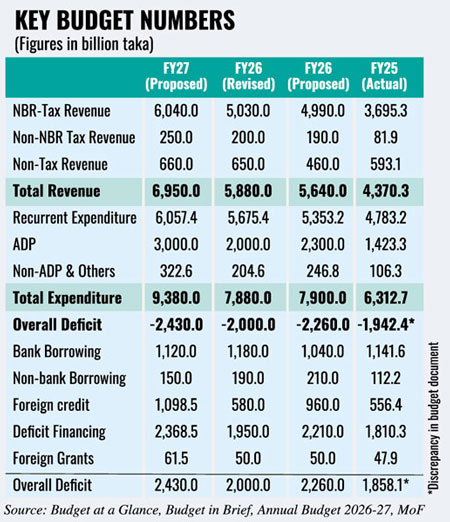
At Tk 9.38 trillion, the spending plan is among the largest in Bangladesh's history. Yet its significance lies not in how much the government intends to spend, but in how it plans to finance it.
The government expects to mobilise nearly Tk 6.95 trillion from domestic sources - an ambitious target at a time when even the revised revenue goals for the outgoing fiscal year appear difficult to achieve.
For tax authorities, the challenge resembles an ascent up Everest with uncertain weather and limited oxygen.
The financing strategy relies heavily on borrowing. Of the total resource envelope, around Tk 2.43 trillion is expected to be financed largely through the banking system despite a sector still struggling with weak governance, capital deficit and rising defaulted loans.
If revenues underperform while expenditure execution remains relatively strong, the fiscal deficit automatically widens. Bangladesh has seen this repeatedly.
The government then has three options: cut expenditure, increase domestic borrowing, or rely more heavily on monetary accommodation.
In practice, expenditure adjustment is rarely immediate. Salaries, pensions, subsidies and ongoing projects are difficult to cut quickly, meaning the burden of adjustment often shifts to domestic financing.
This is where the risks begin to reinforce one another. Higher domestic borrowing requires greater issuance of treasury bills and bonds. Banks respond by allocating more of their balance sheets to government securities, crowding out private credits.
A budget designed to accelerate growth may, therefore, end up reducing credits available to the private sector expected to generate that growth.
External financing presents another hurdle.
The budget just presented anticipates Tk 1.08 trillion in foreign borrowing, a level of financing the country rarely secured in the past.
At a time when global capital is becoming more expensive and development lenders increasingly selective, meeting the target may prove easier on paper than in practice.
Yet foreign borrowing has frequently underperformed projections because of implementation delays, slower disbursements and administrative bottlenecks. This year, uncertainty is compounded by questions surrounding the timing and scale of future external financing.
Inflation expected to remain high: To help ease inflationary pressures, the finance minister has reduced source taxes on around 60 essential goods. Yet the effectiveness of the measure remains uncertain.
Actually supply-side distortions - including extortion along transport routes, market manipulation and unauthorised toll collection - often play a more significant role in driving prices than taxes alone.
If those structural bottlenecks remain unaddressed, the benefits of tax reductions may not fully reach consumers.
The government correctly identifies inflation control as the immediate macroeconomic priority and the medium-term framework assumes a gradual return to price stability. Yet inflation remains above 9.0 per cent and has repeatedly exceeded official projections. More importantly, stabilisation and rapid growth do not always move together.
Tight monetary conditions, positive real interest rates and continued macroeconomic adjustment may be necessary to reduce inflation.
Finance minister's vision: Yet the budget is not solely a story of financing gaps and fiscal arithmetic. It also offers a glimpse into the government's broader economic vision.
Education, healthcare, social protection, the creative economy and the blue economy have all received greater emphasis while cancer and kidney patients are set to receive additional support through cash assistance and tax reductions on select medical equipment and machinery.
The government is seeking to promote a "creative economy" in its entire spectrum. Income generated through content creation remains outside the tax net--a move aimed at encouraging a rapidly expanding digital sector and attracting younger entrepreneurs into the formal economy.
Public-sector employees are expected to receive a new pay structure in phases, providing some compensation for years of inflation-induced erosion of real incomes.
For private-sector employees and middle-income households, however, the gains may appear less obvious.
The finance minister wants to reduce the economy's traditional dependence on bank lending by expanding the use of sukuk, corporate bonds, municipal bonds and other capital-market instruments.
Such reforms could broaden access to long-term financing and deepen domestic capital markets, although achieving that objective is likely to take years rather than months.
Among the most consequential proposals is the introduction of a five-year predictability framework for personal-income taxation.
The tax-free income threshold has been raised to Tk 375,000, while authorities plan to strengthen tax compliance by linking bank accounts more closely with the National Board of Revenue and requiring Taxpayer Identification Numbers (TINs) for opening new bank accounts.
Corporate tax rates remain unchanged.
However, companies conducting all transactions through formal banking channels will receive a 2.5-percentage-point tax waiver.
The measures could broaden the tax base, modernise revenue administration and reduce tax evasion.
The budget also contains an ambitious attempt to reverse one of Bangladesh's longstanding challenges: the migration of skilled workers.
Officials hope to transform decades of "brain drain" into "brain circulation" by encouraging talented Bangladeshis living abroad to return home.
Yet economic incentives alone may not be sufficient. Professionals who leave often cite governance, public services, quality of life, environmental concerns and social security alongside economic opportunities.
For businesses, meanwhile, the budget offers a broad package of incentives designed to stimulate investment and industrialisation.
To attract foreign direct investment, exploring new free-trade agreements, and promoting environmentally friendly transportation, including electric motorcycles, scooters and commercial vehicles, are among the priorities.
As part of a wider deregulation agenda, the government also plans to establish a digital single-window platform intended to simplify administrative procedures for investors and businesses.
The government's strategy is clear: encourage investment today in the hope of generating jobs and growth tomorrow.
Whether those ambitions can be realised remains the central question.
Many of the reforms outlined in the budget are structural and long-term ones. Their benefits, if realised, are likely to emerge gradually rather than immediately.
In the short term, households will continue to confront elevated living costs, businesses will face financing constraints and policymakers will remain under pressure to balance growth with stability.
The budget is, therefore, both a statement of ambition and a test of execution.
It reflects a government attempting to convert political goodwill into economic momentum while operating under severe fiscal and institutional constraints.
The success of that effort will depend not only on the policies announced in parliament but also on the government's ability to mobilise resources, restore confidence and deliver results in an increasingly uncertain world.
Whitening black money?
The National Board of Revenue (NBR) created an opportunity to show the actual value of a flat-plot without any question.
If a taxpayer wants to show the actual value on their own initiative, they will get this opportunity, according to the finance bill.
The bill states that regardless of anything contained in this Act or any other law in force in Bangladesh, a person will have the opportunity to show the actual value of the flat-plot displayed on their own initiative. "No questions will be asked for this."
If the actual purchase price of a taxpayer's land, building or apartment is higher than the deed value, he will pay income tax on that undisplayed additional purchase price at the regular tax rate applicable to the individual category.
jasimharoon@yahoo.com
© 2026 - All Rights with The Financial Express

