The Asian Development Bank hinted at doubling its assistance for Bangladesh economy as it grows rapidly and demands higher investment to maintain the momentum.
To support the advances, which an ADB functionary likened to the East-Asia model, the Bank is likely to enhance its financing to Bangladesh in the current year to around US$2 billion.
Hun Kim, director-general at the South Asia department of the Asian Development Bank, made the observations on Sunday morning at a media briefing arranged on the sidelines of the 50th Annual Meeting of the Board of Governors of the ADB in this Japanese port city.
This is for the fifth time Japan hosted the annual meeting of the Asian development-financing bank that concluded Sunday. The theme of the meeting was 'Building Together the Prosperity of Asia'.
"Bangladesh is an emerging economy and the country needs more investment to go ahead," Mr Kim said, adding: "Our lending to Bangladesh is now $1.0 billion but it can easily go up to $2.0 billion."
Last year, the ADB approved 10 projects for Bangladesh, with loans totalling $1.1 billion and technical assistance worth $7.85 million.
He was of the view that the country is doing right in policy formulation and development-project implementation.
Bangladesh is now totally a different country from the past as its economy is growing fast, he said.
Mr Kim, however, noted that Bangladesh has to improve upon its project-implementation capacity to sustain 7.0 per cent growth and reach 8 per cent in the long run.
Bangladesh's Gross Domestic Product (GDP) growth stood at 7.11 per cent, by official count, in the last fiscal year while the target for this year is 7.20 per cent. ADB annual outlook, however, projects 6.9 per cent growth for the current year.
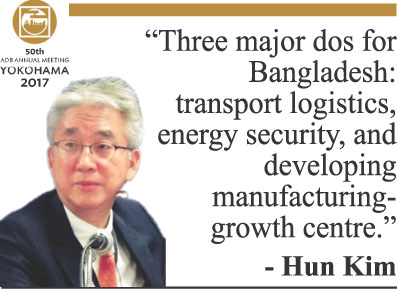
The top official of ADB's South Asia Department said they see three major dos for Bangladesh: transport logistics as Bangladesh is becoming a regional hub in the sense, energy security, and developing manufacturing-growth centre.
He finds a similitude of the country's current economic advances with the East-Asia development model, save one major factor lacking in it.
"The only difference is that East Asia has supply of huge skilled workers where Bangladesh is lacking," he said.
In this context, he said the ADB is working with Bangladesh for training and improving the skills and qualities of the labourers and workers.
Mr Kim also said the foreign investment in Bangladesh is very low--only around 1.0 per cent of the GDP.
The net inflow of FDI last year stood at $2.33 billion, according to the latest estimate done by Bangladesh Bank.
In reply to another question, Mr Kim said Bangladesh and Sri Lanka are the two biggest beneficiaries of ADB's capital expansion.
Asked about the status of the private-sector lending by ADB, he said the lending agency is negotiating a deal with the government in the transport sector to promote Public-Private Partnership (PPP) since opportunities are there.
Diwesh N Sharan, deputy director-general of the same department of ADB, said currently the bank is focusing three broader areas in Bangladesh as well as in South Asia. These are: transport, energy, and economic corridor.
Bangladesh joined the ADB in 1973. As of 31 December 2016, ADB's cumulative lending to Bangladesh had stood at $18.3 billion for 269 loans, $252.4 million for 422 technical-assistance projects, and $787.10 million for 35 grants.
As of 31 March 2017, ADB-aided projects under implementation for Bangladesh comprised 90 loans and grants amounting to $7.6 billion; and 32 technical-assistance projects involving $28.58 million.
asjadulk@gmail.com
© 2026 - All Rights with The Financial Express

